
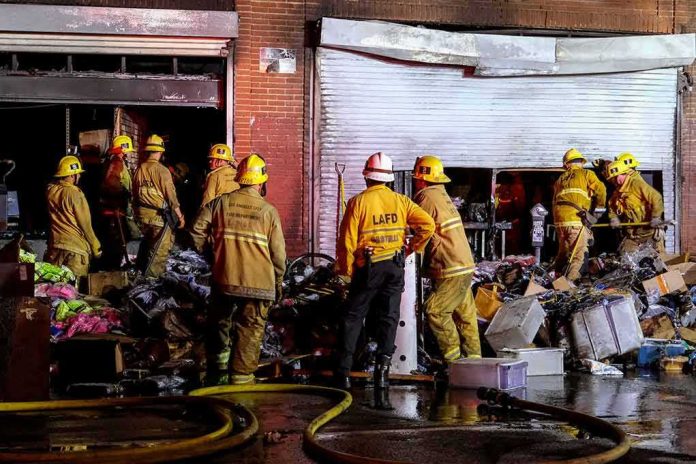
Los Angeles firefighters answered a homeless- or encampment-related fire call 47 times a day this year, and the strain is showing.
Story Snapshot
- Los Angeles Fire Department crews responded to 12,241 fires tied to homelessness or encampments between January 1 and September 20 this year.
- That works out to about 47 such fires every single day across the city.
- Most were trash fires, but the total also included brush, car, and structure fires.
- Skid Row and the 110 freeway corridor stand out as the worst hotspots for repeat fire calls.
A Staggering Daily Count Straining Crews
Fire department data show 12,241 incidents classified as “Homeless or Encampment Related” from the start of the year through late September. Spread across those months, that averages out to 47 fires a day tied to homelessness somewhere in Los Angeles. The number is down about 6% from the same stretch last year, but even a modest dip still leaves crews answering dozens of these calls daily, week after week, without a break in the pattern.
The vast majority of these fires were small trash fires, but the breakdown shows real danger mixed in. Fire officials counted 189 vegetation or brush fires, 173 car fires, and 153 structure fires among the total. Brush fires carry extra risk in a city surrounded by dry hillsides, and structure fires put occupied buildings and neighboring residents directly in harm’s way, not just the encampments where the flames start.
Skid Row And The 110 Corridor Bear The Brunt
Fire data point to clear geographic hotspots. One small stretch of Skid Row alone recorded 77 fires, and the 110 freeway corridor shows a heavy concentration of repeat incidents. These are not random, scattered events. They cluster in the same blocks and roadside areas where encampments have grown largest, forcing the same fire stations to return to nearly identical locations again and again throughout the year.
Firefighters assigned to rapid response units describe the pace as relentless. Andrew Machado and Anthony Verdecia, two crew members who patrol these hotspots, told reporters they often hit multiple trash fires within minutes of each other, including one sparked by a shopping cart set up as a makeshift grill. That kind of back-to-back response eats into rest time, equipment readiness, and the department’s ability to handle other emergencies across the city.
City Hall Points To Encampment Removals
The mayor’s office declined a sit-down interview but issued a statement acknowledging the danger these fires pose to residents and businesses. The statement reaffirmed a commitment to ending street homelessness and noted more than 1,000 encampments have already been removed citywide. That is a real number, and removing encampments does address one visible piece of the problem. But it is a policy claim, not a fire-safety metric, and it does not by itself explain whether removals are reducing fire calls in the neighborhoods that need it most.
Longer-term reporting backs up the idea that this is not a one-year spike but a sustained pattern. Los Angeles Times reporting found that between 2018 and 2024, homelessness was a factor in about one-third of all fires citywide, according to fire department figures. That context matters. It shows this year’s 12,241 figure sits inside a years-long trend rather than an isolated anomaly, which should shape how seriously city leaders treat the strain on fire crews going forward.
Why The Math Should Worry Every Angeleno
Common sense says a city cannot keep sending fire engines to the same encampment blocks dozens of times a week without eventually paying a price elsewhere. Every truck tied up on a trash fire in Skid Row is a truck slower to reach a house fire in Reseda or a car crash on the 405. Residents who pay for fire protection through their taxes deserve a department that is not perpetually stretched thin by a problem the city has struggled for years to fix.
The 6% year-over-year dip is worth noting, but it is a thin silver lining against a backdrop of nearly 50 fires a day tied to homelessness. Removing encampments is one lever city leaders are pulling, but the raw fire numbers suggest the underlying conditions driving ignition, from open flames for warmth or cooking to unsafe electrical rigging, have not been solved. Firefighters on the ground are living with the consequences of that gap every shift.
Firefighters stretched to breaking point after homeless people spark over 12K fires in Los Angeles https://t.co/QJHno1mZps pic.twitter.com/6ALeaexreT
— New York Post Metro (@nypmetro) September 26, 2026
Los Angeles will keep debating how to balance compassion for homeless residents against the safety of neighborhoods and the limits of its fire department. The numbers from this year give that debate a hard, specific baseline: 12,241 fires, 47 a day, concentrated in known hotspots, and crews who say the calls rarely let up.