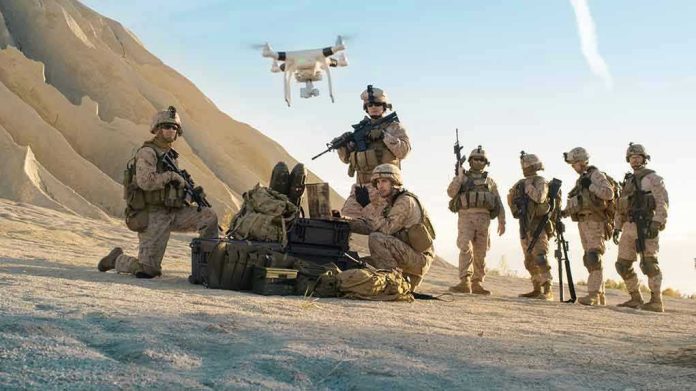
The Pentagon demands $54.6 billion for drones in one audacious leap, dwarfing the Marine Corps budget and igniting a drone arms race that could redefine warfare forever.
Story Snapshot
- Pentagon proposes $54.6 billion for Defense Autonomous Warfare Group (DAWG) in FY2027, a 24,070% surge from $225.9 million in FY2026.
- Funding targets drone dominance across air, land, sea, and undersea domains, absorbing Biden’s Replicator initiative for Pacific threats.
- DAWG integrates with special operations for real-world testing, focusing on procurement and evaluation of existing systems.
- Part of $1.5 trillion defense request, with $75 billion total for drones and counters, hinging on risky Republican reconciliation bill.
DAWG Emerges from Replicator Roots
Defense Autonomous Warfare Group launched late 2025 under Trump administration, tied to U.S. Special Operations Command. It absorbed Biden’s 2023 Replicator initiative, which aimed to field thousands of low-cost attritable drones by 2028 for Pacific confrontations with China. DAWG unifies drone efforts across domains. Special operators test systems daily, providing industry feedback for rapid improvements. This evolution counters Ukraine war lessons on cheap drone swarms overwhelming legacy platforms.
Unprecedented Funding Surge Details
Pentagon requests $54.6 billion for DAWG in FY2027 budget: $1 billion from base funding, $53.6 billion via reconciliation bill. This 24,070% increase exceeds USMC’s $52.8 billion budget. Funds prioritize procurement, training, logistics, and counter-drone tech like one-way attack drones and MQ-25 Stingray. Total drone push hits $75 billion within $1.5 trillion defense ask ($1.15 trillion base + $350 billion reconciliation). April 2026 briefings unveiled the plan.
Pentagon Leaders Drive the Push
Lt. Gen. Steven Whitney, Director of Force Structure, Resources and Assessment, oversees funding for rapid innovation. Acting Comptroller Jules Hurst calls DAWG a pathfinder for drone dominance and troop protection. DAWG evaluates autonomous and human-operated drones for military integration. Air Force contributes unmanned collaborative combat aircraft. Industry partners supply systems for commando testing. Republican Congress holds approval power through reconciliation.
Strategic Goals Target Pacific Deterrence
DAWG emphasizes collaborative autonomy over human-piloted systems amid Indo-Pacific focus. Cheap drone swarms threaten expensive carriers and fighters. Funds accelerate “Drone Dominance” with procurement over pure R&D. Special ops requirements shape evaluations. Industry feedback loops speed deployment. This counters peer adversaries like China, building on Replicator’s hundreds-of-thousands drone goal by 2028.
Impacts Reshape Military and Economy
Short-term procurement boom boosts attritable systems and operator training. Long-term shifts doctrine to swarm tactics. U.S. troops gain protection; Pacific foes face deterrence. Defense sector explodes with contracts rivaling small GDPs. Political risks loom from 42% budget hike and partisan funding path. Ethical debates arise on AI warfare, but facts align with conservative priorities: strength through innovation deters aggression.
Sources:
Pentagon officials broadly detail $55 billion drone plan under DAWG
Pentagon Requests $54 Billion for Autonomous Warfare (DAWG)
Pentagon’s little-known drone office just claimed the largest single military funding surge ever
The Pentagon’s $54 Billion Bet on Autonomous Warfare
New Pentagon Plan Would Pour $54B Into Drones, AI Combat
Pentagon’s Little-known DAWG Fetches $54.6B In Spending Plan