Mandatory Ebola screenings at Atlanta’s airport are not just about thermometers and forms – they are a live stress test of how much liberty Americans will trade for protection from a deadly virus.
Story Snapshot
- Mandatory Ebola checks and 21-day monitoring now target travelers routed through Atlanta’s Hartsfield-Jackson from recent hotspots in Africa.[1][2][3]
- Federal health agencies frame the move as one “layer” in a broader shield, not a magic bullet.[2]
- Critics question whether adding Atlanta does much more than create theater, bureaucracy, and delay.[2][3]
- The deeper fight is over trust: do Americans believe health officials can use targeted power without overreach?
Atlanta becomes a gateway for risk – and a funnel for control
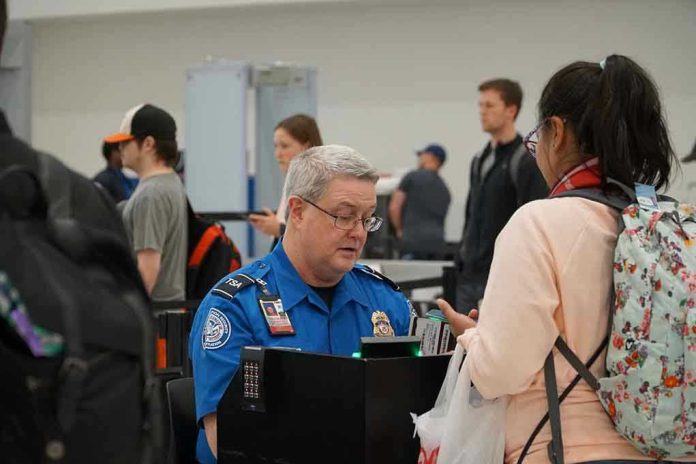
Federal health authorities have now designated Hartsfield-Jackson Atlanta International Airport as a formal entry point for Americans returning from the Democratic Republic of the Congo, Uganda, and South Sudan, if they have been there within the prior 21 days.[1][2][3] Travelers in that category must route through either Atlanta or Washington Dulles, where they undergo mandatory Ebola screening that began at Atlanta just before midnight on May 22, 2026.[1][2][3]
These travelers are taken to a screening area, asked detailed questions about their travel and possible exposures, and have their temperatures checked; anyone with symptoms is pulled aside for further medical evaluation.[1] The Centers for Disease Control and Prevention (CDC) describes this as “enhanced public health entry screening,” a more intensive process than routine customs and health questioning.[2] That label sounds bureaucratic, but it carries real consequences for the small group of Americans who now move through this funnel.
Inside the CDC’s layered defense strategy
The Centers for Disease Control and Prevention insists Atlanta’s role is not a political stunt but a cog in a larger machine.[2] The agency explicitly calls airport screening only one component of a “layered public health approach” that also uses overseas exit screening in affected countries, mandatory illness reporting by airlines, and post-arrival public health monitoring for 21 days after travelers land.[2][4] The logic is simple: no single step catches everything, so multiple thinner filters might together block a dangerous spark.
Hartsfield-Jackson previously conducted enhanced screening in past outbreaks and already has operational procedures and teams in place.[2] That experience lets federal officials ramp up quickly without building an entirely new infrastructure. News reports emphasize that U.S. citizens and permanent residents who recently traveled through those three African nations must use designated airports such as Atlanta for these checks, reinforcing that this is a targeted, not universal, policy.[1][3] For now, many noncitizen travelers from those countries are simply barred from entering at all.[1][3]
Does more screening equal more safety, or just more theater?
Supporters argue that routing a small, higher-risk cohort through a limited set of airports makes common sense: it concentrates expertise, allows consistent protocols, and eases follow-up monitoring.[2][3][4] From a conservative, order-focused perspective, that looks like a reasonable tradeoff: a modest burden on a narrow population to reduce the odds of a deadly virus slipping into crowded American cities. Public health leaders repeatedly stress that the risk to the general U.S. population remains “very low.”[1]
Yet the public record so far does not show that adding Atlanta was backed by a published, quantitative risk model that proves a clear marginal benefit over using one entry airport such as Dulles alone.[2] No available reports document Ebola cases tied to travelers through Atlanta since these policies were put in place.[1][3] That gap fuels the recurring suspicion that airport checkpoints may function as visible reassurance – health theater – as much as hard-edged risk reduction, especially when infected travelers are rare to begin with.
Freedom, trust, and the American instinct to question centralized power
The deeper question is not whether Ebola is dangerous; it clearly is. The real fight is over process, transparency, and proportionality. Many Americans accept the idea of targeted screening when a lethal disease spreads overseas, especially if it focuses on recent travelers from active outbreak zones.[1][2][3][4] That aligns with a conservative preference for risk-based, narrowed measures rather than sweeping controls on the entire population. But respect for individual liberty demands that such powers remain clearly limited, time-bound, and grounded in evidence.
"Mandatory Ebola screenings have officially expanded to Hartsfield-Jackson Atlanta International Airport for travelers arriving from the DRC, Uganda, and South Sudan. 🚨
Those who pass will still face 21 days of strict symptom monitoring by local health departments.
— Mazi okwuoma (@MaziEzike_Nedu) May 26, 2026
Public health authorities emphasize that enhanced screening is paired with 21-day monitoring after arrival, underscoring that the airport checkpoint is just the visible tip of a deeper tracking system.[2][4] That reality should motivate two parallel instincts: support for serious, competent containment of a deadly virus, and vigilance against open-ended normalization of special restrictions on travelers. The proper standard in a free republic is not zero risk at any cost, but transparent, targeted measures that earn public trust because they make sense, stay in their lane, and end when the crisis passes.
Sources:
[1] Web – Ebola-related travel restrictions now include Atlanta’s Hartsfield …
[2] Web – Enhanced Ebola Airport Screening Expands to Atlanta – CDC
[3] Web – US names second airport for Ebola screening as cases in Congo …
[4] Web – Public Health Arrival Restrictions and Enhanced Ebola Screening