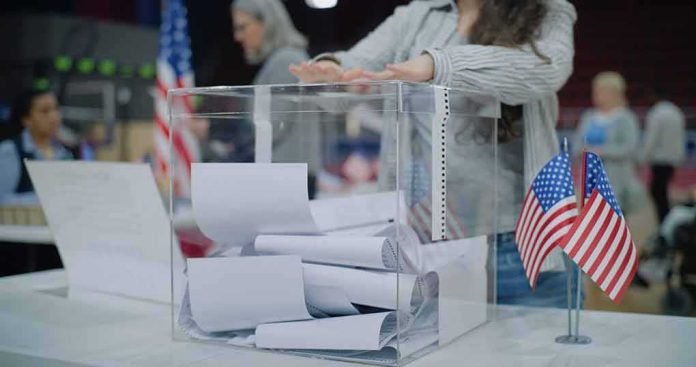
Ohio lawmakers just turned a routine voter ID rule into a high-stakes constitutional fight that will test how much control voters want over the rules of their own elections.
Story Snapshot
- Ohio Senate passed a resolution to put a photo voter ID amendment on the November ballot.
- The amendment would lock current voter ID rules into the state constitution, not create brand-new rules.
- Supporters say it protects elections from future rollbacks and new tech-driven fraud.
- Critics say it is redundant, political, and ignores looser rules for mail-in voting.
Ohio’s voter ID fight shifts from law to the state constitution
Ohio already requires voters to show a valid photo identification to vote in person, a rule that has been in effect since 2023.[1][2] Now Republican state senators want to move that rule out of normal law and into the Ohio Constitution. The Senate passed Senate Joint Resolution 10, which would send a constitutional amendment to voters this November to enshrine voter ID in the state’s highest law.[1][3][5] That step turns a policy debate into a long-term power struggle.
Supporters describe this as more than a routine security tweak. Senate leaders say Ohio law already requires photo ID at the polls, but a future legislature could weaken or repeal those rules.[5] A constitutional amendment is harder to undo, because only voters can change it in a statewide vote. For conservatives who worry about shifting majorities at the statehouse, putting voter ID in the constitution acts like a deadbolt on the front door of election law.[1][3][5]
What the amendment would actually require voters to show
The proposal does not invent new kinds of documents or obscure paperwork. It would require electors to provide identification “in accordance with laws passed by the General Assembly,” while listing the major forms of photo ID.[3][5] These include a driver’s license or state identification card, a United States passport or passport card, a United States military identification card, an Ohio National Guard card, or an identification card from the United States Department of Veterans Affairs.[3][5] Lawmakers could later add other photo IDs by statute as technology changes.[3]
Supporters frame this flexibility as a feature, not a bug. They argue that as artificial intelligence makes it easier to fake utility bills or bank statements, hard photo identification becomes more important.[3] By setting the photo ID principle in the constitution but allowing lawmakers to define acceptable IDs over time, they claim to balance strong rules with room for updates.[3][5] That pitch aligns with a basic conservative instinct: set clear guardrails in foundational law, then adjust the details through normal politics.
Why backers say election security now needs constitutional armor
Republican leaders stress that voter photo ID is already the norm in much of the country and widely supported by voters.[3][5] The National Conference of State Legislatures reports that thirty-six states now request or require some form of identification at the polls.[5] In their telling, the debate is no longer about whether identification should exist, but whether protections are strong enough and durable enough to survive future partisan swings.[3][5] They point to other states where legislatures or courts rolled back similar laws.[5]
The sponsors also tie their argument to public faith in elections. They say voters “need to know” that the person casting a ballot is the person on the rolls, and that photo ID is the cleanest way to prove it.[5] That language mirrors a broader conservative view: even when fraud numbers look small, clear and simple rules help deter misconduct and reassure honest citizens that the system is not being gamed. From that standpoint, waiting for a crisis before tightening rules looks reckless.
Critics see redundancy, politics, and a mail-in loophole
Opponents do not argue that Ohio has no ID rules. They point out that photo ID is already required for in-person voting under current law.[1][2] To them, the amendment mostly duplicates what already happens at the polls, which raises the question of why it belongs in the constitution at all. Some describe the resolution as a political move to drive Republican turnout rather than a serious fix for a documented security gap.[1][4] News reports also note there is no evidence of widespread voter fraud in Ohio elections.[1][4]
Let's Rock-And-Roll ✌️. Let's hope it stays on the Ballot 🗳️ and it gets voted on in November
.
Ohio Senate passes resolution to put voter photo ID amendment on Nov. ballot https://t.co/TtJWcvVUOR— CharleysBabySister (@CharleysSister) June 9, 2026
Critics also highlight what the measure does not touch. Existing coverage explains that the push does not tighten rules for mail-in voting, which now uses less strict identification standards.[2] For many skeptics, that is the real weak point, not someone showing up at a precinct without a driver’s license. When lawmakers leave that channel alone while elevating rules that already exist for in-person voting, critics see mixed priorities. Their case rests on the idea that serious reform would focus first where verification is weakest.[1][2][4]
What this fight says about elections, power, and the long game
This clash in Ohio fits a national pattern. Once a policy like voter ID becomes common, the political battle shifts from “should we have it?” to “how hard is it to undo?” Supporters are trying to “constitutionalize” a rule they like, so it cannot be rolled back by one election cycle.[1][3][5] Opponents answer that turning routine election procedures into constitutional text is overkill and usually serves the party now in power rather than neutral principle.[1][2]
From a conservative, common-sense point of view, some questions are hard to ignore. If voter ID is already working and broadly accepted, locking it in the constitution may simply match the importance of clean elections. At the same time, leaving mail-in safeguards looser while claiming a major security upgrade looks incomplete. Voters in November will not just decide on photo ID. They will decide whether they want election rules to live in everyday law, where lawmakers can adjust them, or in the constitution, where change is slow and squarely in the people’s hands.
Sources:
[1] Web – JUST IN: Ohio State Senate Passes Bill to Put Voter ID Amendment on …
[2] Web – Ohio Legislators Introduce Joint Resolutions Enshrining Voter ID …
[3] Web – Ohio’s New Election Laws | LWV Ohio
[4] Web – Ohio Senate advances photo voter ID amendment measure
[5] Web – [PDF] Secure And Fair Elections – Ohio Attorney General