Two hundred fifty years from now, Americans will dig up a steel cylinder in Philadelphia and meet the version of us we chose to lock in the ground.
Story Snapshot
- A congressionally mandated national time capsule was sealed and buried in Philadelphia for 250 years.
- The stainless-steel capsule holds contributions from all 50 states, Washington, DC, five territories, and all three federal branches.
- Designers built it to survive underground until July 4, 2276, when it is scheduled to be opened.
- The choices inside reveal what today’s leaders think is worth remembering—and what they quietly leave out.
America just locked its story in steel
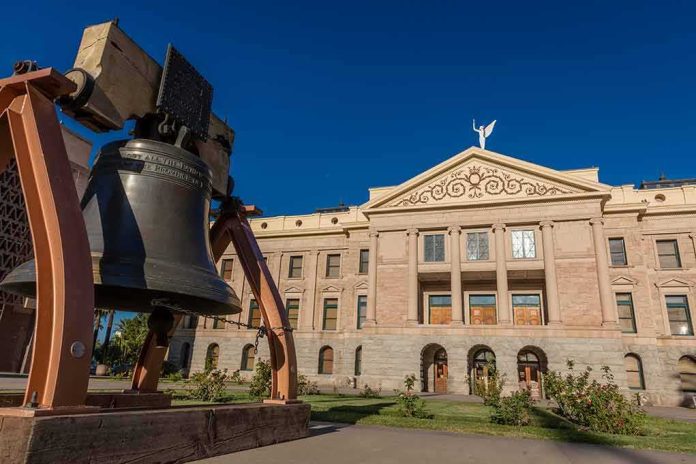
On July 4, at Independence National Historical Park in Philadelphia, officials lowered a gleaming stainless-steel cylinder ten feet into the ground, steps from Independence Hall and the Liberty Bell. This is “America’s Time Capsule,” the official national capsule for the 250th anniversary of the Declaration of Independence, created by the congressionally mandated America250 commission and handed over to the National Park Service to guard for a quarter of a millennium.
The capsule was sealed weeks earlier at the National Institute of Standards and Technology in Gaithersburg, Maryland, after engineers finished fabricating a three-foot-tall tubular vessel with multiple protective layers. Designers chose a round cylinder to avoid weak corners and wrapped it in stainless steel with three inner layers and a bell jar air pocket, so paper, textiles, and digital media stand a fighting chance of surviving 250 years underground.
What we chose to send to Americans not yet born
Inside the capsule sit nearly 200 artifacts, carefully packed into archival boxes and shelves. There is a signed pocket Constitution, a folded American flag, and items from all 50 states, five territories, and Washington, DC, plus contributions from the White House, Congress, and the Supreme Court of the United States. Some items are symbolic, like a piece of metal from New York’s Freedom Tower, built after the September 11 attacks, or a white whale bone representing Maine’s maritime heritage.
Sports and pop culture also muscled their way in. Commissioners for the National Hockey League and National Basketball Association wrote letters to the future, though the exact words remain sealed from public view. Tech made the cut too: an artificial intelligence prompt from a modern system tries to predict America’s future, a choice that says more about our current obsession with algorithms than about any settled vision of tomorrow.
How do you build something to last 250 years?
The engineering challenge behind this shiny tube is more serious than the photo ops suggest. Time capsules have a poor track record; many open to dust, mold, and disappointment instead of crisp documents and relics. Designers responded by building a three-layer internal system, including an inner chamber for the most fragile items, and then placing the whole capsule ten feet below ground to buffer against storms, temperature swings, and surface-level chaos.
National Park Service staff and America250 planners are betting that this extra depth, the stainless-steel shell, and tight environmental controls will do what so many past projects failed to do: keep oxygen, moisture, and pests from turning history into sludge. That hope is ambitious. No time capsule has actually proven itself over 250 years, which means this is, in part, a very public experiment.
Who gets to speak for “America” in a metal tube?
Supporters frame the capsule as a unifying snapshot of the whole country in 2026. It does reach widely on paper: every state, every territory, every federal branch, plus big cultural institutions and events like the Rose Parade. But questions started quickly about who is really represented. Some viewers who saw early media segments complained that they saw little evidence of African American and Native American stories in the highlighted items, and worried that our diversity might be more tagline than reality.
America is celebrating the 250th anniversary (Semiquincentennial) of the Declaration of Independence . Festivities include massive fireworks displays, block parties , and a time capsule burial in Philadelphia . The U.S. government established the America250 Commission….. #News pic.twitter.com/caPcE2Hd4s
— LAKSHY DREAM FOUNDATION GLOBAL NEWS (@GlLakshy) July 4, 2026
From a common-sense, right-of-center view, that concern hits a nerve. A national capsule should not be a glossy branding exercise or a political ad. It should reflect the people who work, worship, and raise families here, not just the people who write press releases. The good news is that many contents are still only listed, not heavily marketed, so a full inventory may show more breadth. The bad news is that no independent archival body has verified the selection or its balance.
Trust, doubt, and the long memory test
Official documents are clear on the basics: Congress ordered the capsule, America250 built it, it was sealed at the federal standards lab, buried on July 4 in Philadelphia, and scheduled to be opened on July 4, 2276. Some local or social media posts have muddied that with loose talk about it “never” being opened, but those claims do not match the written record. The core facts, for now, stand on solid, documented ground.
The real question is not whether the capsule exists. It is whether Americans trust the people packing it. There has been no independent forensic audit to confirm that what America250 says is inside actually matches what went into the tube. That gap leaves room for suspicion in an era when many Americans already distrust federal projects. A culture that jokes the capsule might hide Jimmy Hoffa is also a culture that quietly wonders what else its leaders are hiding.
Sources:
facebook.com, america250.org, nps.gov, womenforgreaterphiladelphia.org, spotlightpa.org, pbs.org, yellopolitics.com