
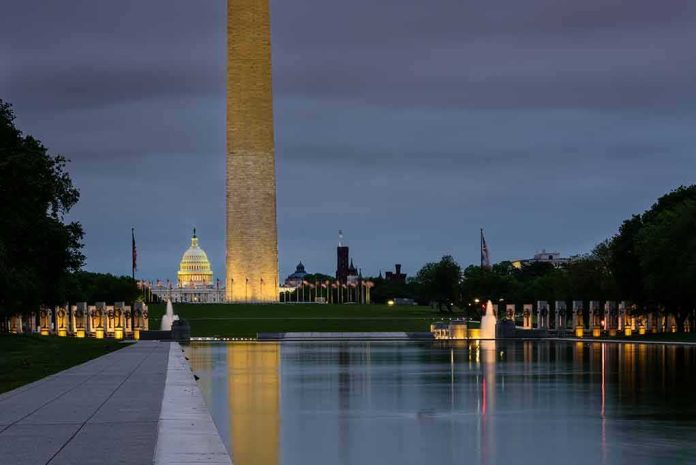
President Trump’s anger at Jeanine Pirro is not about gossip or hurt feelings; it is about a deep clash over whether Washington’s most famous pool was wrecked by vandals or by government incompetence.
Story Snapshot
- Trump insists the Lincoln Memorial Reflecting Pool was “a pure case of vandalism” and says Pirro “choked.”
- Pirro first secured a felony indictment against former Olympian David Hearn, then moved to drop the case.
- New Justice Department filings blamed a rushed, flawed contractor installation, not criminal damage.
- Trump is now reportedly weighing whether to remove Pirro and sees her reversal as a dangerous sign.
How A Grand Monument Turned Into A Political Fault Line
The Lincoln Memorial Reflecting Pool is not just another government project. It is a symbol that millions of visitors see as part of the heart of Washington. When fresh paint and sealant started peeling off the newly renovated bottom, the White House framed it as an attack on that symbol. President Trump talked about vandals with knives and box cutters slicing up a $14 million renovation, turning a maintenance failure into a test of law and order.
Jeanine Pirro, Trump’s handpicked United States attorney for the District of Columbia, stepped hard into that frame. Her office took the damage as a serious crime. A grand jury indicted former United States Olympic canoeist David Hearn for felony destruction of property, based on claims he ripped up the pool’s liner with his hands in front of the Lincoln Memorial. For a time, the message was simple: someone attacked a national monument, and the government would respond with full force.
Why Pirro Reversed Course On The Vandalism Case
The story shifted when Pirro’s office began receiving more detailed records about what went wrong with the renovation. In a court filing, the Justice Department said newly provided information pointed to “flawed installation” by the contractor as the real cause of the sealant failure. The filing described a rushed, mishandled job and said that made it hard to honestly tie widespread peeling and damage directly to vandalism beyond a reasonable doubt.
Pirro then moved to dismiss Hearn’s indictment, even after earlier statements that government witnesses had seen him “forcefully and violently” pulling up the bottom liner. Legally, that move tracks with basic American conservative values about proof and fairness: you do not send someone to prison when technical evidence starts to show the damage came from shoddy work, not a clear criminal act. The filing also faulted the Interior Department for not providing full information at the start of the case.
Trump’s Fury And The Clash Over What Justice Should Look Like
Trump did not treat Pirro’s reversal as a dry legal decision. He treated it as a collapse. On Truth Social and in Oval Office remarks, he said he “disagrees 100% with Pirro,” called the situation “a pure case of vandalism,” and complained, “I don’t know what she was thinking.” He added that she “choked” and “folded like a cheap umbrella,” language that turns a prosecution memo into a loyalty test in front of the entire country.
Trump: Jeannine Pirro folded like an umbrella!
The Guardian: Speaking to reporters from the Oval Office, Trump said: “Frankly, I think she choked because the judge was really vicious. Instead of going after the people that did it, the judge went after her and went after her… pic.twitter.com/mzTMp0el80
— ForeverMAGA🇺🇸 (@LynneA294) August 4, 2026
Reports say Trump is now “furious” and actively considering removing Pirro over the filing. From his point of view, government experts and eyewitnesses still back the vandalism narrative, and dropping the case lets people “get away with things” at a national monument. Interior Secretary Doug Burgum publicly supported Trump’s view, saying his department provided “every piece of evidence they asked for” and “expert and eyewitness testimony to the damage done by vandals.” That keeps the focus on personal responsibility rather than bureaucratic failure.
Vandalism Or Botched Work: What The Evidence Fight Really Means
Underneath the drama sits a dry but important question: when a public project falls apart, is it crime or incompetence? Pirro’s dismissal filing leans heavily toward bad construction. It says the new documents “significantly undermine” the case that vandals caused the bulk of the damage and instead show a flawed sealant job. Other reporting notes that peeling began very soon after completion, which matches a bad installation timeline better than later, focused attacks.
At the same time, officials have reported multiple arrests or citations for people messing with the Reflecting Pool area. That suggests there was at least some illegal behavior near the monument, even if it did not fully explain why the liner failed so widely. This mix of facts creates the tension: Trump talks as if vandalism explains everything, while Pirro now treats contractor error as the main cause and any criminal acts as too thin for a felony case.
Why This Fight Hits Deeper Than One Empty Pool
This clash speaks to a larger pattern in modern politics. Highly visible damage to public property tends to be blamed on bad actors first, then on bad management once engineers and inspectors dig through the details. Many Americans want both things punished: crooks who tear up shared spaces and agencies that waste millions on rushed, defective work. But the law has clear lines. Felony charges demand solid proof that a specific person caused a specific loss on purpose.
From a common-sense conservative view, Trump is right to demand real accountability for damage to a cherished national site, and he is right to be angry if bureaucrats hide facts. Yet Pirro’s insistence on evidence strong enough to win in court also matches core conservative ideas about limited government power. That is the real friction here. One side prioritizes moral certainty and public resolve; the other prioritizes the strict burden of proof. Until the full contractor records and forensic reports are public, that gap will keep the Reflecting Pool controversy alive far beyond the moment when the water finally returns.
Sources:
townhall.com, cnbc.com, youtube.com, wsj.com, bbc.com, pbs.org