
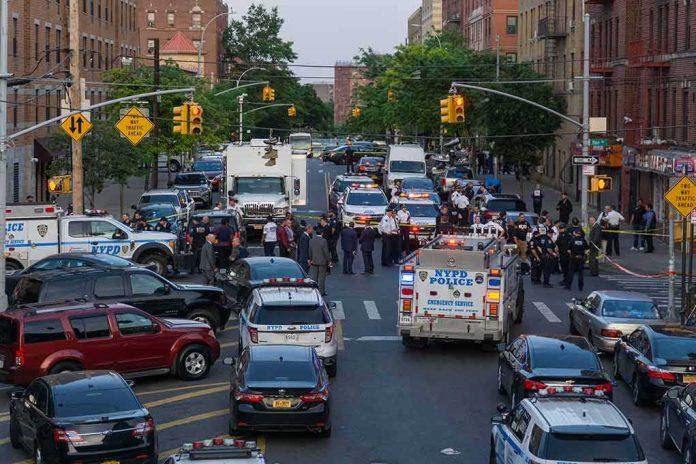
A woman stabbed two people in Times Square, killing one, then advanced on police with knives and was shot.
Story Snapshot
- Police say the attacks were random and happened seconds apart.
- The 32-year-old woman who was stabbed died at a hospital.
- Officers fired after stun guns failed and the suspect moved toward them.
- The victim was identified as Bank of America vice president Erin Piacenti.
What Happened On A Busy Midtown Block
New York City Police Department officers confronted a 49-year-old woman with two knives near the Times Square substation in daylight. Police officials said she stabbed a 32-year-old woman and a 68-year-old man about 20 seconds apart. The police commissioner called the attacks random and unprovoked. The younger victim, identified later as Erin Piacenti, died at a hospital. The older victim was treated and listed in stable condition. Officers used stun guns, which failed, then fired when she advanced.
US: Times Square stabbing claims life of Bank of America executive as rampage ends in police shooting https://t.co/5kQzcjeIep @NYPDPC @NYPDnews @NYCMayor
— Public TV English (@PublicTVEnglish) September 2, 2026
Police described a narrow window to stop more harm in a packed tourist zone. Times Square crowds leave little room for delay or error. Officers reported the suspect threatened to kill them and moved closer with both knives up. That changed the risk for everyone within reach. The New York Police Department said the officers shot only after less-lethal tools did not stop her and she closed distance. This sequence tracks what many agencies teach for edged weapon threats.
Who The Victim Was, And Why Her Name Matters
Officials identified the woman who died as Erin Piacenti, 32, from New Jersey. Her employer, Bank of America, confirmed she worked as a vice president. Her death moved this from a crime blotter entry to a national headline. A mid-day walk in one of the most watched places in America ended in tragedy. That detail cuts through the noise and drives a simple point: public safety is not abstract policy. It is a promise tested block by block.
Police also said the second victim, a 68-year-old man, survived his wounds and was in stable condition. That survival underscores how seconds changed outcomes. The suspect struck two people fast, then turned to officers. The line between life and death narrowed with each step she took. In that tight span, the officers’ choices became the last shield between a crowd and more victims.
Why Knives Force Split-Second Calls
Knife attacks are fast, close, and lethal at short range. Courts judge these cases by whether an imminent threat exists, not by a perfect hindsight script. The United States Supreme Court has repeatedly granted qualified immunity to officers in sudden weapon confrontations when no clear law said otherwise. The standard centers on immediate danger to officers or others, not on an abstract rule about tools or distance.
Training circles often teach that movement and distance decide everything during a blade attack. Reaction time, crowd density, and paths to cover all matter. A person with a knife who advances can close ground before officers can cycle through many options. That is why agencies stress a quick shift from warnings and stun tools to firearms when a suspect keeps moving in. It is not theory. It is physics and human reaction speed under stress.
The Hard Geometry Of Times Square
Times Square packs people shoulder to shoulder, with tourists, workers, and vendors filling the frame. That limits safer backstops for any shot and narrows room to maneuver. When the suspect lunged forward after ignoring commands and after stun guns failed, officers had to choose between firing or risking more victims. Based on the facts police released, that choice fits established law and common sense. Protect the innocent first. End the threat before it spreads.
Sources:
independent.co.uk, nbcnews.com, cbsnews.com, abc7ny.com, asomef.org.co, police1.com