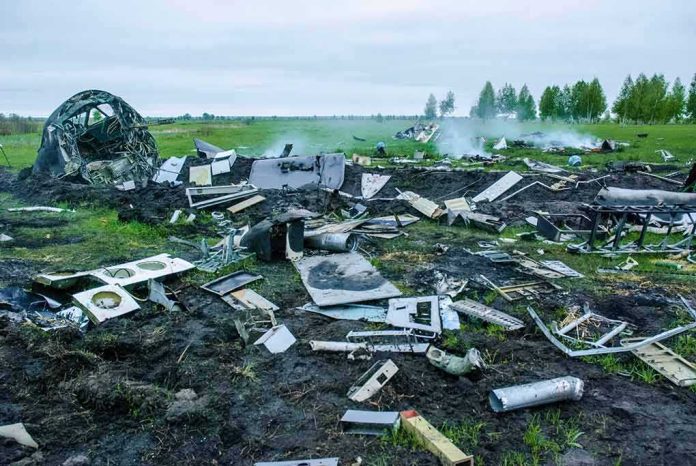
Poland says three Russian-made objects pierced NATO airspace and landed on Polish soil during a massive strike on Ukraine, and that changes the stakes overnight.
Story Snapshot
- Poland reported two missiles and a jet-powered drone crossed into its airspace.
- One object was identified as a Russian Kh-101 cruise missile, officials said.
- Prime Minister Donald Tusk called it an “intentional provocation” by Russia.
- Jets scrambled, leaders huddled, and Poland sought more NATO forces.
Poland Reports Three Russian Objects Landed Inside Its Territory
Poland’s defense minister said three Russian-linked objects crossed into Poland and came down at three sites near the Ukraine border. He said one was a Kh-101 cruise missile. He described the second as likely a missile and the third as likely a jet-powered drone. Officials listed locations near Nowy Lipowiec, Rudnik nad Sanem, and Mołodycz. No injuries were reported. The crossings happened during an intense Russian missile and drone barrage on Ukraine the same day.
Polish air defense tracked a larger picture than the three that crossed the line. The operational commander said forces tracked 11 aerial objects near the border area, with three violating Polish airspace. That ratio matters for planners. It signals a busy, complex air picture where spillover risks rise as strike volume grows. It also shows Poland’s radar and command chain were already engaged when the border breaches occurred.
Leaders Move Fast, Treating The Incident As An Alliance Test
Prime Minister Donald Tusk convened an emergency meeting with top commanders and security officials. The government asked for more North Atlantic Treaty Organization presence in response. The steps signaled that Warsaw viewed the event as more than debris collection. This was an alliance security issue with real deterrence weight. Rapid coordination aimed to show control, keep citizens safe, and remind Moscow that borders backed by the alliance are not a gray zone.
Tusk said the pattern looked like an intentional provocation. He argued there was no doubt the objects that landed in Poland were Russian. That view dovetailed with what the defense minister said about a confirmed Kh-101 and two other likely Russian weapons. The claim of intent sets a sharper tone than a simple overshoot. It tells allies and adversaries that Poland sees purpose, not accident, behind the airspace breach.
The Strike Context: Heavy Fire On Ukraine Drives Spillover Risk
The incursions came amid a large Russian strike package against Ukraine. Massed salvos raise the odds that guidance errors, jamming, or broken parts lead to cross-border entries. They also give cover if planners want to test allied nerves without hitting a city. Since 2022, allied states near Ukraine have faced repeated close calls or brief violations. Poland is not alone in managing that steady grind along the edge of war.
Polish officials named one object as a Kh-101 cruise missile, which Russia has used often in deep strikes on Ukraine. That identification matters because the Kh-101 is designed for long-range precision. A weapon built to hit far-off targets cannot claim the same drift profile as a dumb rocket. When such a system ends up across a NATO border, leaders must decide if they face a message, a malfunction, or both. The Polish stance leaned toward message.
Why This Matters For NATO Deterrence And Common Sense Policy
The alliance lives on two simple rules: borders are real, and responses are unified. Poland’s swift huddle and its request for more forces line up with both. That is deterrence 101. When a member’s airspace gets violated, the group shows up. That does not force escalation. It does force clarity. Clarity is how you prevent the slow creep from “just a test” to “now it is normal.” Moscow respects steel more than speeches. Steel arrived quickly here.
Polish Defense confirmed that two missiles, including the Kh-101 of Russian origin, and a jet-engine drone violated Polish airspace this morning and fell into southeastern regions (Nowy Lipowiec, etc.). Article 5 has not been activated. Poland requested additional NATO support
— Cristian R Rosa R// -WorldWide:.🦅👁 (@RafaelCRosaR) November 20, 2026
One caveat is fair to note: officials described two of the three objects as “likely,” while work continued at the sites. That does not blunt the headline facts. Poland says a Russian Kh-101 landed on its territory, two more objects likely of Russian origin crossed the border, and leaders treated the event as deliberate. The line that matters now is the literal one on the map. NATO credibility rests on keeping it bright, defended, and never optional.
Sources:
redstate.com, reuters.com, kansas.com, politico.com, hromadske.ua