
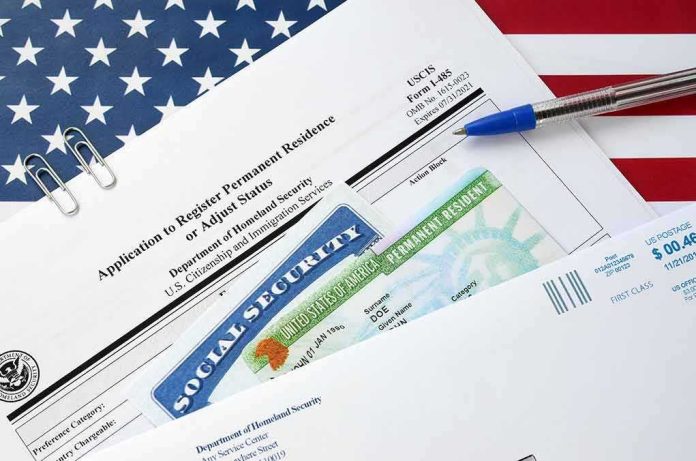
Hugh Hewitt urged President Trump to issue a class-based pardon for up to two million undocumented immigrants, and the firestorm tells us more about the right’s fault lines than any poll ever could.
Story Snapshot
- Hewitt proposed a defined-class pardon for select undocumented immigrants, not a blanket amnesty.
- The suggested scale could reach about two million people, roughly ten percent of the total.
- Supporters frame it as targeted mercy; critics call it amnesty that weakens the rule of law.
- The legal effect on deportation and status is unsettled by clear, public guidance.
What Hewitt Actually Proposed
Hugh Hewitt published a column urging President Trump to use the pardon power for “a defined class” of undocumented immigrants. He drew a line between those who should be removed and a large group who are stable community members. He framed this as a move only Trump could make and called it a “golden touch” on immigration. The pitch centered on federal pardon authority aimed at immigration offenses, not citizenship or a full legal status grant.
Coverage summarized the scale as a ten percent share of an estimated fifteen to twenty million undocumented people. That math yields up to about two million potential beneficiaries. The figure comes from commentary on Hewitt’s pitch, not a formal agency count or legal memo. It sketches the political stakes more than an implementation plan. The raw number, while striking, lacks a transparent method or a named dataset behind it, which limits its precision in policy terms.
How A Pardon Might Work—and Might Not
A presidential pardon can clear federal crimes, but immigration law runs on many tracks. A pardon does not automatically grant lawful status, work authorization, or a visa. It might block some removal grounds tied to a conviction, but it would not wipe away every civil immigration consequence. News reporting on Hewitt’s idea stressed those limits and called the proposal selective relief, not a general mass amnesty. The missing piece is an official legal roadmap from the executive branch.
The open questions are practical and large. Would the White House issue a class proclamation or rely on individual warrants? Which agency would screen claims? What proof would people submit? Would courts accept a class pardon as a bar to certain removals, or demand case-by-case proof? Hewitt’s column did not supply criteria such as years of residence, criminal history bars, or national security checks. The absence of hard lines invites both confusion and litigation.
The Conservative Backlash
Prominent conservative voices rejected the plan as amnesty by another name. A report quoted media figures and policy leaders warning it would undercut the rule of law and national sovereignty. Glenn Beck argued that mass pardons would signal smugglers and cartels that crossing rules are soft, especially while Congress has not fixed loopholes blamed for the last border crisis. That view reflects a deterrence mindset common on the right and lands with many base voters.
Well now Hugh Hewitt wants President Trump to do presidential pardons for undocumented immigrants who are ILLEGALS. Can you believe that? Citing presidential mercy. Unbelievable.
— UTLonghornMadre (@blueeyesmadre) November 25, 2026
Other critics warned about fairness to legal immigrants who waited years and paid large sums to follow the rules. Some argued that any step toward relief becomes a ratchet that future administrations expand. That is a classic conservative concern: once Washington opens the gate, it rarely closes. These objections do not deny a president’s pardon power. They question whether using it here rewards unlawful entry and invites more, which clashes with border-first priorities.
The Strategic Bet—and the Reality Check
Hewitt made a political bet, not just a legal one. He cast Trump as the only figure who could sell mercy to a law-and-order movement. That echoes past moments when presidents used clemency at scale to settle conflict. But immigration law today is a maze, and pardons do not redraw its map. Without a detailed plan, a class pardon risks a headline victory with a back-end tangle that courts and agencies unwind for years, draining capital while the border fight continues.
A targeted clemency plan would need sharp lines and clear exclusions. It would also need a companion enforcement drive that seals the front door while sorting the backlog inside. That pairing would speak to conservative values: law, order, fairness, and mercy earned by conduct over time. Hewitt’s idea tees up that debate. The ground truth remains: a pardon is a tool, not a system. Using it at scale demands rules the public can see and the courts can sustain.
Sources:
thegatewaypundit.com, the-aporia.com, skim.plus, steynonline.com