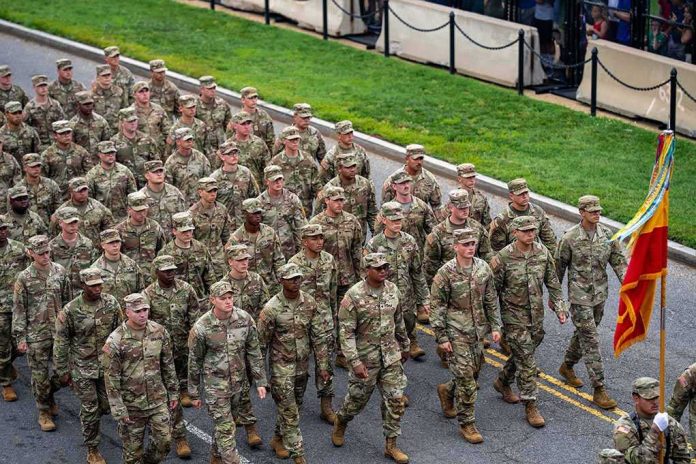
An active-duty U.S. Army sergeant stood in federal court and admitted he sold America’s defense secrets to buyers tied to China.
Story Snapshot
- Jian Zhao pleaded guilty to conspiring to gather and transfer national-defense information.
- Prosecutors say the scheme ran from 2021 to 2025 and involved a named co-conspirator.
- Targets included a major Pacific exercise, operational orders, and radar blueprints.
- Agents seized about $30,000 in cash and Army hard drives during the arrest.
What Zhao Admitted And Why It Matters
The United States Department of Justice said Jian Zhao, an active-duty sergeant at Joint Base Lewis-McChord, pleaded guilty to a federal conspiracy charge. Prosecutors said Zhao agreed to obtain and transfer national-defense information to buyers connected to China. The plea cements the core facts of the case and links Zhao’s access as a supply sergeant to the material at issue. A guilty plea is not a conviction for espionage, but it is a binding admission to the charged conspiracy’s facts and intent.
https://www.youtube.com/watch?v=f7dZcvcyv9w
Federal charging papers laid out how the plot worked across several years. The indictment alleged Zhao and others sought documents, photos, instruments, and notes tied to U.S. national defense. The government identified a co-conspirator, former soldier Ruoyu Duan of Oregon. The timeline stretched from late 2021 through early 2025, which shows planning, tasking, and repeated attempts to get sensitive material, not a one-off lapse or a gray-area leak.
What The Conspiracy Targeted
The government’s account did not describe random browsing. It pointed to specific capabilities and operations. Prosecutors cited operational orders, details of a large Pacific maritime exercise, and technical material on a Ground and Air Task Oriented Radar site in Okinawa. Blueprints and electrical diagrams can expose how a radar sees, how it hides, and how to blind it. Operational orders reveal who moves where and when. That mix can erode surprise and protection for U.S. forces.
Agents also tied the case to physical evidence. According to contemporaneous reporting, federal agents arrested Zhao at his home in Lacey, Washington, and seized roughly $30,000 in cash, electronic devices, and multiple Army hard drives. Cash on hand, paired with devices and government media, fits a classic insider-theft profile: access, extraction, and payout. That is the triad adversaries try to build inside our units and depots.
How This Fits The China Playbook
This case mirrors a long-running pattern: Beijing-linked buyers try to fuse cyber theft, front companies, and insiders with real access. The Department of Justice has reported that the bulk of its economic-espionage dockets involve a China nexus, and a majority of trade-secret cases do too. Those figures span many industries, not only the military, but they map the larger threat environment that makes an insider like Zhao so valuable to foreign collectors.
The Zhao file also shows why the insider threat demands daily discipline. A supply sergeant’s clearance and logistics reach can touch operational orders, technical manuals, and removable media. That is a tempting menu for an adversary who wants fast results without hacking a network. American common sense, and conservative instincts about duty and deterrence, line up here: tighten access, punish betrayal, and make clear that selling out the country will meet certain justice.
The Stakes For U.S. Forces And Deterrence
Operational orders and radar diagrams are not just paperwork. They guide ships, aircraft, and Marines in contested zones. If a rival studies them, it can plan ambushes, dodge detection, or jam our systems. Even if some files never left U.S. control, the attempt alone maps our vulnerabilities and signals demand for more. The surest reply is relentless counterintelligence, strict media control, and a culture that treats removable drives like live ammo, not office supplies.
🚨📦 HE SOLD HIMARS SECRETS AND TOP SECRET HARD DRIVES. 📦🚨
Army sergeant Jian Zhao pleaded guilty Nov 23 in Portland. Prosecutors say he sold HIMARS manual excerpts and classified hard drives to buyers connected to China. He faces up to 10 years. Sentencing is March 1, 2027. pic.twitter.com/aQHShbD8K3
— ZeroBarkThirty (@zerobarkthirty) November 25, 2026
The court will handle sentencing next, and more details may surface in those filings. What is already public is enough to draw the hard line. A uniform and a clearance are not shields from the law. They are oaths with teeth. When someone breaks that oath for cash, the result is not a scandal to spin. It is a crime to punish, and a warning to every unit that the enemy will pay for what a careless insider can touch.
Sources:
zerohedge.com, justice.gov, militarytimes.com