
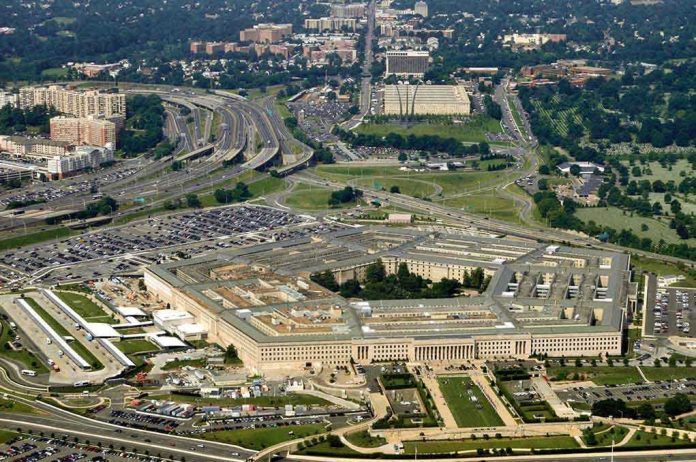
The Trump administration has unveiled a staggering $1.5 trillion defense budget request for fiscal year 2027—the largest in American history—raising urgent questions about whether this unprecedented spending spree will genuinely protect the nation or simply enrich defense contractors while burdening taxpayers already struggling with government overspending.
Story Snapshot
- Pentagon requests historic $1.5 trillion defense budget, a 42% increase over last year’s already-record spending
- The year-over-year increase alone ($445 billion) rivals the combined defense budgets of China, Russia, and the United Kingdom
- Budget excludes funding for the ongoing Iran conflict, with an additional $80-100 billion supplemental likely needed
- Over half the budget ($750 billion) flows to weapons systems and procurement, primarily benefiting major defense contractors
- Republican-controlled Congress must approve through split process: $1.15 trillion via standard appropriations and $350 billion through reconciliation
Historic Spending Escalation Breaks All Records
The Pentagon formally unveiled the $1.5 trillion budget request on April 21, 2026, marking an extraordinary leap from the previous year’s $1.05 trillion baseline. Secretary of War Pete Hegseth justified the increase by claiming “previous administrations underinvested in our military while our enemies grew stronger and more dangerous.” The budget represents the first defense spending plan to exceed $1.5 trillion and includes novel categories like “presidential priorities” totaling $245.3 billion for initiatives ranging from missile defense to drone warfare dominance.
Defense Contractors Positioned for Massive Windfall
Over $750 billion—52% of the total budget—flows directly into weapons systems and capabilities procurement. Aircraft procurement and research receives $102 billion, a 26% increase that includes ramping F-35 production to 85 jets annually, directly benefiting Lockheed Martin. The budget dedicates $53.6 billion to autonomous drone platforms and another $21 billion for munitions and counter-drone technologies. War Department Comptroller Jules W. Hurst III characterized the spending as designed to “supercharge our defense industrial base by expanding production of major weapon systems,” language that effectively promises tens of billions to the same contractors who have built Washington’s revolving door between the Pentagon and private industry.
Service Members Gain While Taxpayers Face Burden
The budget includes genuine benefits for military personnel: 5-7% pay raises weighted toward junior enlisted troops who receive the full 7% increase, expansion of 44,000 additional service members, and $57 billion for bases and facilities including critical housing improvements. Space Force receives nearly 80% budget growth, jumping from $40 billion to $71.2 billion. Yet these legitimate investments come packaged with massive spending that raises fundamental questions about priorities. The budget allocates $1.47 billion for U.S.-Mexico border operations and $605 million for National Guard deployment to Washington, demonstrating how defense dollars fund domestic political objectives.
War Costs Excluded From Already-Record Request
Despite the United States actively engaging in military conflict with Iran, the $1.5 trillion request contains no specific funding for ongoing war operations. Pentagon officials acknowledge a separate supplemental appropriation likely totaling $80-100 billion will be necessary for operational costs and munitions replenishment. This accounting maneuver obscures the true fiscal impact from American taxpayers already shouldering unprecedented peacetime defense spending. The budget structure splits $1.15 trillion through standard congressional appropriations and $350 billion through reconciliation procedures that require only simple Senate majority, reducing Democratic opposition power but raising concerns about deliberative oversight of such massive expenditures.
Space Force Lt. Gen. Steven P. Whitney defended the budget’s scope by noting “we were not forced to make that trade between investment in the capabilities we need and the readiness of our force.” Yet this reasoning sidesteps the fundamental question Americans across the political spectrum increasingly ask: when defense spending approaches levels that strain the entire federal budget, are elected officials genuinely prioritizing national security, or protecting the interests of contractors, bureaucrats, and the military-industrial establishment that President Eisenhower warned against decades ago? The $445 billion year-over-year increase alone could fund substantial investments in infrastructure, border security, or debt reduction—choices that never reach serious consideration once the Pentagon’s appetite is fed.
Sources:
$1.5 trillion budget request prioritizes service members, modernization – War.gov
Pentagon budget 2027 raise for troops – Stars and Stripes
These Are the 3 Biggest Winners From the Proposed $1.5 Trillion Defense Budget – 24/7 Wall St.
US Unveils Details of $1.5 Trillion Defense Budget – Marine Link
What’s Really in Trump’s 2027 $1.5 Trillion Defense Budget? – Wesley O’Donnell