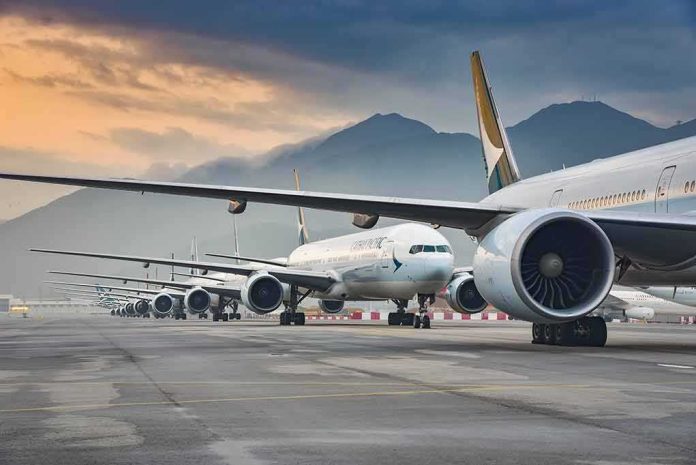
The cockpit fight that made a jet whisper “hijack” to the world shows how one code can rattle three countries.
Story Snapshot
- A Flydubai jet to Tel Aviv briefly squawked code 7500, the hijack signal.
- Israel scrambled jets and treated the case as a live threat.
- Reports later pointed to a physical altercation between the pilots, not a hijacking.
- The plane diverted and landed safely in Tabuk, Saudi Arabia; all aboard were safe.
The alert: one code, instant consequences
Minutes after takeoff from Dubai, the Flydubai flight sent an emergency signal and briefly switched its transponder to 7500, the global code for unlawful interference or hijacking. Air traffic control treats that as serious until proven otherwise. Fighter jets launched in Israel as a precaution. Controllers and defense teams assume the worst because speed saves lives when the threat is real. That posture worked as designed here, and it moved the plane off its route fast.
Code 7500 is plain language in numbers. Federal Aviation Administration guidance instructs pilots and controllers to treat 7500 as a hijack alert and to verify it with care. That is why one squawk can ripple through air-defense systems in minutes. The system is built to err on caution, because time kills in the sky. If the crew cannot talk or gives odd replies, controllers act like the hijack is real. That bias is not panic; it is policy.
What happened in the cockpit
Initial headlines screamed “hijack.” Subsequent reports shifted. Israeli and international outlets, citing officials, said a physical altercation broke out between the captain and the first officer. That fight, they said, triggered the emergency signals and forced the diversion to Tabuk in northwest Saudi Arabia. Flydubai said the aircraft experienced an incident en route and landed safely, with passengers accounted for. That statement tracks with the diversion and confirms a non-routine situation that needed immediate action.
Accounts varied on the details. Some mentioned a brawl and possible injury. Others pulled back from claims of weapons. No public cockpit voice recorder or flight data excerpts have been released yet, which keeps the exact trigger and severity of the scuffle in question. On balance, the pilot-fight explanation fits the outcome: a sharp alert, a safety-first diversion, and a later downgrade from hijacking to internal conflict. Officials also said it was not a hijacking after reviews on the ground.
Why the response still made sense
Skeptics might ask whether jets needed to scramble if this was “only” a crew fight. The answer is yes. When a jet bound for Israel shouts 7500, you do not wait for a second opinion. Controllers and defense teams cannot judge intent from the ground. A fight in the cockpit can threaten control of the aircraft. A bad actor can hide behind chaos and force a diversion. American conservative common sense says secure the skies first, sort the story later. That is what happened here, and it worked.
A massive mid-air crisis was averted aboard Flydubai flight FZ1073 after brave Israeli passengers and cabin crew subdued a pilot during a violent cockpit altercation. En route from Dubai to Tel Aviv, the Boeing 737 MAX suddenly plummeted 14,000 feet in just one minute after one… pic.twitter.com/yqPhDJ3LNg
— R. Sachin Suryavanshi (@RSachinSurya) September 30, 2026
This episode also shows how fast the public story can race ahead of facts. The first wave leaned on unnamed officials and fast takes. That is normal in breaking air incidents. But the evidence the public can see is modest: the 7500 squawk, the scramble, the diversion, and the airline’s safety confirmation. Everything else, including who started the fight and why, still needs records: crew statements, cockpit voice recorder audio, and regulator summaries. Until then, caution beats drama.
What to watch next
Three disclosures would settle most questions. First, the airline’s internal incident report and timelines. Second, regulator findings that match the transponder changes to cockpit audio. Third, official notes from Israeli and Saudi authorities that explain the scramble logic and the Tabuk response. Those items would tell us if 7500 was pressed by mistake in a struggle, used on purpose to call for help, or toggled as part of a checklist under duress. The procedure matters because it guides training and prevents repeats.
The system, however, passed a hard test. A sudden hijack alert spurred immediate action. The crew got the jet on the ground. Passengers went home alive. That is the bar that counts. The rest is accountability. If a cockpit feud sparked it, the operator must fix culture and screening. If a protocol gap confused the codes, regulators must clarify drills. Security that reacts fast and learns faster is how you keep rare scares from turning into tragedies.
Sources:
mediaite.com, bbc.com, haaretz.com, jpost.com, pilotinstitute.com, wayman.edu