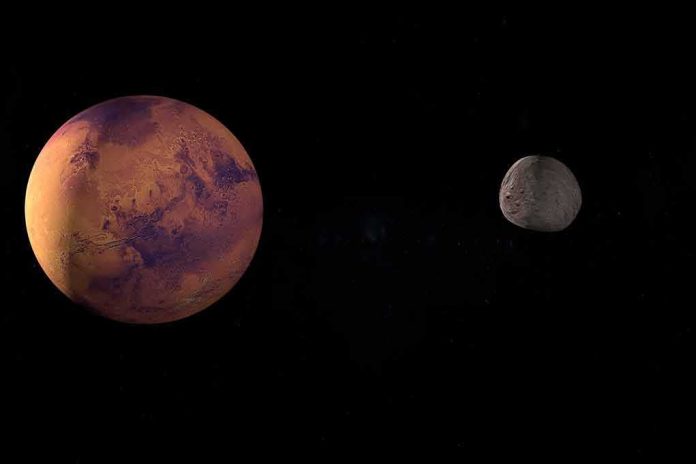
NASA scientists have concluded that meteorites and other non-biological processes cannot account for the mysterious abundance of organic compounds discovered on Mars, leaving the possibility of ancient Martian life as a legitimate explanation that deserves serious investigation.
Story Highlights
- NASA study rules out meteorites, dust, and hydrothermal chemistry as sources for long-chain organic compounds detected by Curiosity rover in Gale Crater mudstone
- Original organic abundance estimated at 120-7,700 parts per million before radiation degradation, far exceeding what non-biological sources could deliver
- Alkanes detected may be remnants of fatty acids, which on Earth are predominantly produced by living organisms
- Findings strengthen case for Mars sample return missions and direct laboratory analysis of Martian rocks
Curiosity Rover Detects Unprecedented Organic Compounds
The Curiosity rover detected long-chain alkanes including decane, undecane, and dodecane in Cumberland mudstone samples from Gale Crater in March 2025 using its Sample Analysis at Mars instrument. These organic molecules, found at concentrations of 30-50 parts per billion, represent the largest such compounds ever discovered on the Red Planet. The mudstone sample had been exposed to harsh Martian radiation for approximately 80 million years, suggesting the original concentrations were substantially higher before radiation degradation occurred over geological timescales.
Radiation Modeling Reveals Abiotic Sources Fall Short
Alexander Pavlov from NASA Goddard Space Flight Center led a team that published findings in the journal Astrobiology on February 4, 2026, demonstrating that known non-biological sources cannot explain the detected organic abundance. Using laboratory radiolysis experiments to calibrate radiation decay rates, researchers calculated that original organic concentrations before radiation exposure ranged from 120 to 7,700 parts per million. The team systematically evaluated potential abiotic delivery mechanisms including meteorite impacts, Martian dust, atmospheric haze, and serpentinization processes, finding all insufficient to account for the modeled pre-radiation levels.
Fatty Acid Fragments Point Toward Biological Origins
The detected alkanes are potentially fragments of fatty acids, organic molecules that on Earth are predominantly produced by living organisms, though they can form through some geological processes. Researchers emphasize that while a biological origin remains unproven, it represents a reasonable hypothesis given the data. This finding builds on Curiosity’s 2018 discovery of kerogen-like macromolecules and thiophenes in Mojave drill site mudstones, which were preserved by sulfur compounds despite Mars’ harsh radiation environment. The Cumberland sample’s location in Gale Crater’s ancient lakebed provides an ideal setting for organic preservation across billions of years.
Scientific Scrutiny and Sample Return Implications
The research team stresses the need for extraordinary evidence before declaring proof of ancient Martian life, echoing Carl Sagan’s famous principle that extraordinary claims require extraordinary proof. Scientists acknowledge uncertainties including unknown Mars-specific abiotic pathways and limitations in radiation modeling. The study strongly advocates for Mars sample return missions, particularly analysis of cores collected by the Perseverance rover, to conduct direct laboratory searches for intact fatty acids that would provide definitive evidence. This discovery strengthens NASA’s case for Congressional funding of sample return operations, which could fundamentally rewrite our understanding of Mars habitability and the potential for life beyond Earth.
The findings represent a significant departure from previous assumptions that meteorite bombardment could adequately explain Martian organics. George Cody from Carnegie Institution noted that this research eases the defense for expensive sample return missions by demonstrating that remote analysis has reached its limits. NASA continues operating Curiosity after more than a decade on Mars, while debates continue regarding Perseverance’s 2023 organic signals, which some scientists suggest may actually be inorganic cerium compounds rather than true organic molecules, highlighting the challenges of remote detection.
Sources:
NASA Study: Non-biologic Processes Don’t Fully Explain Mars Organics
NASA rover hits organic pay dirt on Mars
Mars Organics Are Hard to Explain Without Life, NASA-Led Study Finds
Non-Biological Processes Don’t Fully Explain Mars Organics