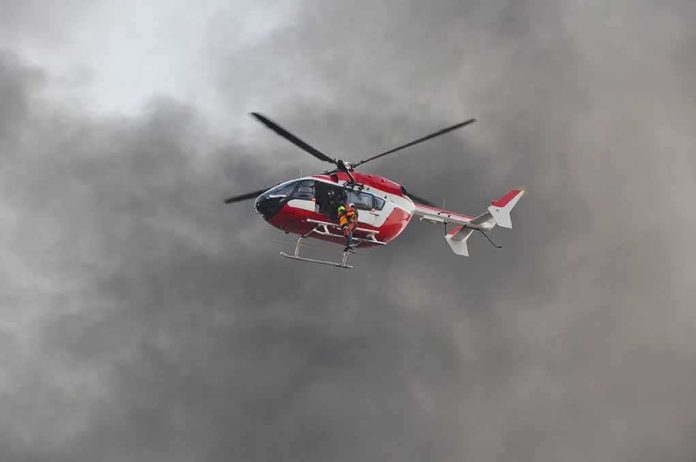
Three people died and one was hospitalized after a Los Angeles news helicopter crashed and burned in Chatsworth just before 7 p.m., drawing a massive fire response and a federal investigation.
Story Snapshot
- Firefighters found a helicopter down, burning, and extinguished the fire fast.
- Three victims died at the scene; one person was taken to a hospital.
- NBC’s local station later confirmed it was News Chopper 4 from KNBC.
- Federal investigators from the National Transportation Safety Board and the Federal Aviation Administration took the case.
What Happened And When
The Los Angeles Fire Department logged an aircraft crash at 6:57 p.m. near 9151 North Mason Avenue in Chatsworth. Dispatch labeled it an aircraft crash or crash imminent and sent a large strike team. Crews reached an active fire around wreckage near vehicles and cargo containers. Command reported four patients. Three were declared dead at the scene. One person was moved to a local hospital in unknown condition. The fire was knocked down, and hazards were controlled.
Los Angeles Fire Department officials first described the craft as a helicopter of unknown make and type. The scene suggested a news aircraft based on the location and circumstances. NBC Los Angeles later said it had lost contact with its News Chopper 4 around that time and confirmed the downed aircraft was theirs. Station coverage placed the crash just before 7 p.m., matching the fire department’s incident time.
The Scene, Damage, And Response
Firefighters arrived to heavy fire and debris near parked vehicles and two large cargo containers. Crews prevented spread to nearby structures and worked amid fuel and heat risks. Fifty-six firefighters responded, which is a strong indicator of both fire load and the need to search for survivors. After suppression and medical triage, the department secured the site and handed it over to federal investigators for the technical work that follows in fatal air accidents.
Crews reported the helicopter wreckage made immediate identification hard. That is common in high-heat crashes where tail numbers and markings burn or break. Early casualty figures can shift, but the department’s formal tally stood at three dead on scene and one transported. Officials did not release identities or roles of the victims at that time. The cause was not known, and the department deferred to the federal process.
Who Investigates And What Comes Next
The National Transportation Safety Board leads with a “Go Team” after fatal aviation crashes. The team maps the site, documents the wreckage, and collects witness accounts. Specialists analyze engines, structures, maintenance, operations, air traffic control, and weather. The Federal Aviation Administration supports with records and regulatory data. A preliminary report usually posts within weeks and lists facts, not blame. A final probable-cause finding can take a year or more.
An NBC news helicopter just crashed on live TV while covering a crash in Los Angeles
Three confirmed dead, 2 on board and one person on the ground.
pic.twitter.com/34FBxAIRGb— Paul of Legally Armed America (@Paul_of_LAA) September 16, 2026
Helicopter cases often hinge on many factors rather than one. Investigators look at pilot decisions, mechanical health, fuel system integrity, rotor and transmission function, and visibility and wind near the ground. They also study workload during breaking news flights, which can add pressure. This measured approach matches American conservative values of order, due process, and facts first. Rushing to cast blame before the record is built helps no one and can harm safety lessons.
Why The “News Helicopter” Detail Matters
Local news aircraft play a public role that most people only notice on the worst days. They bring eyes to fires, crashes, floods, and rescues. That visibility adds scrutiny. When a branded helicopter goes down, the employer, the audience, and the city all feel it. Station confirmation that the helicopter belonged to KNBC gives investigators a clear path to crew rosters, dispatch logs, maintenance records, and flight plans, which can speed the fact-finding stage.
Clear records are how safety improves. The National Transportation Safety Board has pushed fixes before when system risk, routing, or oversight played a part in other crashes. That history shows why the board gathers hard data before any call on cause. Families, employers, and first responders deserve certainty that comes from evidence, not theories. The Chatsworth crash will follow that playbook: preserve the site, gather the data, release the prelim, then trace the chain of events.
What To Watch For In The Preliminary Report
Expect basic facts: aircraft identity, operator, route, crew count, weather, and a timeline from last contact to impact. Look for notes on fire patterns, rotor and gearbox continuity, control linkages, and signs of fuel starvation or engine distress. Watch for mentions of workload and mission tasking near the impact zone. These pieces do not assign fault. They frame the next steps and focus the lab work, teardown exams, and interviews that lead to recommendations.
Until then, the known facts stand: a helicopter went down near North Mason Avenue at 6:57 p.m.; three people died; one person was hospitalized; firefighters knocked down the blaze; and federal investigators took charge. That is the firm ground. The next duty is patience, truth, and respect for the evidence. When the data are in, the fixes should follow fast and stick.
Sources:
facebook.com, lafd.org, cnn.com, cbsnews.com, news18.com, nbclosangeles.com