
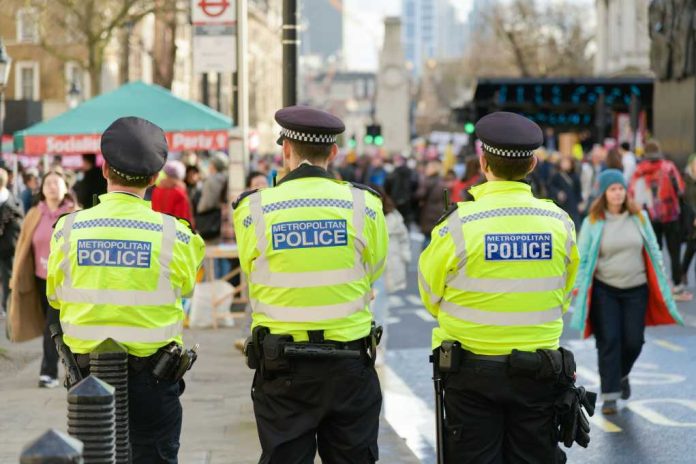
A 14-year-old boy is now at the center of a major terrorism case after police say he planned attacks on two London mosques driven by extreme right-wing hatred.
Story Snapshot
- Police say a 14-year-old from south London drafted plans to attack two mosques in Sutton.
- He is charged with preparing terrorist acts under the Terrorism Act and racially aggravated criminal damage.
- Documents found at his home led officers to label the case extreme right-wing terrorism.
- The case fits a growing trend of teenagers pulled into far-right extremism and charged before an attack happens.
Police say a routine criminal damage call exposed a potential terror plot
Metropolitan Police officers did not go to the boy’s home looking for a terrorist. They arrested him first on suspicion of criminal damage to a vehicle at a south London address, a fairly standard local crime call. During the follow-up search of the property, officers found what they later described as “a number of documents of concern.” Those papers, according to police and prosecutors, pointed to an alleged plan to target two mosques in Sutton in south London.
Detectives from Counter Terrorism Policing London joined the case once the nature of the documents became clear. The boy was then arrested again, this time under section 5 of the Terrorism Act 2006 for preparation of terrorist acts linked to extreme right-wing ideology. Police say he had formed an intention to carry out acts of terrorism and took steps they believe show planning for attacks on the two places of worship. Officers have not claimed there was a wider network, and they stressed they do not currently see a broader threat tied to his alleged plot.
Charges, court appearance, and protections around his identity
Prosecutors charged the 14-year-old with “conduct in preparation for giving effect to an intention to conduct acts of terrorism,” the core section 5 offence used in many modern terror cases. He also faces a charge of racially aggravated damage to property connected to the original criminal damage incident. Because of his age, the boy cannot be named under legal reporting restrictions designed to protect minors in the justice system. He has been remanded in custody and is due to appear at Westminster Magistrates’ Court to face the terrorism and criminal damage charges.
Senior counter-terror officers have publicly underlined the seriousness of the case despite the suspect’s young age. Helen Flanagan, head of Counter Terrorism Policing London, called it “a very serious terrorism charge against a young boy” and said it would understandably alarm both the public and the local Muslim community. Police say they have increased patrols in the affected areas and offered support and reassurance to the mosques named in the alleged plans. They are working closely with local partners to calm tensions and prevent copycat threats.
Teenage terrorism and the rise of extreme right-wing ideology
This case does not stand alone; it reflects a clear shift in who commits terrorism offences in the United Kingdom and why. Research on children convicted of terrorism offences in England and Wales since 2016 shows 43 minors have been convicted, with most cases now driven by extreme right-wing ideology, not Islamist beliefs. One study found that extreme right-wing ideology was the most common motive among teenage terrorism offenders, and that many of these children were charged over online activity and planning rather than completed attacks.
A 14 yr old boy has been charged under the Terrorism Act over an alleged plot to attack two mosques in Sutton.
Fourteen. Who taught this child to hate?
The thing is, this is not one disturbed child. There's a pattern of these cases.
In Greenock, a boy radicalised online was… https://t.co/ilMUeOawCu
— MEND Community (@mendcommunity) July 15, 2026
Investigators and scholars warn that a “far-right ecosystem” online plays a major role in pulling very young users into extremist thinking. Reports describe racist forums, encrypted messaging channels, and meme-heavy propaganda spaces that target teens and even younger children. British counter-terror officials have said that the vast majority of under-18 terrorism arrests now involve boys consuming or sharing far-right content. That pattern aligns with the Sutton case, where police say documents tied to extreme right-wing terrorism were central to the alleged mosque plot.
Balancing public safety, community trust, and common sense
For many adults, the idea of a 14-year-old planning to attack mosques feels almost impossible to accept. Yet the facts reported by police and multiple outlets show the charge is real and grounded in specific evidence, not political spin. From a common sense, conservative view, the first duty of the state is to protect life, which means acting early when a plan to target houses of worship appears. Section 5 of the Terrorism Act allows intervention before blood is spilled, and that tool is now used frequently with minors.
At the same time, some worry that fast-growing counter-terror powers aimed at children could drift into overreach. Past cases show that not every accused teenager is convicted; one 14-year-old charged with plotting a jihadist-inspired attack in 2020 was later acquitted by a jury. That example underscores why facts and due process matter. With the Sutton boy, the charge is grave, but he is still entitled to a fair trial, evidence tested in court, and a chance for rehabilitation if found guilty. That mix of firm security and real justice is the balance most people expect.
Sources:
independent.co.uk, bbc.com, reuters.com, x.com, cst.org.uk, facebook.com, southampton.ac.uk, terrorismlegislationreviewer.independent.gov.uk