
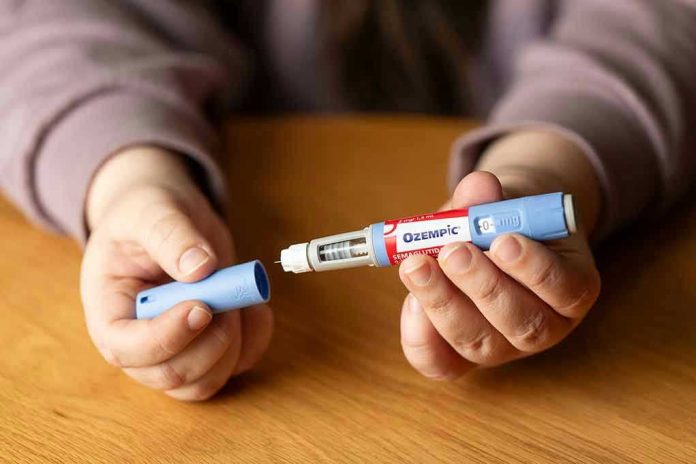
Trump’s TrumpRx deal is forcing Big Pharma’s hottest weight-loss drugs to drop from luxury pricing toward mass-market access—and it’s reshaping who pays, who profits, and who gets treatment.
Story Snapshot
- New U.S. pricing channels are pushing GLP-1 obesity drugs toward $245–$350 per month for many patients, down sharply from $1,000+ list prices.
- The Trump administration’s TrumpRx direct-to-consumer platform is a major driver of the price reset, alongside Medicare/Medicaid negotiations.
- Novo Nordisk and Eli Lilly may still keep revenue strong in 2026 by expanding volume, even as per-patient prices fall.
- Commercial insurers and taxpayers face new pressures as coverage expands and demand surges, with uncertainty about spillover into private pricing.
TrumpRx and Medicare negotiations redraw the pricing map
Trump administration pricing moves in late 2025 and early 2026 have put the GLP-1 obesity drug market into a new phase: lower prices, broader access, and more political scrutiny. Reports describe a Trump-brokered framework that puts Ozempic, Wegovy, and Zepbound around $350 per month via TrumpRx, while Medicare pricing has been cited near $245 per month with low copays. Those figures represent a dramatic break from the $1,000–$1,350 monthly price era that fueled public outrage.
For conservative voters who spent years watching Washington overpromise and overspend, the key distinction is structure. TrumpRx is described as a direct-to-consumer channel designed to pressure prices through transparency and scale rather than by simply expanding blank-check subsidies. That approach may still interact with federal programs, but it changes the leverage dynamic: patients get a clearer price point, manufacturers compete for volume, and politicians can’t as easily hide costs behind complex rebates and middlemen.
Lower prices could expand access fast—but demand is the wild card
Analysts describe unusually high price sensitivity for GLP-1 drugs compared with many chronic medicines, largely because millions of eligible Americans have been priced out. Research summaries cite about 36 million eligible U.S. patients with relatively low uptake so far, meaning lower monthly costs can unlock a large pool of new demand. That scale matters because even if manufacturers accept a “low single-digit” revenue hit per prescription, the total number of prescriptions could rise enough to offset it.
Evidence of that volume logic shows up in reported 2025–2026 revenue expectations for semaglutide products. One analysis pegs semaglutide revenue around $33 billion in 2025 and roughly $36 billion in 2026, implying that the market may keep growing even as prices fall. The policy bet is straightforward: shrink the per-month barrier, increase adherence, and bring in new patients—especially cash-pay consumers and seniors—without turning access into a rationed, bureaucratic maze.
Novo Nordisk and Eli Lilly are preparing the next wave of competition
Novo Nordisk and Eli Lilly still dominate U.S. prescriptions, with research summaries placing Lilly ahead and Novo close behind. Both companies are also expanding product lines and delivery options, which matters in a price-reset market. Novo has been associated with additional semaglutide dosing and the rollout of an oral option, while Lilly’s pipeline includes another oral GLP-1 candidate anticipated in 2026. Easier administration and broader supply can accelerate uptake once pricing stops scaring patients away.
Competition also intersects with the crackdown on workarounds that exploded during the high-price era, including compounded versions of semaglutide. If branded drugs become more affordable through official channels, the incentive to seek alternative supply may decline, which strengthens manufacturer control while potentially improving consistency and oversight. At the same time, the real test will be whether supply and prescribing capacity keep up—especially as telehealth expands access and demand rises quickly.
What this means for taxpayers, insurers, and limited-government conservatives
The central policy tension is who ultimately absorbs the bill as usage expands. Research notes that commercial plans have been bracing for GLP-1 spending and that Medicare’s Drug Price Negotiation Program benchmarks beginning in 2026 could influence private-market pricing. That may reduce some costs, but it also creates uncertainty: when Washington sets benchmark expectations, private contracts and formularies often shift, and the results can be unpredictable for premiums and employer coverage.
For conservatives, the constitutional and cultural stakes are less about “woke” messaging and more about government’s footprint in healthcare decisions. Lower prices can be a win for patients, but long-term dependence on federal price architecture can also invite deeper federal management of coverage rules, eligibility, and medical practice. The available research does not provide final uptake numbers for TrumpRx or the full downstream effects on commercial premiums, so the responsible conclusion is caution: access is improving, but the financing and governance model is still in flux.
One reality is clear from the data points provided: the obesity-drug market is not shrinking just because prices are falling. Market projections still point to rapid long-term growth, with one estimate projecting the anti-obesity drug market rising sharply through the next decade. That creates a closing warning for readers who remember the inflationary spiral of past years—high demand plus expanding public coverage can still become a budget problem if Washington treats every new medical breakthrough as a reason for open-ended spending rather than disciplined, transparent purchasing.
Sources:
https://realeconomy.rsmus.com/5-things-to-know-in-life-sciences-week-of-jan-26-2026/
https://www.aarp.org/health/drugs-supplements/weight-loss-drugs-price-drop/
https://www.towardshealthcare.com/insights/anti-obesity-drugs-market-sizing
https://www.iqvia.com/locations/emea/blogs/2026/01/outlook-for-obesity-in-2026