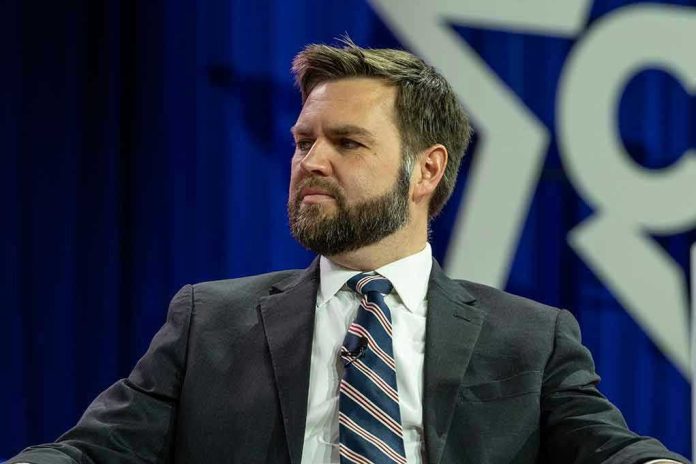
Vice President JD Vance’s Holocaust Remembrance Day post sparked bipartisan fury, but the controversy reveals more about historical memory standards than partisan gamesmanship.
Story Snapshot
- Vance issued a Holocaust remembrance statement on January 27, 2026, without mentioning Jews or Nazis
- Jewish groups across the political spectrum criticized the omission as insensitive erasure
- No evidence supports claims a Democratic governor orchestrated the backlash
- The controversy echoes a similar 2017 Trump administration statement that later received an apology
- Critics warn vague Holocaust references risk normalizing historical revisionism as survivors dwindle
What Actually Happened on Holocaust Remembrance Day
On January 27, 2026, Vice President JD Vance posted a Holocaust remembrance statement declaring “Today we remember the millions of lives lost during the Holocaust” alongside photos from his visit to Dachau. The statement conspicuously avoided naming the six million Jewish victims or the Nazi perpetrators who murdered them. This omission, though seemingly minor, ignited immediate criticism from Jewish organizations spanning the political spectrum, including the conservative-leaning Tablet Magazine and the Jewish Democratic Council of America. Unlike other administration officials like Marco Rubio and the White House, who issued statements specifically mentioning Jewish victims, Vance’s generic language stood out starkly.
The Missing Democratic Governor Plot
Despite headlines suggesting Minnesota Governor Tim Walz orchestrated an attack on Vance, credible sources reveal no such coordination. Walz did make news in early January 2026 by comparing children hiding from ICE raids to Anne Frank, a comparison that drew its own criticism from Trump administration figures. However, this separate controversy preceded Vance’s Holocaust post by weeks. No reporting connects Walz to framing Vance’s statement as antisemitic. The criticism came organically from Jewish commentators, media outlets, and advocacy groups responding to what they perceived as historical erasure, not from a calculated Democratic operation.
Why Specificity Matters in Holocaust Remembrance
International Holocaust Remembrance Day commemorates the January 27, 1945, liberation of Auschwitz. As Holocaust survivors age and their numbers dwindle, precise language becomes crucial for combating denialism and educating new generations. The Jerusalem Post emphasized that statements must specify Nazi Germany’s systematic murder of six million Jews to counter rising antisemitism and conspiracy theories spreading through conservative circles. Figures like Candace Owens and Nick Fuentes have pushed antisemitic narratives within right-wing spaces, making clarity from leadership essential. Vague remembrances that obscure who died and who killed them inadvertently provide cover for those seeking to minimize or distort the Holocaust’s reality.
Echoes of Past Controversies
Vance’s omission mirrored a 2017 Trump administration Holocaust Remembrance Day statement that similarly failed to mention Jewish victims. That earlier incident drew criticism from Holocaust scholar Deborah Lipstadt, who called such omissions disturbingly revisionist. The Trump administration eventually apologized and corrected course. Vance’s statement, however, received no such correction or apology despite comparable backlash. The Jewish Democratic Council of America’s Halie Soifer noted that “it takes effort” to leave Jews out of Holocaust remembrance, suggesting deliberate choice rather than oversight. Ron Kampeas, writing on Substack, contrasted Vance’s “erasure” unfavorably even with Walz’s controversial Anne Frank comparison, calling Vance’s approach malicious given his nationalist political positioning.
The Broader Stakes for Historical Memory
The controversy extends beyond one post to fundamental questions about how America remembers atrocities. With antisemitism at record highs globally and conspiracy theories proliferating online, Jewish communities across political lines demand leaders demonstrate understanding of why the Holocaust happened and to whom. Vance’s previous reluctance to condemn antisemitic rhetoric in conservative spaces, including failing to challenge an antisemitic question from a student and suggesting immigration restrictions could fight antisemitism, amplified concerns about his latest statement. The bipartisan nature of the criticism, from conservative Jewish outlets to progressive groups, reveals genuine anxiety about whether political leaders grasp the stakes of Holocaust education versus partisan point-scoring.
The facts refute claims of a Democratic setup while confirming legitimate concerns from Jewish Americans about how their history gets remembered. When a sitting vice president visits Dachau but cannot name who died there or who killed them, it signals either troubling ignorance or calculated ambiguity. Neither interpretation inspires confidence in an era demanding moral clarity against rising hate.
Sources:
Jerusalem Post – Opinion Article
Jerusalem Post – Diaspora Antisemitism Coverage
Middle East Monitor – US Vice President Criticised for Neutral Holocaust Message
Ron Kampeas Substack – JD Vance and Tim Walz Analysis