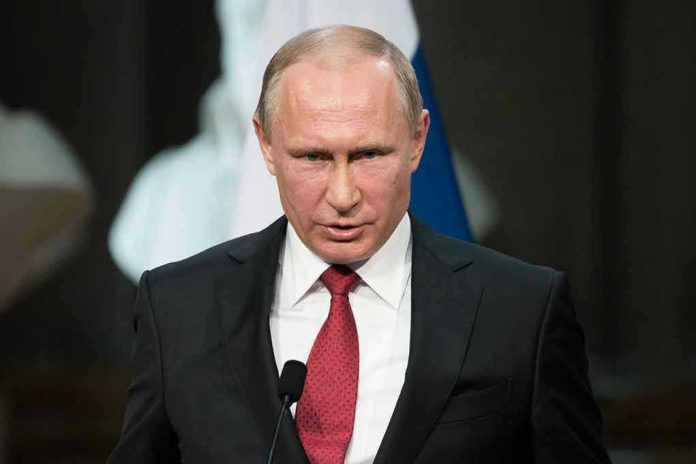
Vladimir Putin has driven Russia into a catastrophic spiral of nearly 1.2 million military casualties, economic decay, and international isolation—yet he calculates that stopping the war would destroy his regime faster than continuing it.
Story Snapshot
- Russia has suffered nearly 1.2 million casualties since February 2022, exceeding any major power’s losses since World War II, while gaining less than 1.5 percent of Ukrainian territory since 2024.
- Russia’s economy contracted through most of 2025, with growth slowing to 0.6 percent while defense spending consumed 40 percent of the national budget and interest rates peaked at 21 percent.
- Ukraine has accumulated $1.7 trillion in economic losses—three times its prewar GDP—with reconstruction costs estimated at $588 billion over the next decade.
- Putin views withdrawal as politically more costly than continuation, fearing regime collapse outweighs the unsustainable military and economic bleeding.
- Experts project Russia could reach 2 million total casualties by spring 2026, cementing its decline from major power status to a second or third-rate nation.
The Bloodiest Gamble Since World War II
Russia’s invasion of Ukraine on February 24, 2022, has produced casualty figures unmatched by any major power since 1945. The Center for Strategic and International Studies confirms nearly 1.2 million Russian military casualties, including an estimated 325,000 killed. The failed Kyiv blitz in early 2022 collapsed into an attritional grind through Donbas, where Russia trades thousands of lives for incremental territorial slivers. The Soviet war in Afghanistan from 1979 to 1989 cost 15,000 Soviet lives over a decade. Putin has exceeded that toll seventy-fold in four years, yet territorial gains amount to less than 1.5 percent of Ukraine since 2024.
An Economy Cannibalizing Itself
Russia’s economy entered a state of controlled demolition throughout 2025. Manufacturing contracted for seven to ten consecutive months as labor shortages intensified and civilian production shifted to military hardware. Russia’s Central Bank hiked interest rates to 21 percent to combat inflation fueled by defense spending, which ballooned to 40 to 50 percent of the national budget. Economic growth decelerated to 0.6 percent in 2025, with projections of 0.8 percent in 2026. Civilian automobile factories now produce tanks instead of cars. The war economy sustains employment but produces no durable assets, cannibalizing productivity for short-term survival.
The Sunk Cost Trap Tightens
Putin’s calculus hinges on a grim equation: stopping now would expose the catastrophic waste of blood and treasure, potentially triggering regime collapse. Withdrawal would spotlight the futility of 1.2 million casualties for negligible gains, undermining the propaganda narrative that has sustained domestic support. Analysts note Putin prioritizes regime survival above economic rationality. The Dmitriev package proposed in February 2026 dangled $14 trillion in economic reintegration as a peace incentive, but experts at War on the Rocks dismissed it as unsustainable fantasy. Putin fears admitting defeat more than enduring deficits that triple predictions and oil revenues lagging below breakeven.
Ukraine Bears the Heavier Cross
Ukraine’s losses dwarf even Russia’s self-inflicted wounds in absolute terms. The Kyiv School of Economics calculates $1.7 trillion in cumulative economic damage, including $696 billion in trade losses and $646 billion in industrial devastation. Housing damage alone tops $26.8 billion, while demining costs reach $24.6 billion. Reconstruction estimates from Euronews place the bill at $588 billion over a decade, concentrated in energy, transportation, and manufacturing sectors. Ukraine’s prewar GDP was approximately $567 billion, meaning the war has erased value equivalent to three times the nation’s entire economy. This dwarfs the Marshall Plan in relative scale, yet Western aid remains fragmented and insufficient to reverse the destruction.
The Global Ripple Effect No One Escapes
The war radiates consequences far beyond Eastern Europe. The International Monetary Fund documents compounded inflation and food insecurity as grain exports from Ukraine—a global breadbasket—remain disrupted. Energy markets remain volatile as Western sanctions redirected Russian oil to Asian markets, particularly India, reducing but not eliminating revenues. Russia’s pivot to Asia diminishes Western economic leverage while prolonging Moscow’s ability to fund the war through sanctions evasion. Global poverty rates climbed as food prices spiked, hitting the poorest nations hardest. NATO faces sustained strain as Eastern European members demand increased defense commitments.
The Descent into Second-Rate Status
Russia’s trajectory points unmistakably toward diminished power status. Defense analysts project casualty totals could reach 2 million by spring 2026, eclipsing even Soviet World War II losses in some estimates relative to force size. The demographic toll compounds as working-age men disappear from the labor force. Returning veterans bring trauma and violence, with crime rates already climbing in Russian cities. Technological isolation deepens as Western sanctions block access to advanced semiconductors and manufacturing equipment. Russia’s trade surplus offers superficial stability, but experts emphasize the economy produces nothing of lasting value, merely converting reserves into wreckage. No path to reintegration exists without regime change.
Why Rationality Looks Like Madness
Putin’s persistence defies conventional cost-benefit analysis yet follows autocratic logic. Admitting failure would validate Western predictions, embolden domestic opposition, and potentially trigger elite defection. The war economy distributes patronage through military contracts, binding oligarchs and regional governors to the conflict’s continuation. Stopping would expose the emperor’s nakedness: minimal territorial gains, a gutted economy, and generational losses for nothing. Putin calculates that grinding forward preserves the illusion of strength, however thin, while retreat guarantees political death. This makes continuation rational within his warped framework, even as it dooms Russia to decades of stagnation and isolation. The tragedy is not irrationality but the cold logic of a dictator prioritizing personal survival over national welfare.
Sources:
Russia’s Grinding War in Ukraine – CSIS
Four years on: The staggering economic toll of Russia’s war in Ukraine – Euronews
The Long-Lasting Economic Shock of War – IMF
Bailing Out Russia for Peace Is a Losing Proposition – War on the Rocks
Russia Economy Low Growth – GIS Reports
Ukraine’s war losses hit $1.7 trillion, three times its prewar GDP – Euromaidan Press