
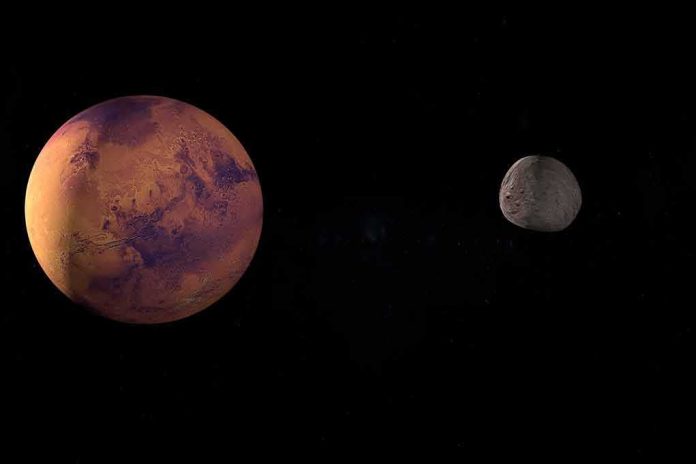
NASA’s Curiosity rover has uncovered the largest organic molecules ever detected on Mars, raising profound questions about whether ancient life once thrived on the Red Planet while billions in taxpayer dollars fund missions that still can’t provide definitive answers.
Story Snapshot
- Curiosity rover detected decane, undecane, and dodecane—the longest carbon-chain molecules ever found on Mars—in ancient mudstone from a 3.5-billion-year-old lakebed
- These molecules are potential fragments of fatty acids, fundamental building blocks of life on Earth, though scientists cannot rule out non-biological origins
- The discovery comes from reanalysis of a 2013 rock sample, published in February 2026 after years of laboratory work
- NASA scientists acknowledge the findings prove Mars could preserve chemical signatures of past life, but stop short of confirming any biological activity existed
Discovery Reveals Complex Chemistry in Ancient Martian Lake
NASA’s Curiosity rover detected decane, undecane, and dodecane molecules in pulverized mudstone from Gale Crater’s Yellowknife Bay region. These long-chain hydrocarbons contain 10, 11, and 12 carbon atoms respectively, surpassing all previous organic discoveries on Mars. The Cumberland mudstone sample, drilled in 2013 from what scientists believe was an ancient lakebed, underwent reanalysis revealing these complex molecules only after extensive laboratory examination. Lead author Caroline Freissinet from France’s CNRS research center confirmed the molecules represent potential fatty acid fragments, compounds essential to life chemistry on Earth.
Decade-Long Analysis Raises More Questions Than Answers
The rover collected the Cumberland sample over a decade ago, yet NASA scientists needed until 2026 to confirm these findings through the Sample Analysis at Mars instrument. Daniel Glavin from NASA Goddard stated that liquid water in the ancient crater enabled “life-forming chemistry,” though researchers remain unable to determine whether biological processes actually produced these molecules. A follow-up study published simultaneously acknowledged that non-biological sources like meteorites cannot fully explain the abundance detected. This ambiguity persists despite the massive investment in Mars exploration, leaving taxpayers funding missions that deliver intriguing hints rather than conclusive evidence about life beyond Earth.
Implications for Future Mars Missions and Funding
The discovery validates preservation potential in Martian mudstone, bolstering NASA’s case for continued exploration including the roughly $11 billion Mars sample return mission. Freissinet emphasized the findings prove scientists “could detect chemical signatures of past life, if it ever existed,” essentially confirming the technology works while admitting ignorance about what actually happened on Mars billions of years ago. The results fuel both scientific optimism about finding biosignatures and public frustration with space agency budgets that consume billions without delivering definitive answers. Private sector entities like SpaceX now leverage NASA’s research to advance commercial Mars plans, raising questions about whether government-funded discoveries primarily benefit corporate interests rather than providing clear returns to American citizens who finance these expeditions.
Mars’ harsh surface conditions degrade organic molecules through radiation, oxidants, and perchlorates, making any organic detection significant regardless of origin. The Gale Crater environment preserved these complex molecules for billions of years, suggesting similar preservation could exist elsewhere on Mars. Scientists acknowledge fatty acids can form through non-biological processes, though on Earth they predominantly link to living organisms. This uncertainty underscores the fundamental challenge facing astrobiology: detecting organic chemistry does not equate to detecting life, leaving the central question unanswered despite decades of exploration and technological advancement in analyzing Martian geology.
Sources:
NASA’s Curiosity Rover Detects Largest Organic Molecules Found on Mars
NASA Study: Non-Biologic Processes Don’t Fully Explain Mars Organics
Curiosity Rover Detects Long-Chain Carbon Molecules on Mars
ScienceDaily: Curiosity Rover Discovery