
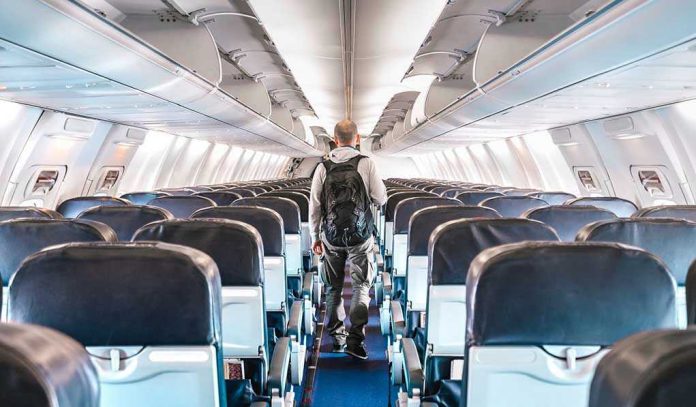
A United Airlines pilot reported striking a drone at 3,000 feet over San Diego in controlled airspace—seven times higher than federal regulations allow—exposing a dangerous gap in enforcement that puts commercial aviation and American lives at risk.
Story Snapshot
- United Flight 1980 pilot reports hitting small red drone at 3,000-4,000 feet during San Diego approach on April 29, 2026
- Federal law limits drones to 400 feet without authorization, raising questions about regulatory enforcement
- FAA and United downplay incident as “potential encounter” despite pilot’s direct “we hit a drone” statement
- No damage found after inspection; plane cleared for next flight with 48 passengers and 6 crew safe
- Drones now involved in two-thirds of near-collisions at major U.S. airports, with over 100 monthly reports to FAA
Pilot’s Account Conflicts With Official Statements
United Airlines Flight 1980 landed safely at San Diego International Airport at 8:28 a.m. PDT on April 29 after the pilot reported a midair encounter during approach. Air traffic control audio captured the pilot stating clearly, “We hit a drone… red, shiny, small,” describing the object at approximately 3,000 to 4,000 feet altitude. The Boeing 737 carried 48 passengers and 6 crew members from San Francisco with no injuries reported. After landing, the pilot coordinated with ground control to document the incident for federal investigators.
Federal Agencies Hedge on Strike Confirmation
The FAA investigation produced contradictory messaging that raises questions about regulatory transparency. Officials stated the crew “believed they saw a drone 1,000 feet below” the aircraft at around 4,000 feet, notably softening the pilot’s direct strike report. United Airlines similarly issued cautious language, confirming only a “potential drone encounter” with “no damage” found during post-flight inspection. The aircraft departed for Houston at 10:16 a.m. after maintenance clearance. No other pilots reported sightings despite air traffic control alerts, and the drone operator remains unidentified—a pattern that suggests inadequate tracking of unauthorized flights in restricted zones.
Altitude Violation Exposes Enforcement Failures
Federal regulations limit recreational and commercial drones to 400 feet altitude without special FAA waivers, and strictly prohibit operations in airport airspace without authorization. San Diego International Airport operates in Class B controlled airspace, handling approximately 20 million passengers annually with tightly managed flight paths. A drone operating at 3,000 feet in this zone represents a sevenfold violation of altitude limits and a direct intrusion into commercial approach corridors. Aviation experts online questioned whether consumer-grade hardware could even reach such heights, suggesting either sophisticated equipment or deliberate regulatory defiance. The FAA’s failure to identify the operator after a reported strike in one of America’s busiest airspaces underscores the limitations of current enforcement mechanisms.
Surge in Drone Incidents Threatens Aviation Safety
Drone near-misses have escalated dramatically since the COVID-19 pandemic. An Associated Press analysis of NASA’s Aviation Safety Reporting System revealed drones accounted for approximately two-thirds of near-collisions at the top 30 U.S. airports in 2024, the highest proportion since 2020. Over the past decade, 122 of 240 reported near-misses involved drones, with the FAA now receiving over 100 monthly airport-related drone reports. Confirmed strikes remain rare—only seven globally by 2018—but incidents like January 2025’s catastrophic midair collision in Washington, D.C., which killed 67 people, demonstrate the deadly potential of congested airspace. Recent disruptions at John Wayne Airport and Dubai following drone encounters illustrate the broader vulnerability of commercial aviation to unauthorized unmanned aircraft.
Government Inaction Leaves Travelers Exposed
The discrepancy between the pilot’s firsthand account and federal agencies’ equivocating language reflects a troubling pattern: bureaucrats minimizing threats rather than confronting enforcement gaps that endanger the flying public. With over one million drones now operating in U.S. airspace and technology enabling higher altitudes and longer ranges, the 400-foot rule and airport exclusion zones mean little without detection systems and penalties that deter violations. The FAA’s inability to identify this San Diego operator—despite a reported strike in controlled airspace with full ATC coordination—suggests the agency lacks the tools or political will to protect commercial flights. Americans boarding planes deserve assurance that regulators are aggressively policing airspace, not issuing vague statements while investigations stall and operators vanish without consequence.
Sources:
United Airlines flight reportedly hits drone at 3,000 feet over San Diego – Washington Times
United pilot reports midair drone scare during airport landing approach – Fox Business
United Airlines pilot reports possible drone strike over San Diego – Los Angeles Times
United Airlines flight hits drone over San Diego, viral ATC clip captures pilot reaction – Times Now