
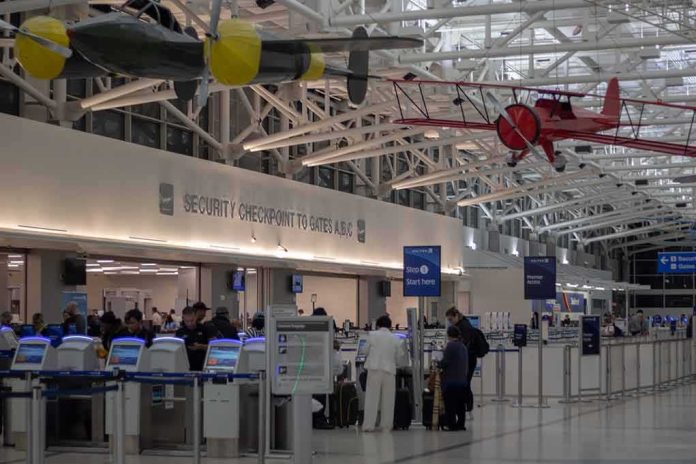
A drone and missile barrage ripped into Kuwait’s main airport amid a so-called ceasefire, killing at least one person, injuring dozens, and forcing flight suspensions—while the facts now battling for daylight could decide whether this was a one-night scare or the start of a colder, longer war.[3]
Story Snapshot
- Kuwait’s government condemned strikes that hit Kuwait International Airport and attributed the attack to Iran.[3]
- Reports describe one dead, many injured, fires, and air-traffic suspensions; the exact casualty count remains unsettled.[3][4]
- Coverage places the airport hit inside a wider wave of regional launches and interceptions, muddling early details.[2][3][6]
- Claims of a ceasefire breach lack a public, verifiable agreement text to test violation specifics.[2][3]
What Happened And What We Can Actually Verify
Kuwait’s foreign ministry publicly condemned attacks that struck vital civilian infrastructure, including Kuwait International Airport, and linked the incident to Iranian operations. The ministry cited one death and several injuries, and authorities suspended air traffic and diverted flights during the emergency response.[3] Broadcast reporting and live segments described drones and missiles launched toward Kuwait and Bahrain, with footage of fires and damage at the airport and references to disrupted operations.[2][6] One outlet reported a large fire at the airport after an Iranian drone hit, but did not confirm casualties tied to that specific blast.[4]
Airline operations data points align with a real disruption. Reports referenced Kuwait Airways resuming flights from an unaffected terminal after assessments, which suggests significant but localized damage rather than wholesale destruction.[3] That matters for truth in labeling: “destroyed terminal” sells fear, but the public record supports fire, damage, and closures—not incontrovertible terminal destruction.[3][4] The strongest facts are the government condemnation, emergency actions, visible damage, and at least one fatality reported by Kuwait. Everything further requires careful sorting of who said what and when.
The Ceasefire Claim And The Burden Of Proof
Headlines shouted breach of a ceasefire, yet no outlet provided the text, parties, or operative clauses of any binding ceasefire to evaluate whether this airport strike violated a specific rule. Reports called the truce “fragile” or “shaky” while acknowledging ongoing hostilities.[2][3] Readers should separate moral outrage from legal precision. If policymakers want American support for escalatory steps, they should release the agreement’s terms and a timeline showing how this strike contravened them. Common sense and conservative prudence say: show the paper, then make the case.
The casualty dispute spotlights why verification beats virality. Kuwait’s statement cited one dead and multiple wounded, while other coverage focused on fires, damage, and suspended operations without confirming fatalities tied to the terminal blast.[3][4] Conflicting tallies are typical in first-wave wartime reporting. The right remedy is documentation—hospital admissions, civil defense logs, and official injury lists—not louder anchors. Until then, responsible readers treat numbers as provisional and focus on what authorities have put on record.[3]
Attribution, Escalation, And The Risk Of Narrative Spillover
Several reports fold the Kuwait strike into a wider night of launches, claimed targets, and interceptions stretching across the Gulf. That narrative bundling blurs which munition hit which structure. Some broadcasts said Iran launched drones and missiles toward Kuwait and Bahrain; others discussed purported strikes on United States assets and contested impacts.[2][3][6] The Kuwait airport incident may be part of that pattern, but accurate attribution requires debris analysis, radar tracks, and chain-of-custody reports—none of which appear in the public record provided here.[2][3][4][6]
An Iranian drone and missile strike heavily damaged Terminal 1 at Kuwait International Airport on Wednesday, June 3, 2026, killing one person and wounding at least 63 others, according to Kuwait’s Ministry of Health. #nigeria24 https://t.co/6fRo4uhYvz pic.twitter.com/RhTTCoIB0M
— NIGERIA 24 (@Nigeria24live) June 3, 2026
The conservative reading of limited facts rejects spin from all sides. Civilian air hubs are not legitimate targets; if Iran directed a strike that hit an airport terminal, that crosses a bright line. Yet accusations must ride on evidence, not editorial drumbeats. Policymakers should insist on publishing radar plots, recovered fragment analyses, and photographs with verifiable geolocation. If the case is solid, sunlight will harden it; if weak, early exaggerations—like “destroyed terminal”—should be retired in favor of documented reality.[3][4]
What To Watch Next—And Why It Matters
Three disclosures would convert speculation into clarity. First, the release of Kuwait’s incident reports: fire brigade records, terminal damage assessments, and airspace closure notices would lock down what got hit, when, and how long it took to restore operations. Second, a forensic packet tying recovered debris to specific Iranian systems would settle authorship claims. Third, publication of any ceasefire terms would answer whether this was not just immoral, but illegal under a signed framework.[2][3][4][6]
Sources:
[2] YouTube – Iranian Drones, Missiles Hits Kuwait Airport, Several …
[3] YouTube – Kuwait airport hit by Iranian drones as US and Iran trade fire
[4] Web – Kuwait says one killed in Iranian missile, drone attack
[6] YouTube – One Dead After Drone Attack on Kuwait Airport