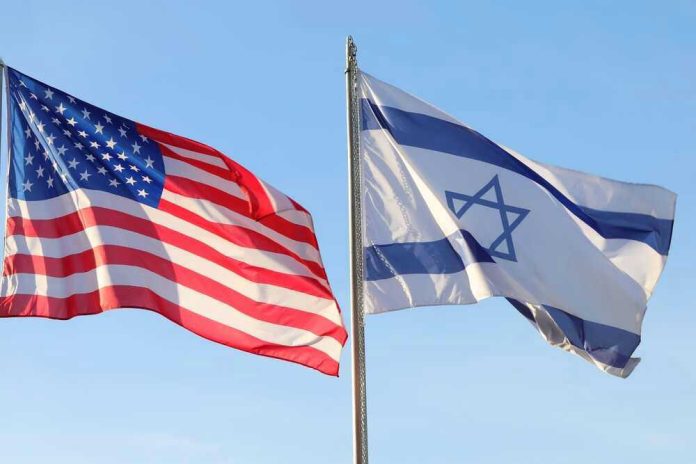
Benjamin Netanyahu and JD Vance are not just arguing about allies; they are exposing how fragile Israel’s place in the world really looks when the American security umbrella starts to wobble.
Story Snapshot
- Netanyahu insists Israel has “many, many friends” and no greater ally than America.
- JD Vance says Trump is Israel’s “only powerful ally left” and backs it with hard numbers.
- The U.S.–Israel alliance is deep, decades old, and now openly strained on Iran and aid.
- Behind the sound bites is a fight over dependence, credibility, and conservative realism.
How Netanyahu And Vance Ended Up In A Public Clash Over Israel’s Friends
Benjamin Netanyahu did not pick this fight out of thin air. For years he has framed the United States as Israel’s closest partner, praising an “enduring alliance” and saying America has “no greater ally than Israel” and Israel has “no better ally than America.” Official records show him boasting of extensive strategic, political, and military cooperation with Washington: aid, intelligence sharing, and joint exercises that go back decades. Yet when JD Vance warned that Donald Trump is Israel’s “only powerful ally,” Netanyahu snapped back, claiming Israel has “many, many friends” and huge support from countries like India. That pushback sounded less like diplomacy and more like a leader refusing to admit how much his country still leans on one superpower when missiles start flying.
JD Vance, speaking as a conservative vice president, did something rare in modern politics: he told an ally to “wake up and smell reality.” In a widely covered interview, he argued that Trump is “the only head of state in the entire world who is sympathetic to the nation of Israel at this moment in time.” He went further and warned Israeli officials who attacked Trump over the Iran deal that they were attacking “the only powerful ally… left in the entire world.” Vance backed his warning with a concrete fact: he said about two-thirds of Israel’s defensive weapons used in the past three months were built by American workers and paid for by American taxpayers. That is not just rhetoric. It is a blunt reminder that when Israel intercepts rockets, much of the hardware and money comes from the United States.
The U.S.–Israel Alliance Is Deep, Asymmetrical, And Politically Charged
Serious research backs up both the depth and the imbalance Vance is pointing to. Analysts put American military funding for Israel at about $3.3 billion a year, plus another $500 million for missile defense. A 2016 memorandum of understanding locked in $38 billion of military assistance over ten years. The United States is Israel’s largest trading partner, with nearly $50 billion in annual trade. The two countries share intelligence on terrorism and nuclear threats, run joint military exercises, and co-develop systems like the Arrow missile defense. In simple terms, the U.S.–Israel alliance is not symbolic. It is hardware, cash, data, and war plans. From a common-sense conservative view, if one country writes the checks, supplies the weapons, and covers you in international forums, you do not treat that relationship as optional.
At the same time, scholars describe this alliance as “asymmetrical.” The United States sets the broad strategic framework, and Israel operates within it. That means Washington holds more leverage, but Israel gives real value in return: intelligence, regional reach, and battlefield experience that has shaped American counterterrorism doctrine. Conservatives who care about American interests can reasonably say the alliance is a two-way street, yet still recognize that Israel’s survival is more tied to U.S. support than the other way around. This is exactly the tension you hear between Netanyahu’s flattery and Vance’s warning: both admit the bond, but only Vance is willing to call it dependence.
Netanyahu’s Drive For Independence And The Problem Of “Many Friends”
Netanyahu has quietly told a different story when cameras are not focused on this feud. During recent negotiations that sidelined Israel, he argued Israel needs to “free ourselves of dependence on U.S. arms.” He has reportedly pledged to end American military aid over the next decade and push a model based more on joint technology projects than direct subsidies. That ambition fits a conservative desire for self-reliance and less foreign aid pressure. But it also suggests he knows Vance is not wrong about current dependence. You do not promise to wean your country off U.S. assistance unless you know the lifeline is both real and politically vulnerable.
"I get a lot of support from 1.4 billion people of India."
– Israeli PM Netanyahu on US VP JD Vance comments that US is the last country that supports Israel now
— Bharatheeyam 🚩🪷✨🪷🚩(Modi Ka Parivar)✨ (@Bharatheeyam9) July 5, 2026
So where do Netanyahu’s “many, many friends” come in? Public discussion of Israel’s allies often names the United States and India as the two meaningful partners, with others like the United Kingdom, Germany, and some smaller nations listed as close but less decisive friends. Social media clips of Netanyahu lean heavily on India’s 1.4 billion people as a cheering section, not on formal defense treaties or billions in hard aid. When he boasts of support from India, he is mostly talking about public sympathy and political warmth, not anything that replaces American missile stocks or air defense systems. That makes his reply to Vance feel more like a crowd-pleasing line than a hard security fact, especially after some Arab and Gulf states accused Israel of “barbarism” over recent strikes and voiced anger at its war conduct.
The Bigger Pattern: Liquid Alliances And Conservative Reality Checks
Political scientists studying the Middle East describe a world of “liquid alliances,” where countries pivot fast and build short-term coalitions instead of deep, stable partnerships. Since the Arab uprisings, states have chased regime survival, playing Washington, Moscow, Beijing, and regional rivals against each other. American focus has shifted toward the Indo-Pacific, pushing allies like Saudi Arabia and the United Arab Emirates to diversify ties with China and Russia while still taking U.S. security help. Israel is not immune to this pattern. It wants to show it has options beyond the United States, especially as Washington debates aid and as domestic critics question the cost of the relationship.
From a conservative American viewpoint, Vance’s message lines up with both the numbers and basic common sense. The United States shoulders the bulk of Israel’s hard security support today. Its taxpayers pay for much of the defensive shield. Its leaders take the diplomatic hits when Israel’s wars grow ugly in global opinion. Netanyahu’s claim about “many, many friends” reflects the reality that Israel has pockets of sympathy and some growing ties, especially with India. But sympathy does not replace missile stockpiles, and tweets do not replace treaties. When the shooting starts, only a few capitals matter. Right now, Vance is correct to say most of those key decisions still run through Washington and Trump’s White House.
Sources:
mediaite.com, en.wikipedia.org, facebook.com, state.gov, notus.org, axios.com, sajr.co.za, tandfonline.com