
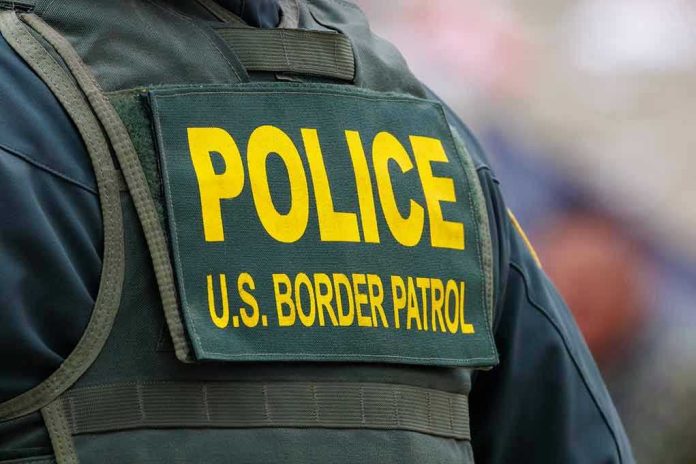
A six-year-old girl is dead because a driver blew a stop sign at high speed, and the case now spotlights repeated failures to keep a previously deported offender off America’s roads.
Story Snapshot
- Reports say the driver had been deported three times before the crash.
- The collision killed 6-year-old Calli Toler in North Carolina; her mom and 4-year-old brother were badly hurt.
- Social posts claim immigration officers placed a detainer on the suspect after the wreck.
- Key claims rely on partisan and social sources while official records remain out of public view.
A fatal stop-sign run and a family shattered
Witness accounts and partisan outlets describe a driver tearing through a stop sign and smashing into a family car. The crash killed 6-year-old Calli Toler and seriously injured her mother and 4-year-old brother in North Carolina. The reporting names no verified official crash report, but it aligns on core facts: a stop-sign violation and deadly speed that ended a child’s life. Those details set the moral stakes. A stop sign is a promise. Breaking it breaks people.
Social posts and a partisan site claim the driver is an illegal immigrant who had been deported three times. A local Facebook page focused on crime echoed the same point and added that immigration officials placed a detainer on the suspect after the wreck. If accurate, that means multiple bites at the apple for enforcement and a final miss with the worst outcome. The facts that can be checked right now are thin on government paper, which heightens public anger.
What we know, what we do not, and why that matters
Several claims lack official confirmation that would remove doubt. No public police crash report is cited. No Immigration and Customs Enforcement record has been released with the suspect’s identity, dates, or legal basis for the three deportations. Without that, the public sees a pattern they fear, but they cannot audit the timeline or the decisions that let the driver stay on the road. Demands for the crash report, immigration court filings, and the detainer file are not nitpicks; they are how a community learns and fixes holes.
Claims that the suspect ran a stop sign at high speed fit the horror of the outcome. Still, immigration status does not explain speed choice. That is not a shield for the driver; it is a guard against lazy reasoning. If the suspect reentered after removal, that is a separate, serious offense. But the proximate cause is a driving decision. Conservative common sense keeps both ideas in hand at once: enforce the border and the traffic laws, and release records so the public can see where the system failed.
The broader pattern and the policy fight it fuels
High-profile crashes linked to undocumented drivers often begin in partisan outlets and social feeds and may take months, if ever, to gain official confirmation. This case follows that script. It also slots into a larger policy fight over whether current choices reduce or raise roadway risk. One recent paper argues that allowing driver’s licenses for undocumented immigrants increases fatal crashes by about five percent, driven by risk behavior, not traffic volume. Another research review finds license access can cut fatal hit-and-runs even if total fatalities do not change.
Zoom out one more notch. A policy brief from a libertarian think tank found no statistical link between higher illegal immigrant population shares and drunk driving deaths across states and big cities. That does not wash away personal blame; it reminds us that anecdotes are not the same as rates. The lesson is simple and hard: judge this crash on facts, fix the specific gaps it exposes, and do not let either side use a child’s death to sell easy answers that skip evidence.
Accountability steps that respect facts and families
Local officials should release the crash report with speed estimates and a clear narrative as soon as legally allowed. Immigration authorities should confirm the detainer and the suspect’s prior removal history, including dates and legal grounds. Prosecutors should state the charges and whether they will seek detention without bond. Those are basic moves that honor victims, deter rumor, and let voters see what went wrong and where enforcement broke down. Transparency is not a courtesy; it is the job.
Public safety improves when consequences are swift and predictable. If the suspect reentered after prior removals, charge that. If the stop-sign run involved impairment, charge that. If the driver had no license or insurance, charge that. The goal is simple: no next time. North Carolina owes that to Calli’s mother and brother. The nation does too. A child’s burial should never be the first time the system finds its voice.
Sources:
foxnews.com, thegatewaypundit.com, instagram.com, justice.gov, cbc.ca, thepolicyscientist.com