
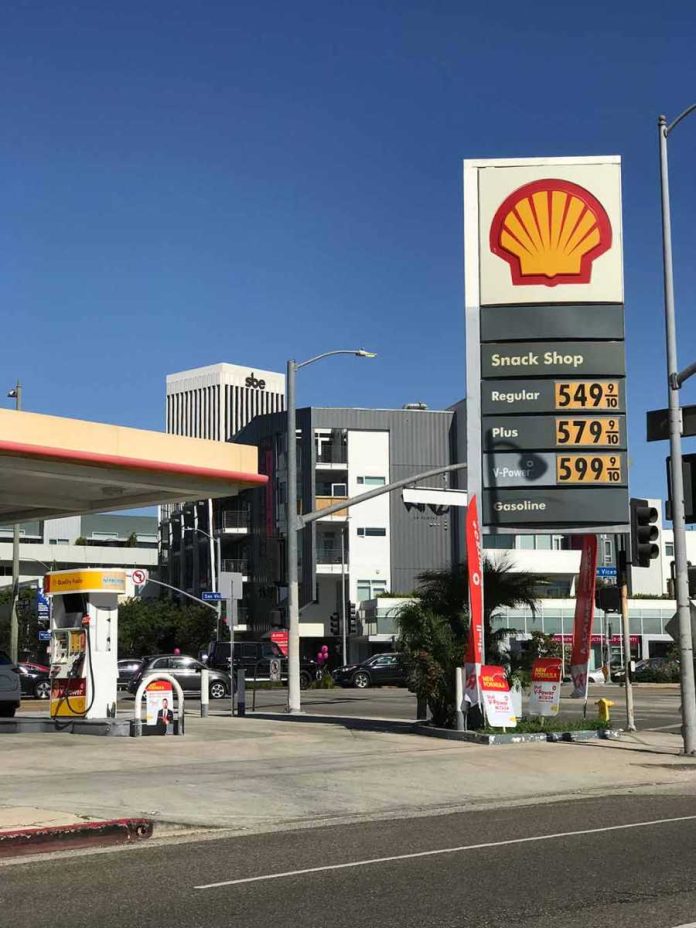
Gas at $4 a gallon is not just a headache at the pump; it is the visible price of a shooting war colliding with fragile energy math.
Story Snapshot
- National average gas prices have jumped back to about $4 a gallon as attacks fly between the United States and Iran.
- Traffic through the Strait of Hormuz, the world’s key oil chokepoint, has slowed to a trickle, choking supply and feeding fear.
- Brent crude oil is near $90 a barrel, and families have spent hundreds more on fuel since the war began.
- Some data shows prices dipped earlier in the month, raising sharp questions about media narratives and market games.
Gas hits $4 again as war headlines turn into wallet pain
On July 20, the average United States gas price pushed back to roughly $4 a gallon, according to national motor club data and wire reports. That number is not abstract. It means a typical household has shelled out hundreds more on gas and travel since late winter, while wages mostly stand still and the grocery bill is already ugly. Gas had flirted with $4 earlier in the year, but this new jump rides directly on the latest round of United States and Iranian strikes.
Major outlets agree on the core facts: gas is back near $4, this is the highest territory since 2022, and it is happening as the Iran war heats up. Reporters cite American Automobile Association data showing national averages just above the threshold, with some stories noting a roughly $1 rise since late February. That is real money, and for older readers who remember the 1970s, it feels like déjà vu with smartphones and streaming added.
The Strait of Hormuz choke point and why it matters so much
The Strait of Hormuz is a narrow waterway off Iran and Oman, but it carries about one fifth of the world’s oil exports each day. Tankers from Saudi Arabia, Iraq, Kuwait, and other Gulf producers sail through it to reach global refineries. Foreign and American energy analysts warn that when that flow slows, prices do not just rise; markets panic. Recent reporting describes tanker traffic dropping to a “single-digit trickle” amid drone strikes, tower attacks, and mutual bombardment.
United States Central Command released footage showing an Iranian surveillance tower destroyed along the Strait, proof that this is now an active military zone. Time-lapse tracking shows ship crossings plunging after July strikes, backing the story that real barrels, not just fears, are being held back. For a conservative reader who values strong defense but also cheap energy, this is where the trade-offs get stark. Every missile near Hormuz carries a price tag that shows up on the corner gas sign the next morning.
Oil futures, household budgets, and the new inflation squeeze
Brent crude, the global oil benchmark, moved toward or above $90 a barrel in recent days as the Iran crisis escalated. That rise flows through refineries, wholesalers, and finally to your local station. Some estimates say families spent hundreds extra on fuel in the months since the conflict kicked off, with analysts warning that companies are building these higher energy costs into prices for goods and travel well into next year. That means gas pain does not stay at the pump; it leaks into airline tickets, food packaging, and shipping fees.
This is where the inflation story returns with teeth. Bank chiefs and energy watchers warn that as long as conflict keeps a premium on oil, overall prices will stay stubborn. For many right-leaning Americans, the frustration is simple: the United States sits on huge domestic oil and gas reserves, yet families still get slammed by wars half a world away. When Washington leans on green talking points while relying on foreign barrels, it looks less like strategy and more like planning by wishful thinking.
Are prices really surging, or is the narrative doing some work?
The picture is not perfectly one-way. GasBuddy tracking cited in a Minnesota report showed United States national averages around $3.82 on July 20, down about 21 cents from a month before, even as local prices ticked up a few cents that week. That suggests volatility, not a smooth rocket ride higher. Some experts on financial news say “market fatigue” is keeping a lid on prices unless something truly catastrophic happens around Hormuz. In plain language, traders will not chase every headline forever.
The Strait of Hormuz story is beginning to move beyond a geopolitical headline.
Restricted tanker traffic is now being reflected in energy and rates. Oil and European gas are higher, bond yields are rising, and energy stocks are outperforming fuel-sensitive sectors.
The first…
— Data Over Noise (@DataOverNoise) July 20, 2026
Energy officials model a path where crude prices cool into late 2026 and 2027, even while acknowledging that Hormuz closure and production outages are major drivers right now. They also point to other forces: drone attacks on Russian refineries, older OPEC-plus supply cuts, and seasonal summer driving demand. This fuller picture fits basic common sense. Blaming one strait alone ignores the way bad policy, cartel games, and war all layer on top of each other to hit the working middle class first.
Media framing, conflict of interest, and what conservative common sense sees
Mainstream outlets from CBS and ABC to NBC and regional affiliates repeat a simple storyline: Iran war flares, Hormuz gets choked, gas goes up. That storyline is not false, but it is narrow. Oil companies and traders with big positions benefit when fear drives prices higher. They do not have to falsify data to enjoy that boom; they just have to let alarmist coverage roll. At the same time, government agencies may feel quiet pressure to stay close to the White House narrative.
For an American conservative, the core test is whether policies protect citizens from predictable shocks. History shows Middle East conflicts almost always spike oil prices, then settle when supply routes adjust or fears cool. The current war follows that script. The question is whether the United States finally builds a strategy that uses domestic energy strength, clear information, and honest debate to shield families, instead of asking them yet again to fund wars, bail out markets, and swallow higher prices as the “new normal.”
Sources:
washingtontimes.com, aljazeera.com, reuters.com, cnbc.com, news.un.org, en.wikipedia.org, usatoday.com, bloomberg.com, nytimes.com, x.com, britannica.com, eia.gov