
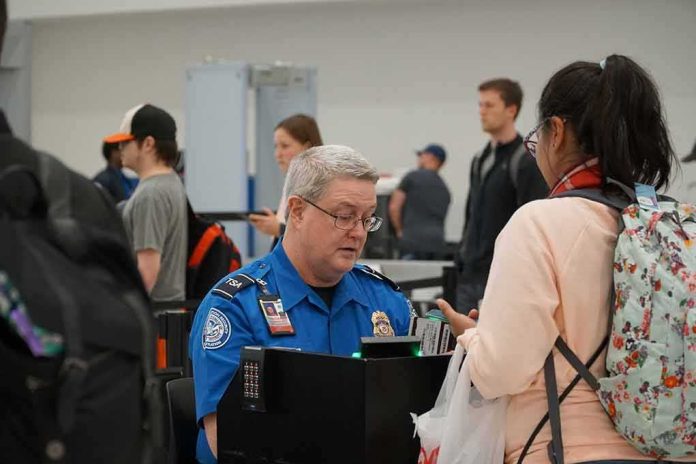
Airlines are pushing back because airport immigration arrests have moved from theory into the gate area.
Quick Take
- Airlines asked the Department of Homeland Security for clearer rules and safer arrest locations.
- Their main concern is operational safety, not a broad fight over immigration policy.
- Reporting says some arrests have happened at gates, jet bridges, and even on aircraft at the gate.
- DHS says airport enforcement is part of a broader crackdown on people in the country unlawfully.
Why Airlines Drew a Line at the Gate
Airlines are not objecting to law enforcement in the abstract. They are objecting to where officers show up. Reporting says industry leaders met with the Department of Homeland Security and asked that arrests happen before security screening, not in secure areas where passengers, crew, and ground staff are trying to keep flights moving.
That detail matters because airports run on timing. A single arrest near boarding can pull gate agents, ramp workers, and other passengers into a fast-moving situation. One CBS report said industry officials were worried about employees and travelers being caught in the middle, while a trade group said carriers wanted “proper procedures and protocols” to protect safety and security.
What the Reporting Says Is Happening
The reports describe a real shift in airport enforcement. The Wall Street Journal said immigration officers had made occasional airport arrests over the past year, then stepped up enforcement and used flight manifests to find travelers with lapsed visas. CBS reporting said arrests were happening in gate areas, sometimes on jet bridges, and in some cases on planes parked at the gate.
Those are not abstract locations. They are the most sensitive parts of the airport flow. Once a traveler reaches the gate, the airline has already moved into boarding, baggage handling, and departure timing. That is why even a lawful arrest can feel disruptive if it happens at the wrong moment.
The Case for DHS
DHS has a simple answer: these arrests are enforcement, not theater. Reporting says the department is targeting people it believes are in the country unlawfully, including travelers with expired visas or deportation orders. That makes the program look less like random airport dragnet work and more like a focused effort tied to passenger lists and immigration records.
The scale also gives DHS leverage. The reporting says airport arrests have risen sharply, with estimates ranging from a dozen to three dozen a day in recent periods. Reuters-linked reporting also described more than 800 arrests after Transportation Security Administration tips through February 2026. In other words, this is not a one-off flare-up. It is a working enforcement channel.
Why the Fight Is About Procedure, Not Just Politics
The most revealing part of the dispute is that both sides keep talking about process. Southwest said it follows state and federal law and wants proper legal documentation before law enforcement interactions in gate areas. Airlines for America said member carriers had constructive talks with Immigration and Customs Enforcement and the Transportation Security Administration to make sure any airport enforcement uses the right procedures.
🇺🇸🛫🛬✈️⚡️ — U.S. airlines are pushing back against increased Immigration enforcement at airports as #ICE expands arrests near gates, ticket counters, and jet bridges under pressure to meet a White House target of roughly 2,000 arrests per day, according to WSJ.
Some airlines,… pic.twitter.com/KddBBsQfxm
— Mahalaxmi Ramanathan (@MahalaxmiRaman) August 7, 2026
That is the heart of the story. Airlines are not trying to shut down federal enforcement. They are trying to keep it from spilling into the busiest, most fragile part of airport operations. DHS, for its part, is showing no sign it plans to leave the airport as a blind spot. The result is a clash between federal power and airline order, with passengers standing right in the middle.
What Is Still Missing
The public record still does not settle the biggest practical question: whether moving arrests before security would preserve enforcement without creating fewer disruptions. The reports quote airline concerns, but they do not give hard data on delays, injuries, or security breaches caused by airport arrests. They also do not show a court ruling that clearly settles the airport-location fight.
That gap keeps the debate alive. Without public incident logs or the full Transportation Security Administration-Immigration and Customs Enforcement agreement, both sides can claim common sense is on their side. Airlines can say gate arrests are unsafe. DHS can say airport arrests are lawful and targeted. For now, the evidence proves the confrontation is real, but it does not prove which side has the better operating model.
Sources:
cbsnews.com, wsj.com, aol.com, youtube.com, theguardian.com, facebook.com, cnn.com