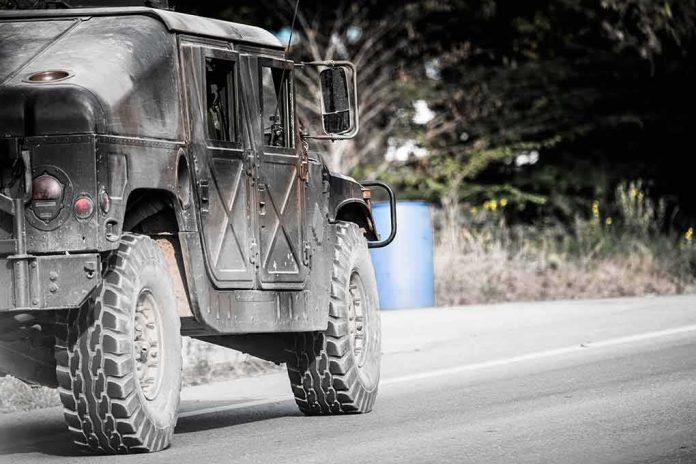
A signed Pentagon memo loans Homeland Security a military “heat ray” for seven months to test at the southern border—while putting DHS fully in charge of how, when, and whether it gets used next.
Story Snapshot
- The Defense Department authorized a seven-month loan of one Active Denial System to DHS.
- DHS, not the military, is responsible for operation and developing procedures.
- The authorization permits testing and tactics development; it is not a deployment order.
- The system creates intense heat sensation to push people back from a distance.
What The Hegseth Memo Actually Does
Defense Secretary Pete Hegseth signed a memorandum authorizing a temporary loan of one Active Denial System to the Department of Homeland Security for seven months beginning in September 2026, according to reporting that reviewed the document. The memo assigns the Department of Homeland Security responsibility to operate the system and to write the playbook for how to use it. The document states the device “shall not be operated by Department of War personnel,” placing the burden squarely on the civilian side.
The authorization frames a test window, not a green light to deploy to the line. The Department of Homeland Security can develop tactics and procedures during the loan and may ask for continued use after the period ends if it sees a need. Axios reported the memo does not itself mean field deployment along the border. It sets up an evaluation phase first. That distinction matters for policy, training, and accountability fights to come.
How The “Heat Ray” Works And Why DHS Wants It
The Active Denial System is a directed-energy tool that sends an invisible beam to the skin. The beam creates a strong burning sensation on the surface, which makes people instinctively move away. Reports describe a range of just over a half mile. Border officials see a possible crowd-control role where distance, terrain, and numbers make it hard to hold a line without close contact. The point is to push groups back while avoiding bullets, batons, and close-in force.
Supporters argue this kind of tool could lower injuries compared to hands-on confrontations. They want a way to stop large groups from rushing a gate, breaching a barrier, or overrunning a small team. They also want to spare agents from constant physical clashes. A long-range “move back now” effect sounds like common sense if it works as advertised. But the promise needs proof in real border conditions, not only in lab tests.
The Gaps: Safety Rules, Operators, And Where This Gets Used
The memo leaves key blanks. It does not name where tests will occur, who the trained operators are, or how supervisors will approve each activation. It points to the Department of Homeland Security to build the tactics and rules. That creates risk if the agency does not publish a clear use-of-force ladder, operator certification, and incident review steps that match the stakes of a powerful tool. Silence breeds suspicion faster than any beam ever could.
The Pentagon has lent DHS a military-grade “heat ray” to test for possible use at the U.S.-Mexico border. The military crowd-control weapon is designed to create an intense burning sensation that forces people to move out of its path.
According to a memo CNN obtained, Defense… pic.twitter.com/G8iS092qCW
— Straight Arrow (@StraightArrow__) October 22, 2026
Medical and collateral-risk questions remain. Critics cite past cases of second-degree burns during research and training. Physicians for Human Rights warned that extended exposure could threaten eyes and face, and that pain effects might cause panic near water or hazardous ground. If testing happens near rivers or canals, the plan must include strict standoff margins, wind checks, and rescue-ready teams. These concerns are not “gotchas”; they are solvable if owned up front.
Accountability And American Principles
Former Department of Homeland Security officials say a similar idea surfaced in 2018 and was rejected by then-Secretary Kirstjen Nielsen over concerns that it treated migrants and citizens like enemy combatants. That history will color today’s debate. The test should not drift into normalization without elected oversight. A conservative approach demands order at the border and also demands tight guardrails on power. Both can be true at once if leaders do the hard, public work.
Here is the pragmatic path that aligns with common sense. First, publish the signed authorization and annexes so the public knows the limits and the chain of command. Second, release the Department of Homeland Security tactics, training standards, and prohibited-target rules before any field test. Third, post independent medical thresholds and environmental cutoffs. Fourth, log every activation with body-camera corroboration and after-action reviews. A tool that promises fewer injuries must prove it in daylight, not in secrecy.
What To Watch Next
Watch for the Department of Homeland Security to name the test site and the unit in charge. Look for medical protocols tailored to border terrain and vulnerable people. Expect lawmakers to press on sovereignty questions if a beam could affect people still on Mexican soil. The seven-month clock lets leaders test claims against real-world results. If the Active Denial System cannot show better outcomes than current tools, it should go back to the warehouse and stay there.
Sources:
military.com, cnn.com, stripes.com, thedailybeast.com, axios.com