Two Democratic-led governments rushed to federal court to halt President Trump’s 250-foot memorial arch at Arlington’s gateway, claiming traffic chaos and legal violations—just as the administration signals work could start soon.
Story Snapshot
- Virginia and Washington, D.C. filed a 46-page lawsuit to block construction at Memorial Circle, citing safety and legal concerns.
- The complaint claims three years of work would choke a key bridge, hinder ambulances, and disrupt evacuation routes.
- Plaintiffs argue the project lacks required congressional authorization and bypasses environmental and historic laws.
- The White House says the arch honors service members and enhances visits to Arlington National Cemetery.
What Virginia and D.C. Told the Judge
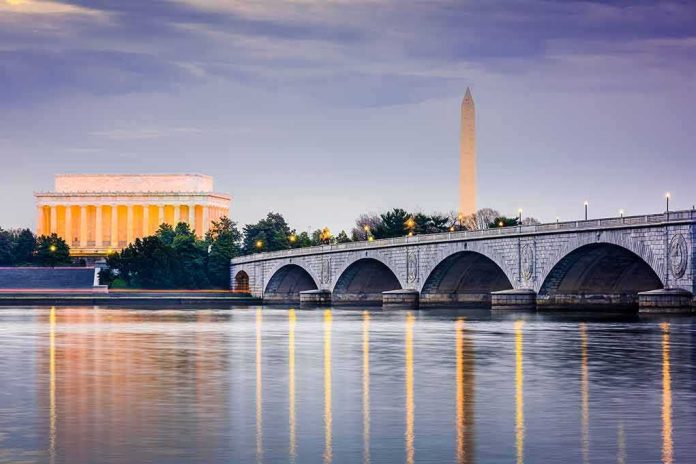
Virginia Attorney General Jay Jones and District of Columbia Attorney General Brian Schwalb sued in the United States District Court for the District of Columbia to stop the arch at Memorial Circle. Their 46-page complaint says the site sits at the mouth of Arlington Memorial Bridge, where daily commuters, walkers, and cyclists mix with tourists. They allege the three-year build would clog lanes, block paths, and slow emergency crews moving between the two jurisdictions, creating “irreparable harm” once ground is broken.
The suit links the project to a vital evacuation corridor and cross-river aid plans. It warns that lane closures, staging areas, and detours would ripple through bridge traffic and nearby roads. The filing also points to stormwater runoff and construction pollution entering the Potomac River but does not provide measurements in the public summaries reported so far. The plaintiffs want emergency relief to pause any site work while the court weighs the legal claims on the merits.
The Legal Fault Lines the Case Raises
The complaint stacks multiple theories. It claims the administration did not secure needed congressional authorization, that the proposed height exceeds federal limits, and that agencies skipped or mishandled required environmental and historic-preservation reviews. Reporting describes a 250-foot structure at a highly sensitive, symbolic junction that links the National Mall to Arlington National Cemetery. That scale could make visual and historic impacts obvious and easy to understand for a judge and the public.
At the same time, the record reported to date has gaps. The summaries do not list a case number, the specific counts, or the injunction language. There is no cited traffic-impact model or quantified ambulance-delay analysis in the public descriptions. There is also no environmental sampling or modeling data included in those summaries. A court may still grant a pause based on procedural defects alone, but a longer fight will likely hinge on hard data the plaintiffs have not yet shown publicly.
How the Administration Frames the Arch
The White House says the arch will honor veterans, comfort families of the fallen, and uplift visitors with a striking landmark. Officials describe it as a national symbol, not a mere local project. That message positions the monument as a tribute to sacrifice at the entrance to Arlington National Cemetery. Supporters argue the country deserves bold memorials and that this one will enhance the visitor experience for all Americans who come to reflect and remember.
🚨 IT'S OFFICIAL: Facing lawsuits, President Trump designates his DC Triumphal Arch as a MILITARY PROJECT — meaning it just got a lot more difficult for activist judges to stop it. LFG!
REPORTER: DC and Virginia just sued to stop your Triumphal Arch because it violates—
TRUMP:…
— MR X (@TheMrXGuy1) November 1, 2026
An Interior Department spokesperson has addressed one concern by saying agency modeling shows only a small portion of the cemetery would fall under the arch’s shadow, and only during the hour after sunrise for less than two weeks each year. That claim answers visual and shadow worries but does not tackle the lawsuit’s core traffic and emergency-response objections. The administration has also indicated work could start soon, raising the stakes of any delay ruling.
What Matters for Conservatives Watching This Fight
Process and prudence matter. Big projects near the nation’s most sacred ground must follow the law and protect public safety. If federal reviewers checked every box, a court can say so. If not, a pause protects order and accountability. The bridge and circle move people, ambulances, and firefighters every day. Washington has a history of memorials that take time and review. Rushing the job may backfire and hand power to judges instead of elected leaders.
There is also a deeper tension here. Many readers are tired of lawsuits used to stall anything a Republican president proposes. Yet solid planning and clean records are how conservative governance wins in court. The administration’s tribute message is strong, and the goal is worthy. The fastest path to a lasting monument is clear compliance, transparent traffic plans, and verifiable safety measures that defang opponents’ claims before a judge needs to. That is how you build for generations.
What to Watch Next in Court
Watch for a docket entry setting a timeline on emergency relief. Look for filings that attach traffic counts, construction phasing maps, emergency-response modeling, and environmental plans. If the court finds likely legal violations or unresolved safety risks, it could pause work while the case proceeds. If the record is tight and the plans are sound, the court could allow early site steps while ordering further review in parallel.
Either way, facts will decide this. Data on lane closures, ambulance times, and stormwater controls can settle much of the fight. Clear statements on congressional authority and height rules can settle the rest. This is the capital’s front door and Arlington’s threshold. Build something worthy—by the book, with safety first—and it can honor our heroes without grinding daily life to a halt.
Sources:
cbsnews.com, thehill.com, nbcnews.com, abc27.com, wdbj7.com, washingtonexaminer.com