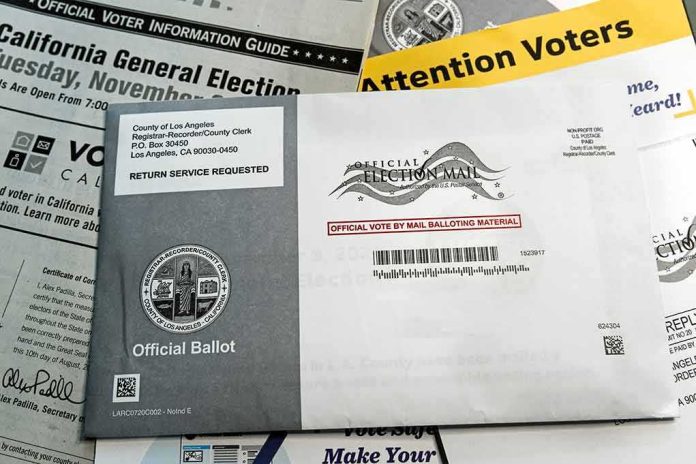
Federal grand-jury subpoenas hit California election offices after investigators flagged about 20,000 suspected noncitizen registrations tied to upcoming ballot counts.
Story Highlights
- Federal grand jury subpoenas demand records from Los Angeles County election officials right after Election Day.
- Justice Department requests methods used to screen out noncitizen voting and related evidence.
- Investigators identified a list of roughly 20,000 suspected noncitizen registrants for targeted records review.
- A judge declined to order immediate ballot segregation, but the criminal probe continues.
Grand Jury Subpoenas Signal Criminal-Scale Inquiry
Justice Department subpoenas dated October 21 and October 24 ordered Los Angeles County election staff to appear before a federal grand jury on November 4, the day after Election Day. The timing shows criminal investigators want sworn testimony and documents as ballots are processed and certified. Subpoenas carry legal force that public letters do not. Federal prosecutors use grand juries to gather evidence under oath and test whether crimes occurred involving election records or related conduct.
The documents demand registration files, address records, voting histories, and any materials on screening for unlawful voting by noncitizens. Investigators asked for internal communications and any evidence already collected about suspected unlawful voting. Requests named California Secretary of State Shirley Weber and top federal officials as parties to correspondence, suggesting a wide scope that spans state policy and county-level practice. The focus is not abstract; it targets how officials actually check citizenship and handle red flags in real time.
Federal List Drives Targeted Records Demands
Reporting describes a federal list of more than 20,000 people identified as likely noncitizens who appear on California voter rolls. Subpoenas seek voter-level details to confirm who registered, who was mailed ballots, and who cast votes in covered elections. The Trump administration also filed suit to segregate ballots linked to that universe until citizenship could be verified, escalating pressure on state and local officials to preserve chain of custody while facts are checked.
A federal judge declined the immediate request to segregate or halt counting of those ballots, limiting near-term remedies but not halting the probe. Courts often require concrete, verified evidence before stopping ballot handling. That ruling does not decide whether noncitizen voting occurred. It does illustrate the high bar for emergency election orders. Prosecutors can still build a record through subpoenas, sworn testimony, and data matching that could support later actions if the evidence holds up.
What California Officials Say—and Where Gaps Remain
California Secretary of State Shirley Weber said the federal government has not shown a reliable basis for labeling the 20,000 as noncitizens and called the list too thin for election use. Los Angeles County leaders said they would not plug in a federal thumb drive, citing data security rules. In a 200-record sample, the county said 112 entries were canceled or inactive and did not get ballots, while 86 were mailed ballots; the county said it cannot directly check federal citizenship files.
Newsom got directly called out on Saturday for not wanting to identify potential non-citizens on California’s voter rolls and set their ballots aside. First Assistant U.S. Attorney Bill Essayli responded to Newsom’s dismissal of DOJ lists of names of potential fraudulent voters…
— Paul A. Szypula 🇺🇸 (@Bubblebathgirl) October 24, 2026
These claims point to process problems that voters can understand. State rules bar noncitizens from registering, but counties often rely on sworn declarations and do not have direct access to federal immigration databases. That makes screening harder and errors more likely on both sides. The federal estimate also shifted from about 190,000 to roughly 20,000, a large change without a public method explained in available reports, which critics cite to question accuracy. The grand jury can now test matches, confirm statuses, and separate false flags from real cases.
Why This Matters for Election Integrity Nationwide
The core issue is simple: only citizens should vote. If even a fraction of the 20,000 were both ineligible and voted, that would erode confidence and harm lawful voters. If many are lawful citizens or never voted, that also matters because bad lists can waste resources and fuel distrust. The investigation can sort this out by comparing voter histories with citizenship records and documenting how officials handled known leads. Clear answers protect honest voters and expose any real abuse.
Conservatives expect firm screening, transparent methods, and respect for the law. President Trump’s administration is now using formal tools—grand juries, subpoenas, and litigation—to get answers while ballots are secured. California leaders say they follow state law and need better federal detail before acting. Both claims can be tested. The clean path forward is evidence: release methods under court safeguards, verify statuses, and report counts of any unlawful registrations and votes. That is how trust is rebuilt.
Sources:
cbsnews.com, sfchronicle.com, dcnewsnow.com, nytimes.com, cnn.com, nbclosangeles.com, politico.com, washingtonexaminer.com