
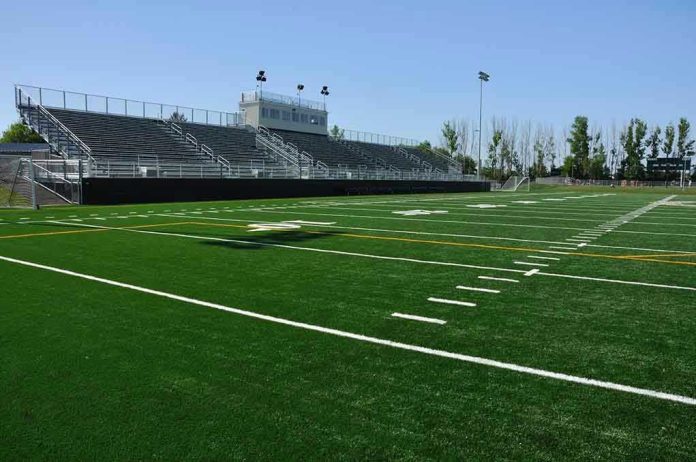
When a man who built 40 years of hope for a city’s youth is gunned down at the heart of his own campus, the shock reverberates far beyond the football field—reminding us that even legends are not bulletproof.
Story Snapshot
- John Beam, the coach who transformed Oakland’s gridiron dreams and starred on Netflix’s “Last Chance U,” was shot at Laney College’s fieldhouse and remains in critical condition.
- The shooting marks the second school-related gun incident in Oakland within 24 hours, intensifying calls for safer campuses.
- Beam’s vast legacy—spanning NFL-bound proteges and decades of mentorship—is now shadowed by uncertainty and grief.
- Authorities have arrested a suspect, but the motive and circumstances remain shrouded in unanswered questions.
Legacy Collides with Violence on a Thursday Morning
John Beam shaped generations of Oakland’s youth from the gridirons of Skyline High to Laney College, building a reputation as a builder of men and a lifeline for those teetering between promise and peril. On the morning of November 13, 2025, that legacy was shattered in an instant when Beam was shot just before noon inside the fieldhouse at Laney College. The familiar hum of a campus morning was replaced by chaos and sirens. For Oakland, a city all too accustomed to gun violence, this was an especially bitter blow—Beam was more than a coach; he was a community pillar whose presence made the extraordinary feel possible for so many at-risk youth.
Laney College immediately entered lockdown, students barricading themselves in classrooms as the news rippled across the city. The suspect, described by police as a male in a hoodie, triggered a citywide manhunt. Beam, gravely wounded, was rushed to the hospital—his fate uncertain. By the next day, a suspect was in custody, but the campus remained haunted by the senselessness of the act. The motive, whether personal, random, or otherwise, was not disclosed, leaving the community with more questions than answers and a gnawing anxiety about what, if anything, could have prevented this tragedy.
A Coach Who Became the Face of Redemption
Beam’s journey through Oakland’s football ecosystem began at Skyline High School, where he dominated for 16 years—securing 11 section titles and nurturing countless young men. He joined Laney College in 2004, ascending to head coach in 2012, and led the Eagles to two league championships. His no-nonsense style and fierce loyalty earned him a starring role in the 2020 season of Netflix’s “Last Chance U,” a series that chronicled the high-wire act of junior college football—where every snap could be the difference between a scholarship and oblivion. The show introduced Beam to millions, but it only scratched the surface of a man who launched 20 players to the NFL and inspired hundreds to transcend their circumstances.
His coaching was never about wins alone. Beam’s legacy is written in the stories of young men like Nahshon and Rejzohn Wright, both NFL players who mourned their mentor in public tributes. For them—and for Oakland’s embattled schools—Beam was a stabilizing force. Mayor Barbara Lee called him a “giant” who “shaped leaders on and off the field,” and the Peralta Community College District described the community as “stunned and heartbroken.” As news of the shooting spread, the outpouring of grief underscored just how deeply Beam’s influence runs through the city’s fabric.
Violence on Campus: A City’s Old Wound Reopened
The timing of the shooting was as shocking as its target. Only a day earlier, a student was shot at Skyline High School—the very place where Beam’s legend was born. Acting Oakland police chief James Beere was quick to assert that the two incidents appeared unrelated, but the symbolism was impossible to ignore: two campuses, two shootings, 24 hours apart, one city in turmoil. Mayor Lee’s statement captured the anguish: “Schools should be the safest spaces in our city. We need guns off our streets now.” The sense of crisis is not theoretical for Oakland’s teachers, students, and families. For them, safety is now a daily negotiation, not a given, and Beam’s shooting has become a painful rallying point.
The immediate aftermath saw Laney’s operations suspended and the community left to process the trauma. The Peralta Community College District must now reckon with both the emotional and practical fallout: how to protect students and staff, how to support a shaken campus, and how to restore a sense of security where it has been violently broken. For the athletic program, the question of continuity looms large—Beam’s future, should he recover, is uncertain, and the void he leaves behind is immense.
Beyond One Man: What This Means for Oakland and America
Beam’s shooting is not just a personal tragedy; it is an inflection point for a city already on edge. In the short term, the lockdown, fear, and disruption are visceral. The longer-term implications are more insidious: a legendary program in limbo, a generation of athletes without their guiding force, and a city forced to confront the ongoing epidemic of school-related gun violence. Nationally, the incident will likely fuel debate over campus security, the reach of gun violence into every American institution, and the paradox of fame offering no shield against random brutality. Netflix’s “Last Chance U,” which once celebrated Beam’s redemptive impact, now finds itself entwined with a story of loss and violence—a stark reminder that even the most inspiring narratives can turn tragic in an instant.
For Oakland, the road ahead is uncertain. The city must decide whether to let this become just another headline, or to channel its grief into real change. For now, all eyes remain on John Beam’s hospital room, and on the future of the field he so fiercely defended.