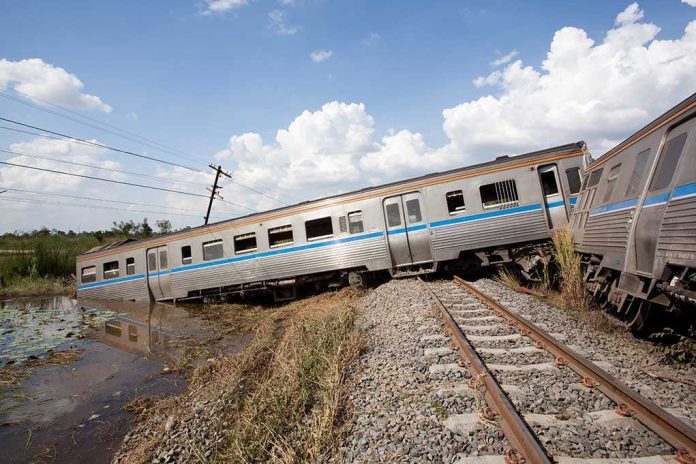
Two passenger trains collided south of Cairo, killing seven people and injuring more than 100, after one train hit the rear of another that had stopped on the same track.
Story Snapshot
- The crash happened in al-Ayyat district in Giza, about 52 kilometers south of Cairo.
- A Giza-to-Fayoum train struck the back of a Cairo-to-Aswan train on the same line.
- Authorities reported seven dead and more than 100 injured, with emergency crews on scene.
- Prosecutors opened an investigation and began scene inspections the same day.
What happened on the line south of Cairo
Egypt’s Chief Prosecutor’s office said a Giza-to-Fayoum passenger train hit the last carriage of a Cairo-to-Aswan service that had stopped on the same track in al-Ayyat district in Giza province. The strike crumpled the rear cars and sent debris across the ballast. The office reported seven dead and more than 100 injured and confirmed the conductor of the Giza-Fayoum train was among the dead. The Health Ministry and major outlets matched the death toll and reported injuries above 100.
Rescue teams, railway crews, and cranes moved quickly to cut through metal, lift damaged carriages, and restore limited service. Prosecutors arrived, documented the scene, and began interviews. The Egyptian Railway Authority described a step-by-step clearance plan to reopen the corridor while investigators worked in parallel. The area has seen heavy passenger traffic for decades, and any closure ripples across the southbound network. The quick dispatch of cranes signaled a push to reopen at least one track for controlled movements.
The sequence officials describe
The Transportation Ministry and prosecutors outlined a straightforward rear-end impact: a north-to-south Giza-Fayoum train entered a block already occupied by the Cairo-Aswan train and struck its tail. That pattern points investigators toward the signaling system, dispatch orders, train speed, and crew actions. The exact reason the Cairo-Aswan train stopped, and for how long, matters for timing. Officials have not yet stated a cause, and a full technical finding typically follows data downloads and signal-log reviews.
The location adds weight to the inquiry. Al-Ayyat sits on a trunk route that carries packed commuter coaches and long-distance sleepers. Traffic density narrows margins. If a train stops and a following train does not receive or obey a restrictive signal, a rear-end hit can come fast. Investigators will compare the event recorder data, radio calls, and signal aspects to map seconds before impact. That timeline will steer whether fault rests with equipment, procedure, or human error.
Casualties, care, and the first numbers
Authorities reported seven dead and more than 100 injured across Giza hospitals. Health officials and prosecutors cited injury counts that varied slightly between 112 and 114 as admissions and transfers shifted in the first hours. That range is common after mass-casualty events, when duplicate entries and rapid triage can blur the first totals. The stable figure is the death toll at seven, which multiple outlets reported based on official statements. Families traveled south from Cairo to check lists and search emergency rooms.
UPDATE — Egypt train collision: the toll has risen to 7 killed and at least 125 injured, Egypt's chief prosecutor's office says. 71 of the injured have been discharged; 43 remain in hospital. President el-Sisi has ordered an investigation. https://t.co/CcBrjSOWT5
— 2nd amendment (@ProfiloCases) November 9, 2026
The inclusion of the Giza-Fayoum conductor among the dead underlines how thin the safety margin is in a rear-end collision. The front cab is a crush zone when speed and mass meet a stopped steel car. That detail also narrows the technical focus to braking distance, line-of-sight, and warnings. If signals or dispatch orders showed an occupied block, investigators will ask why braking did not prevent impact. If signals failed or were overridden, that becomes the core question for rail managers.
Egypt’s rail record and what common sense expects next
Egypt’s rail network has suffered deadly incidents over the years, including catastrophic fires and collisions that etched al-Ayyat into collective memory. The country has pledged upgrades and better training, yet the crashes keep coming. Conservative common sense says promises are not performance; the standard is trains that stop short of danger, every time. That requires reliable signals, strict operating rules, and leaders who enforce them without excuse. The public will judge by fixes that hold, not statements that fade.
How investigators will likely close the loop
Prosecutors and rail investigators will pull signal logs, dispatch records, and locomotive event data. They will test brakes, radios, and track circuits. They will match witness statements with time-stamped records to verify when the Cairo-Aswan train stopped and what alerts the following crew received. If negligence appears, charges will follow under Egyptian law. If equipment failure emerges, the railway will face a redesign or maintenance mandate. Either way, the measure of respect for the victims is prevention that sticks.
Sources:
youtube.com, abcnews.com, bbc.com, thefacts.com, nvdaily.com