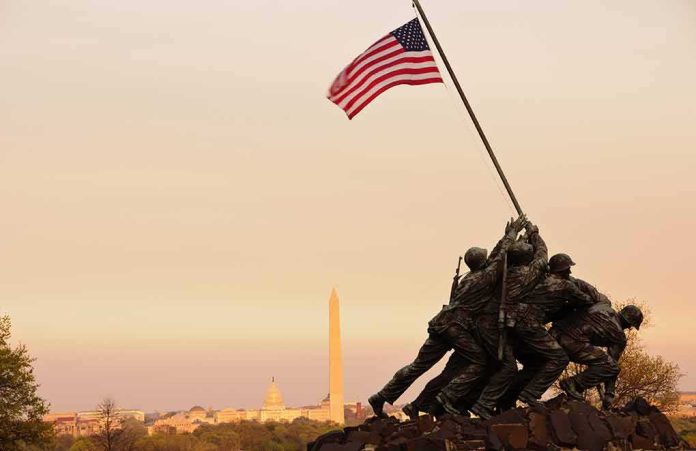
Police say they caught a man swinging a sledgehammer as a Marine’s sculpted head hit the ground.
Story Snapshot
- Officers detained a suspect they say was actively smashing the Iwo Jima memorial near Quantico.
- The statue lost a Marine’s head and suffered other visible damage, with costs projected high.
- Felony charges include destruction of property and injury to a monument, plus trespass.
- A judge later granted a $2,500 bond over prosecution objection, igniting debate.
Police say the attack was caught in the act
Prince William County Police say they arrived at the Iwo Jima memorial near Marine Corps Base Quantico around 10 p.m. and found Miguel Alonso Maldonado Soriano striking the monument with a sledgehammer. Officers detained him without incident. Police reported that one sculpted Marine’s head was removed and other parts of the limestone statue were damaged. The department described the harm as significant and visible to anyone at the scene.
Reporters and police described damage that went beyond a single blow. The head of one figure was knocked off, the face of another was marred, and other areas of the memorial showed signs of impact. Police and local outlets relayed early cost estimates in the hundreds of thousands of dollars, a range common when skilled conservators must rebuild stone and reset joins on historic works. The Marine Corps Heritage Foundation launched a restoration fundraising effort soon after the incident.
Felony charges fit the reported conduct
Authorities charged Soriano with felony destruction of property, trespass with intent to damage property, and felony injury to a monument. These charges align with the alleged sledgehammer strikes and the scope of the damage police described. The location adds weight. The memorial sits near one of the nation’s core Marine sites, which helps explain why police and prosecutors framed the case as more than routine vandalism.
Congress has long backed strong penalties for attacks on military memorials. The Veterans’ Memorial Preservation and Recognition Act allows felony punishment for willful injury or destruction of monuments that honor military service in qualifying circumstances. That policy reflects a clear judgment: damage to symbols of service harms more than stone. It strikes at shared memory and civic duty.
The bond decision and the legal split it exposes
Chief Judge Petula Metzler granted a $2,500 bond after a hearing, even as the Commonwealth’s Attorney’s Office objected. That ruling did not clear the charges; it set conditions for release before trial. Virginia courts assess bond by risk of flight and danger to people, not only by the anger a crime stirs or the price of repairs. That is the rule set used by pretrial services across the Commonwealth.
A man accused of decapitating part of the Iwo Jima memorial in Quantico was granted $2,500 bond. https://t.co/F2zMSby0dN
— News 4 Reno (@News4Reno) October 26, 2026
Many readers ask why a reported sledgehammer attack on a revered memorial did not lead to continued detention. The answer sits in the pretrial standard. Judges must decide if any set of conditions can manage risk. They often weigh criminal history, ties to the community, prior court behavior, and specific threats. A shocking allegation alone does not settle that question. The process aims to protect the public while respecting the presumption of innocence before trial.
What comes next for the monument and the case
The Marine Corps Heritage Foundation’s campaign suggests a long, careful repair. Conservators may need to recreate missing features, match limestone color and grain, and stabilize microfractures caused by repeated blows. That work takes time and money. Police and press placed the early estimate in the six figures, which tracks with projects that require highly skilled stone restoration and secure transport of damaged elements.
The criminal case will turn on the officers’ observations, physical evidence like the sledgehammer, photos of the scene, and any expert reports on damage and cost. Prosecutors will seek to prove willful conduct that meets felony thresholds. Defense counsel will test each element and may contest valuation, motive, or specific intent on trespass. A trial, or a plea, will decide accountability. For now, the memorial stands as both a wound and a promise to restore what matters.
Why this struck a nerve beyond Virginia
Americans see military memorials as living vows. The flag at Iwo Jima marks blood, brotherhood, and victory paid in lives. When someone smashes that image, the hit feels personal to many families. The law reflects that feeling by setting tougher penalties for attacks on symbols of service. That is not theater. It is common sense in a country that asks young men and women to risk everything and honors them in stone when they do.
Sources:
redstate.com, people.com, princewilliamtimes.com, wtvr.com, nbcwashington.com, stripes.com, abc6onyourside.com, potomaclocal.com