
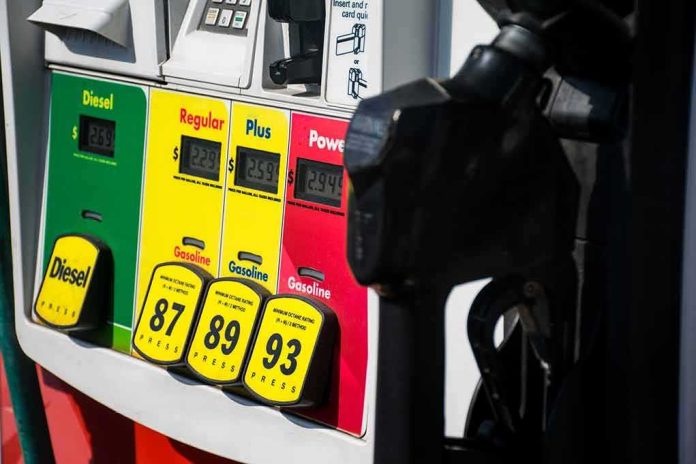
Trump told a Georgia crowd the nation is “making a freaking fortune” from pricey oil while drivers pay more, and that is the political fuse still burning.
Story Snapshot
- Trump said high oil prices bring “hundreds of billions” to U.S. producers and states.
- He acknowledged higher pump prices but predicted they would fall soon.
- Average gasoline hovered above $4 per gallon during his remarks.
- Critics argued voters feel real pain and the message risks backlash.
What Trump Actually Said In Georgia
President Trump told supporters in Perry, Georgia, that the country and its oil industry are making huge sums because oil is expensive. He linked the jump to turmoil in the Middle East and visits by buyers to Texas, Oklahoma, and Louisiana. He said advisers warned him not to highlight gains while people pay more, but he brushed that off and promised prices will drop. Reports captured him saying, “We’re making a freaking fortune” and citing “hundreds of billions” in gains.
That framing mixes two ideas that many voters split apart: national and industry income versus household costs. U.S. gasoline prices around the time were widely reported above $4 per gallon, with one outlet citing $4.29 and noting Americans were paying more at the pump. The mismatch between a producer windfall and family fuel bills set the tone problem. People do not feel aggregate profits in their wallet. They do see the total on the pump screen.
How Pump Prices And Oil Profits Can Move In Opposite Directions For Voters
Gasoline includes crude oil costs, refining margins, distribution, marketing, and taxes. When crude rises, producers tend to gain, some states collect more royalties and taxes, and refiners can earn more if margins expand. Drivers and small firms, however, pay more right away. The Energy Information Administration explains that crude oil is the largest piece of the pump price, while other parts can swing by season and region. That is how “good for producers” and “bad for drivers” can both be true at once.
Conservatives often focus on durable supply. They ask whether policy clears the way for drilling, pipelines, refining, and leases. That lens says the honest fix is more American energy, not slogans. Trump’s promise that prices would “come way down” lacks a clock and a cause in the record. A claim without timing or a mechanism is a hope, not a plan. Voters who pay weekly want to see barrels, rigs, and repairs, not just applause lines.
The Political Risk: Tone, Trust, And Timing
Trump’s words drew fast attacks from opponents, who cast the line “I don’t give a damn” as proof of indifference. The Hill highlighted Democratic strategist David Axelrod’s view that the remark is a losing message because people feel pump pain first and policy logic later. That political critique hits because the price board is public. If prices stay high, a boast about windfalls sounds off-key, even if state budgets and drillers are flush.
Reports also point to specific, checkable pain. A local outlet put the national gasoline average at $4.37 on October 9, up 47 percent from before the war, and noted that diesel hikes filter into food and freight costs. Those facts back a common-sense warning: even if energy states boom, spread-out consumer pain can outweigh regional gains at the ballot box. If the White House wants credit, it must show how rising energy income flows back to families fast.
The Open Questions That Decide Who Wins This Argument
Three tests will settle the debate. First, scale and split: do federal, state, and private gains approach Trump’s “hundreds of billions,” and who gets the cash? Without budget tables or company filings, that number remains an applause line, not a ledger entry. Second, timing: do prices “come way down,” and by when? A forecast needs barrels, not vibes. Third, flow-through: do higher royalties, wages, and taxes beat the added costs at the pump and in store aisles?
🚨BREAKING: President Trump dismisses criticism over high gas prices, saying the U.S. is making record profits and that he doesn’t care about the backlash.
The "Corporation" is making record profits!
The People are struggling.
Trump is part of the "Corporation"
The SWAMP! pic.twitter.com/WDKju7lh7B— Texas Warrior Kimm Schuman (@SchumanKimm) October 25, 2026
History says presidents wear the pump price whether or not they cause it. The Energy Information Administration’s primer shows crude drives most of the price, so wars and supply breaks hit home first. The lesson for a conservative policy case is simple: expand reliable American supply, cut red tape that strangles refining, keep strategic reserves for shocks, and tell the truth about tradeoffs. People can handle hard news; they will not forgive glib talk while the meter spins.
Sources:
yahoo.com, themirror.com, thehill.com, juneauindependent.com, cnn.com