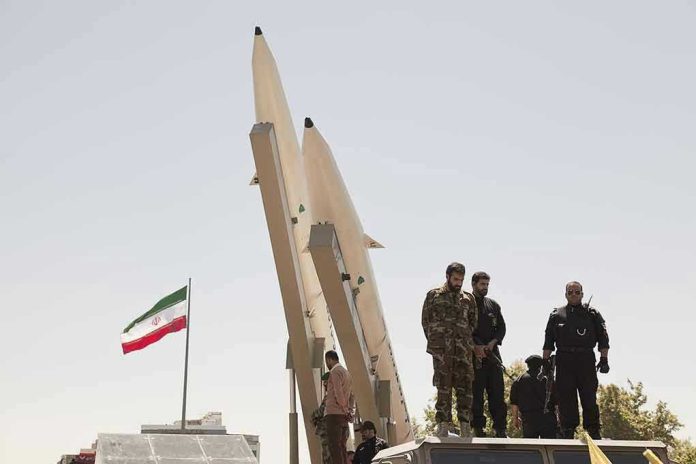
Iran arms itself with Chinese supersonic missiles and Russian portable rocket systems to directly threaten American ships and aircraft in the Persian Gulf, even as President Trump’s military buildup signals resolve against this axis of aggression.
Story Highlights
- Iran signed a secret €500 million deal with Russia in December 2025 for 500 Verba MANPADS units to rebuild air defenses degraded in the June 2025 war with Israel.
- Iran nears completion of a deal with China for CM-302 anti-ship missiles, capable of striking U.S. naval assets from 290 kilometers with supersonic speed.
- These acquisitions violate U.N. arms embargoes and strengthen the Iran-Russia-China alliance aimed at undermining American dominance in the Middle East.
- U.S. responds with unprecedented aircraft surges, one of the largest military movements in decades, to counter escalating threats.
- Shift to mobile, distributed defenses raises risks for U.S. helicopters and ships, complicating operations to protect free navigation and allies like Israel.
Post-Israel Conflict: Iran’s Urgent Arms Race
Israel’s 12-day war with Iran in June 2025 exposed fatal weaknesses in Tehran’s fixed S-300 air defense batteries, enabling Israeli air superiority through precision strikes. Days later, Iran requested Russian Verba man-portable air defense systems from Rosoboronexport. Iranian defense officials, including a U.S.-sanctioned figure, sealed the €500 million contract in Moscow by December 2025 for 500 launchers and 2,500 missiles. Deliveries begin 2027, though some units may already be in place. This pivot prioritizes survivable, infrared-guided systems over vulnerable radar sites, frustrating U.S. and Israeli strike capabilities.
Chinese Missiles Target U.S. Navy Supremacy
Negotiations for China’s CM-302 supersonic anti-ship cruise missiles accelerated after the Israel conflict, led by Iran’s Deputy Defense Minister Massoud Oraei. As of February 24, 2026, Iran stands on the verge of securing these sea-skimming weapons with 290-kilometer range. Experts assess the CM-302 as a major threat to U.S. naval forces, compressing ship defense reaction times. Beijing advances its Belt and Road interests by constraining American maneuverability in the Gulf, protecting its energy imports while eroding U.S. regional leverage. This deal circumvents sanctions, signaling contempt for international norms.
Deepening Axis Against American Interests
Russia supplies Verba systems without depleting its stocks, sustaining Iran as a partner via the INSTC sanctions-evasion corridor that bypasses Western chokepoints. China positions itself as a Middle East counterweight, deepening military ties despite U.S. pressure. This Iran-Russia-China alignment challenges President Trump’s efforts to restore deterrence after years of Biden weakness. U.N. embargoes prove toothless against Russian and Chinese vetoes, emboldening regimes that sponsor terror and threaten global shipping lanes critical to American prosperity.
U.S. Military Response and Strategic Risks
Amid these deals, U.S. air activity surges to levels unseen in decades, bolstering presence against Iranian naval threats. Verba MANPADS endanger low-flying U.S. helicopters, while CM-302 missiles hike costs for carrier operations in the Gulf. Commercial shipping faces heightened risks in chokepoints, potentially spiking energy prices that hardworking Americans have already endured under past mismanagement. Iran’s “win by not losing” doctrine seeks regime survival through deterrence, not victory, but empowers aggression against allies like Israel and Gulf partners.
These cost-efficient buys—totaling about $1.1 billion—avoid indigenous development while evading sanctions via INSTC trade in oil and arms. President Trump’s firm stance counters this axis, prioritizing American security over globalist appeasement that fueled inflation and weakness abroad.
Sources:
Russia supplying Iran new missile might for a US war
Iran poised to acquire advanced Chinese anti-ship missiles: report
Iran nears deal with China for CM-302 anti-ship missiles amid rising US tensions
Iran seeks Chinese CM-302 supersonic anti-ship missiles to challenge U.S. Navy in Persian Gulf
China to send Iran aircraft carrier-killing missiles
Iran Orders Russian Triseeker Missile
Exclusive: Iran nears deal to buy Chinese anti-ship missiles