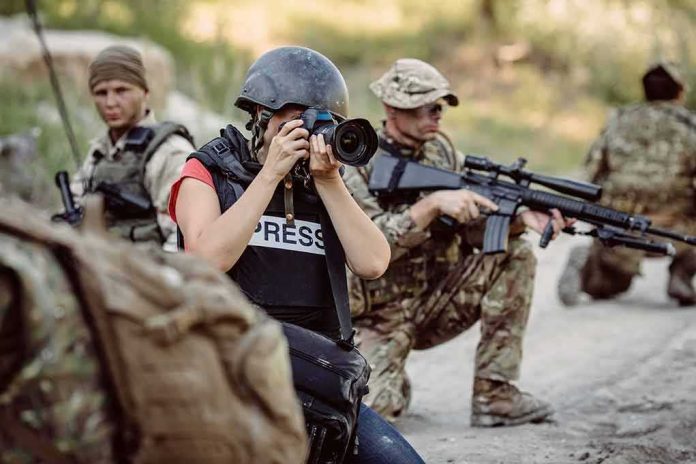
A Washington Post photojournalist ended up bloodied on a West Bank dirt road, whispering, “I’m going to die.”
Story Snapshot
- Masked settlers attacked near Abu Falah during the olive harvest, injuring Heidi Levine.
- Video shows Levine on the ground, bleeding and in severe distress.
- Witnesses reported arson, rocks thrown, and at least one gun fired.
- Levine was treated locally, then hospitalized in Ramallah and reported stable.
A journalist caught in a wave of masked violence
Washington Post photojournalist Heidi Levine was injured near Abu Falah while covering the Palestinian olive harvest. Dozens of masked settlers rushed the groves, burned trees, and hurled rocks, according to on-scene reporting. Palestinian medics said two people were taken to hospitals, including Levine. A Reuters photographer saw at least one armed settler fire a gun. The attack unfolded amid smoke and panic, the kind of chaos that turns a routine assignment into a race for survival.
Video from the scene shows Levine on the ground, bleeding and struggling to speak. She says, “I’m going to die,” as bystanders try to help. Outlets that reviewed the clip reported that at least three masked settlers stood near her as she lay on a dirt road. That image cut through the fog of claims and counterclaims. People know what fear looks like on a face. They know what a beating looks like on a body.
How the attack unfolded, and what we know about injuries
Reports from the ground describe a large group of masked settlers dressed in black moving into olive groves and setting trees on fire. Rocks flew toward Palestinians. Levine was pushed to the ground and kicked, according to accounts relayed by reporters who spoke with people on site. She received initial treatment at a local clinic and was then hospitalized in Ramallah. Media reports described fractures and cuts, and said she was in stable condition afterward.
The scene fits a pattern that often appears during the olive harvest. Farmers, families, and journalists face seasonal risk as tensions spike over land, access, and security. The United Nations Office for the Coordination of Humanitarian Affairs has documented harvest-linked incidents across many West Bank communities, with injuries and thousands of trees damaged. These figures set the scene. They do not decide who threw which punch in Abu Falah, but they explain why crews brace for trouble each October.
Competing claims and the narrow question that still matters
The Mateh Binyamin Regional Council claimed Palestinians provoked a confrontation, and that the Palestinian Authority brought people into the area. That account clashes with reports of masked settlers burning trees and throwing rocks. The narrow question here is not the entire clash. It is the harm to a working journalist. On the strength of the on-scene reporting and the video, the beating claim carries weight, and it aligns with common sense about right and wrong in a free press.
American conservative values demand law, order, and accountability. That means protecting lawful work, including reporting. It means that masked mobs do not get to decide who documents public events. When disputes over land or protest turn violent, the standard stays the same: defend innocent life, punish crime, and keep speech and press free. Those rules are not partisan. They are the guardrails that keep any society from sliding into rule by mask and club.
Why this season keeps turning bloody—and why that matters now
Year after year, the olive harvest brings both hope and hazard. Families try to pick fruit in peace. Activists, settlers, and security forces often collide at the edges. Journalists enter that space because the public has a right to see what happens. The Committee to Protect Journalists has tracked multiple cases this year where settlers threatened or assaulted reporters in the West Bank. That trend line makes the Abu Falah video feel less like an outlier and more like a warning.
Across the West Bank today, Israeli settlers attacked farmers, burned vehicles and injured Palestinians and an American journalist. Settler violence is systematically used to deny Palestinians access to their land. Impunity allows it to continue.
📸 Ammar Awwad/Reuters | AbuFalah pic.twitter.com/m67sxTTW8v— Khaled Abu-Qare (@KhaledAbuqare) October 16, 2026
Policy will have to follow facts. Authorities should identify suspects, review all footage, and bring a clear case. Witness material, medical records, and dispatch logs can lock the timeline. A clean investigation respects both Israeli and Palestinian civilians by drawing a bright line against masked violence. It also honors the work of a journalist who showed up to do her job and left in an ambulance. That is the line a free society must hold.
Sources:
washingtonpost.com, yahoo.com, ground.news, mediaite.com, elperiodicodearagon.com, yesh-din.org