Two giant quakes struck minutes apart, and the facts arrived slower than the fear.
Story Snapshot
- Two strong earthquakes hit near Morón; reports list magnitudes 7.1 and 7.5 [1].
- Caracas saw collapsed buildings and “alarming situations,” officials said [1].
- Tsunami alerts reached Puerto Rico and the Virgin Islands after the jolts [1].
- Early data conflicted on size and location, fueling confusion and rumor [3][4].
What Happened And Where The Data Agrees
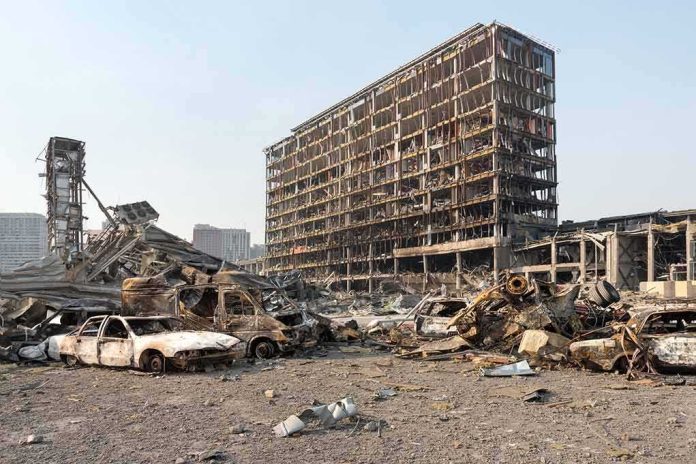
The United States Geological Survey reported a 7.1 earthquake west of Morón at shallow depth, followed minutes later by a larger 7.5 event southwest of the city [1]. The epicentral area sits in the Yaracuy region, about 168 kilometers from Caracas, according to early summaries that drew from the same technical feed [4]. Emergency crews worked through the night across Caracas. Officials reported building collapses and tense scenes in the Altamira district as people fled into the streets [1]. The core picture is simple: big shaking, short interval, wide impact.
The United States Pacific Tsunami Warning Center pushed alerts to Puerto Rico and the Virgin Islands soon after the quakes [1]. That move matched the playbook for powerful, shallow events near the Caribbean Basin. Alerts do not mean waves will strike, but they buy time if they do. People on coasts do not wait for perfect data. They move to higher ground. That is common sense, and it has saved lives in other basins when seconds mattered more than certainty.
Where The Record Splinters And Why It Matters
Early reports from one outlet said “no official injuries or damage,” while other sources soon relayed images and ministerial claims of collapsed structures [1][2]. Another report flagged a 6.3 earthquake near Mene Grande, which may have been a separate shock in the broader sequence or a misread of the data stream [3]. Wikipedia entries tied the epicenter to Yaracuy based on the same United States Geological Survey feed [4]. These gaps reflect a known pattern after major quakes: numbers shift, maps tighten, and rumors race ahead of measured facts.
Some posts pinned the event on the Boconó Fault, a major crustal break that runs along the Venezuelan Andes [5]. That fits the regional stress picture, but a social post is not a field study. Until seismologists finish waveform inversion and fault-slip models, treat that as a working lead, not a verdict. Data from the United States Geological Survey will likely firm up the rupture geometry and confirm whether the two shocks formed a classic “doublet,” as the timings suggest. When the dust clears, the science will catch up to the headlines.
Why Caracas Took It Hard
Caracas sits far from the epicenter but lives with soft soils, tall buildings, and aging stock. Long-period waves can sway towers far from the fault. Shallow depth increases shaking strength. If collapses in Altamira hold up under formal review, expect causes to cluster around poor reinforcement, soft-story designs, and older code regimes. This is not unique to Venezuela. Cities from Mexico City to Kathmandu learned the same hard lesson. Earthquakes expose what time, shortcuts, and weak oversight hide.
Following the twin earthquakes that struck northwestern and central Venezuela on June 24, 2026, the tremors were felt extensively across the region, triggering building evacuations and safety concerns in several neighboring countries and Caribbean islands:
Colombia: Shaking was…— Chaya Eitan (@ChayaEitan) June 25, 2026
Conservative instincts favor clear chains of proof. The strongest anchors here are the United States Geological Survey bulletins for magnitude and location, the tsunami alert records, and on-record statements by named officials [1]. Anonymous clips and hype about giant death tolls do not pass that test. Media that rush to “catastrophe” before engineers walk the rubble feed panic and drain trust. Demand named sources, precise numbers, and documents. Accept that early counts will change as responders reach more blocks.
How To Read The Next 72 Hours
Expect magnitude updates as more stations sync. Shocks of this size often produce aftershocks large enough to damage already cracked buildings. Hospitals will sort injuries by daylight, then the harm map will sharpen. The tsunami alerts will likely downgrade to advisories or all-clears with measured wave heights. The United States Geological Survey technical pages should post moment tensors and fault models. Those reports will answer the Boconó question and settle the doublet debate for good [1][4].
Hold two ideas at once. First, the quakes were big and close enough to test any city. Second, early noise will always inflate or deflate reality. The job now is simple and hard: rescue first, verify second, rebuild third. Lawmakers and inspectors should push honest audits of what fell and why. Citizens should press for better codes, not louder sirens. Nature runs the drill. We choose whether to learn from it.
Sources:
[1] Web – BACK TO BACK MAJOR QUAKES ROCK VENEZUELA… MORE
[2] Web – Back-to-back powerful earthquakes hit Venezuela, …
[3] Web – Powerful 7.1 and 7.5-magnitude earthquakes hit Venezuela
[4] Web – Venezuela hit by 6.3-magnitude earthquake
[5] Web – 2026 Venezuela earthquake