
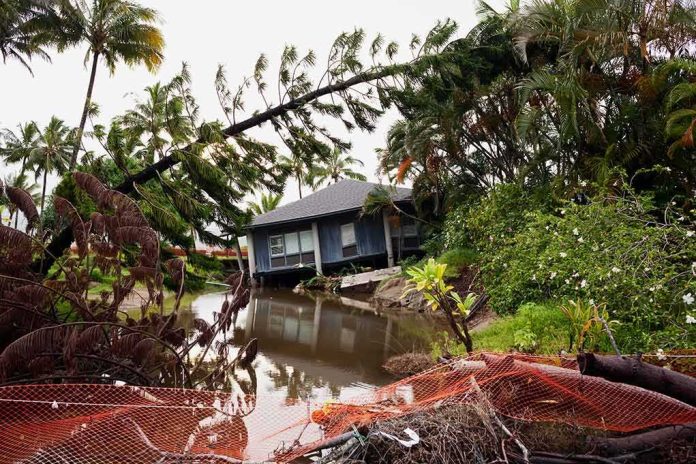
Video from Port St. Lucie showed schoolchildren stepping off a bus directly into standing floodwater, as the city declared a state of emergency over a rain event that shut down major roads and triggered an overnight flood warning.
Story Snapshot
- Port St. Lucie declared a local state of emergency on November 2, 2026, after heavy rain overwhelmed the area.
- Major roads including California Boulevard, Savona Boulevard, Port St. Lucie Boulevard and Prima Vista Boulevard were closed by floodwater.
- The National Weather Service issued a flood warning for St. Lucie County that stayed active until 9:30 a.m. the next day.
- Video circulating online showed children stepping off a school bus into standing water as the storm hit.
- The city canceled a scheduled Planning and Zoning Board meeting because of the storm conditions.
City Declares Emergency As Water Keeps Rising
Port St. Lucie’s city government declared a local state of emergency on November 2, 2026, pointing to the rain event hammering the area. City officials said the declaration could speed up access to extra resources needed to respond to the flooding. The move followed an earlier emergency declaration from St. Lucie County, showing the storm’s reach went beyond city limits and strained local government at multiple levels the same day.
Roads Disappear Under Rising Water
By 6:45 p.m. that evening, the city reported several major roads closed by floodwater. California and Savona boulevards went under, along with Port St. Lucie Boulevard at Aviation Avenue and the eastbound lanes of Prima Vista Boulevard near Airoso Boulevard. Officials noted that many smaller side streets were also impassable, though the city did not list every closure by name.
The closures reflected more than isolated puddling. Ground across the region was already saturated before the heaviest rain arrived, meaning new downpours had nowhere to drain. That setup, described directly in the National Weather Service warning, turned ordinary streets into standing lakes within hours and kept crews scrambling to reroute traffic through the evening.
Weather Service Warns Of More Rain On Soaked Ground
The National Weather Service issued a flood warning for St. Lucie County at 9:15 p.m. on November 2, valid until 9:30 the next morning. The warning described flooding as either happening already or about to happen in low-lying and flood-prone spots, and said water could take hours to work through local drainage systems.
Forecasters added a blunt warning for the overnight hours: more downpours moving over already saturated ground could force additional flash-flood warnings before sunrise. The city echoed that urgency in its own public notice, telling residents to avoid unnecessary travel and never drive through standing water, a simple rule that saves lives every hurricane season in Florida.
Schoolchildren Caught In The Floodwater
Footage that spread widely online showed children stepping off a school bus straight into standing water during the storm, a moment that captured just how fast conditions turned dangerous for ordinary daily routines like the school run. Local shelters opened for families displaced by flooding in their homes as the storm continued, underscoring that the danger extended well past the roadways into people’s living rooms.
ATTN: Temporary shelters are open for those who experienced flooding in their homes.
Northport K-8 School: 250 N.W. Floresta Drive, Port St Lucie, 34983.
Havert L. Fenn Center: 2000 Virginia Ave, Fort Pierce, 34982, opening at 1 p.m.
Visit https://t.co/hrN601Acja pic.twitter.com/KLSldj6VQz
— St. Lucie County (@StLucieGOV) November 3, 2026
Official city and weather service records confirm the broader emergency conditions, including the warnings, closures, and declarations, but they describe the rain in general terms rather than listing an exact rainfall total or school-specific water depth. That gap doesn’t change the basic picture: a fast-moving storm turned routine bus stops into flood scenes within a single afternoon.
Routine City Business Paused By The Storm
The flooding reached far enough into daily city operations that officials canceled the November 2 Planning and Zoning Board meeting outright, pushing its agenda items to December 1 instead. Canceling a scheduled public board meeting is not a small step for a city government, and it signals how seriously officials treated the storm’s immediate safety risks that evening.
Why Florida’s Flat Terrain Makes Storms Like This So Dangerous
Flooding in flat, low-lying Florida communities rarely comes down to rainfall totals alone. Regional emergency planners point to a mix of factors, including how hard and how long the rain falls, how saturated the ground already is, local topography, and whether drainage systems and inlets can keep pace with the runoff. Port St. Lucie’s emergency fit that pattern: saturated soil, flat streets, and heavy rain combined to overwhelm drainage faster than crews could clear it, closing roads block by block through the evening hours.
For residents, the lesson lands close to home every time storms like this hit the Treasure Coast. City and county emergency declarations, National Weather Service warnings, and basic safety rules like avoiding floodwater exist because the ground and the storm drains simply cannot always keep up with Florida’s rain. The video of kids stepping into floodwater is a stark reminder of why officials keep repeating that warning every single storm season.
Sources:
facebook.com, cityofpsl.com, forecast.weather.gov