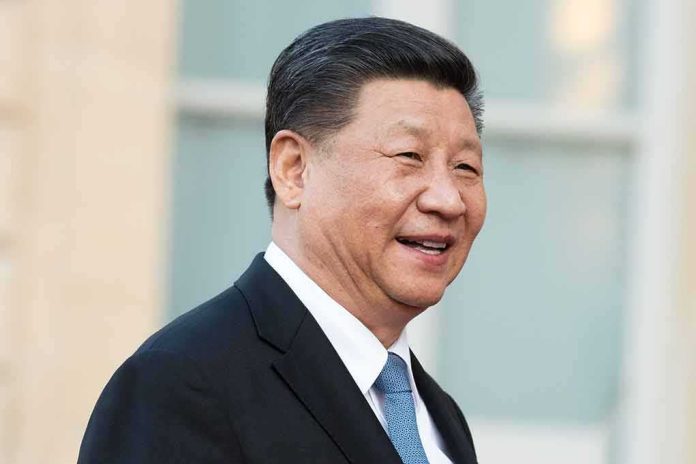
China’s leader ended his U.S. visit face-to-face with America’s founding words, and that choice speaks volumes.
Story Highlights
- President Trump and First Lady Melania hosted Chinese President Xi and Peng for tea at the White House.
- The two couples then toured the National Archives to view the Declaration, Constitution, and Bill of Rights.
- The Archives stop served as the ceremonial finale before Xi’s departure from Washington.
- Coverage framed the day as symbolism over deals, but symbolism with a clear message.
The Final Day: Tea, Founding Documents, Farewell
President Trump closed Chinese President Xi Jinping’s three-day Washington visit with a simple script that carried weight. The presidential couples shared morning tea in the White House Red Room. They then traveled a few blocks to the National Archives. There, they viewed the core documents of American liberty: the Declaration of Independence, the Constitution, and the Bill of Rights. Xi was set to depart Washington after the tour, capping a schedule built for pageantry and clarity of message.
The sequence was deliberate. The White House tea offered hospitality and privacy. The Archives tour placed the argument of America, written in ink and parchment, in the same room as the leader of the world’s most powerful communist state. Reporters described the visit as a ceremonial finale, heavy on symbolism, light on fresh policy breakthroughs. The public record from the day focused on the optics and the order of events rather than new agreements, which fits the state-visit playbook.
Why This Stage Matters In Diplomacy
State visits are performances with text and subtext. The text is the visible schedule. The subtext is the message each stop sends to home and abroad. Scholars note that leaders use historic sites to signal values, boundaries, and intent. The National Archives houses the “Charters of Freedom,” so the subtext here was not subtle: here is what grounds American law and power; here is what frames any deal with Washington. That is not mere theater; it is guardrails in plain view.
Such staging also answers a basic conservative test: show strength through rules, not moods. The United States does not need to lecture when it can point to the rulebook. Let the documents do the talking. Walking a rival through the house rules is common sense. It reminds both sides that trade, tech, and security talks sit under a constitution, not above it. That is how a republic signals resolve without saber-rattling or apology.
What The Coverage Emphasized—And Why
News outlets homed in on two things: the setting and the timing. The Archives visit came during America’s 250th anniversary year, which amplified the symbolism. Reports stressed that the finale featured a look at the documents that limit government power and protect rights that are not the state’s to give or take. They also noted that the day ended without splashy deliverables. That is fine. Not every act three needs a treaty. Sometimes the closing image is the message.
Chinese President Xi Jinping will wrap up his Washington visit Friday with a stop at the National Archives, home to the Declaration of Independence, Constitution, and Bill of Rights.https://t.co/u6RDwb3Eqx
— CBS 21 News (@CBS21NEWS) September 25, 2026
The tour also fit a pattern from earlier eras. Past administrations used historic venues to frame hard talks, whether with allies or competitors. The lesson is steady: symbols shape expectations, and expectations shape behavior. If a partner leaves Washington with the image of the Bill of Rights fresh in mind, then the next round of arguments over data, speech, or markets starts on ground we choose. That is smart stagecraft and sound strategy.
What To Watch Next
Watch for follow-on working groups to reference themes from the visit: rule of law, private property, and fair play. Expect U.S. officials to cite these ideals in talks on trade and technology. Expect China to push for pragmatic carve-outs. The Archives moment gives U.S. negotiators a simple anchor: here is what we will not trade away. That clarity, set in stone and script, is how you keep deals honest and our interests front and center.
Sources:
facebook.com, foxnews.com, abcnews.com, kcra.com