
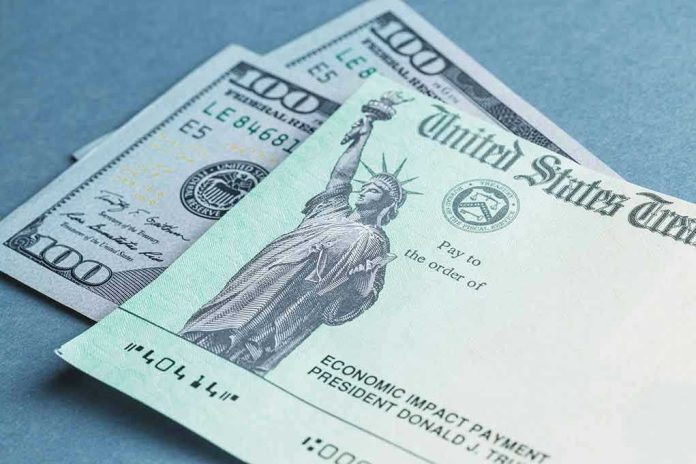
President Trump’s promise to send Americans $2,000 “tariff dividend” checks remains just that—a promise—while your household has already paid nearly $1,200 in hidden tariff taxes since he took office.
Story Snapshot
- No $2,000 stimulus payments approved by Congress or announced by IRS as of January 2026
- American households already paid average of $1,198 in increased costs due to tariffs from February through November 2025
- Tax Foundation analysis reveals massive funding gap: tariff revenue falls $72 billion to $399 billion short of covering proposed payments
- Only military personnel received actual dividend-style payments through housing supplements and Coast Guard bonuses
- Economists warn payments could fuel inflation, while Republican lawmakers express skepticism about feasibility
Trump’s Tariff Dividend Promise Remains Unfulfilled
President Trump’s December cabinet meeting generated headlines when he claimed the U.S. is collecting “trillions of dollars” from tariffs and predicted 2026 could be “the largest tax refund season ever.” He suggested this revenue would be returned to citizens as dividend-style refund checks of $2,000. Yet nearly two months later, Congress has approved nothing, the IRS has announced no upcoming checks, and American families are left wondering if relief is coming. The proposal differs from previous stimulus payments because Trump suggests using executive authority over trade policy rather than Congressional legislation—a distinction that raises questions about constitutional limits on executive spending power.
Americans Already Paying the Tariff Tax
While Washington debates hypothetical dividend payments, hardworking Americans are experiencing the very real costs of tariff policy right now. Democrats on Congress’ Joint Economic Committee calculated that import taxes have cost the average household nearly $1,200 since Trump returned to office, with total consumer costs reaching approximately $159 billion from February through November 2025. These figures come from Treasury Department data and Goldman Sachs economic analysis. Tariffs function as consumption taxes—government doesn’t absorb import duties, foreign manufacturers don’t simply eat the cost, and American consumers ultimately pay higher prices at checkout. The promise of future payments rings hollow when families are already shouldering these increased costs today.
Math Doesn’t Add Up on Funding
The Tax Foundation conducted analysis revealing a fundamental problem with Trump’s proposal: the numbers simply don’t work. Projected tariff revenue totals $158.4 billion in 2025 and $207.5 billion in 2026, while funding $2,000 payments to all Americans would cost between $279.8 billion and $606.8 billion depending on structure. That leaves a funding gap ranging from $72.3 billion to $399.3 billion—and this assumes tariff revenue isn’t needed for deficit reduction or other priorities. This represents the kind of fiscal mathematics that frustrates conservative Americans who remember when Republicans stood firmly for balanced budgets and fiscal responsibility. Where exactly would this massive shortfall come from? More borrowing? Higher taxes elsewhere? The administration hasn’t provided answers.
Inflation Concerns and Republican Skepticism
Economists warn that distributing such payments could fuel inflation by boosting consumer spending—ironically echoing the same arguments GOP lawmakers made in 2021 about pandemic relief contributing to rising prices. Some Republican lawmakers and administration officials have expressed skepticism about both tariff and DOGE dividend proposals, suggesting internal party disagreement about feasibility and wisdom. These concerns reflect genuine conservative principles about monetary policy and market stability. Flooding the economy with hundreds of billions in new spending while simultaneously increasing consumer costs through tariffs creates conflicting economic pressures that could harm the very families these policies claim to help.
Only Military Personnel Received Actual Payments
The sole dividend-style payments actually distributed went to military families, not the general public. Approximately 1.28 million active duty members and 174,000 reservists received nontaxable supplements to monthly housing allowances through the “One Big Beautiful Bill,” with $2.9 billion allocated for military housing. Coast Guard members received a “Devotion to Duty” bonus of $2,000 before taxes (approximately $1,776 take-home) funded through November’s government funding measure. These payments represent appropriate support for military families who sacrifice for our nation—but they’re fundamentally different from the broad-based tariff dividend Trump proposed for all Americans. The gap between promise and reality grows wider as months pass without Congressional action or IRS announcements.
Beware of Scams Targeting Desperate Americans
The IRS warns taxpayers to watch for emails, texts, websites, and social media posts requesting money or personal information, as scammers exploit confusion about stimulus payments. Fraudsters frequently use fake accounts or links impersonating the IRS, which never contacts taxpayers through email, text messages, or social media. Recurring claims about $1,702 or $1,390 “stimulus checks” have been traced to state programs or outright scams. American families deserve clarity, not chaos that enables criminals to prey on uncertainty. The administration’s continued promotion of potential payments without concrete implementation details or Congressional approval creates an environment where vulnerable citizens become targets for fraud.