
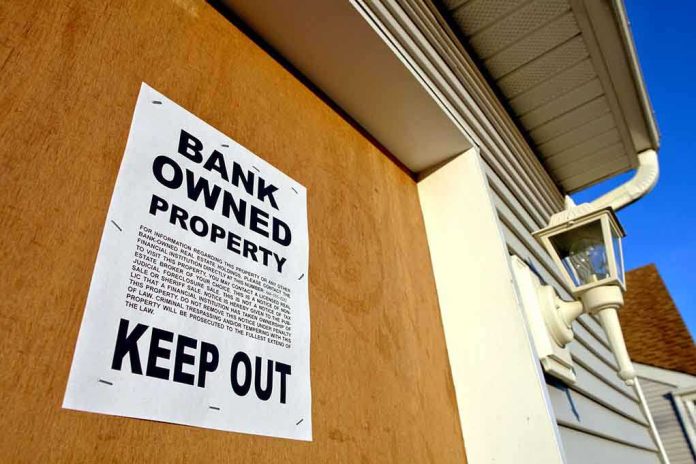
A convicted squatter walked out of a Maryland jail after serving just 11 days of a 90-day sentence and immediately returned to the $2.3 million Bethesda home she illegally occupied, leaving neighbors terrified and exposing a legal system that rewards criminal behavior over property rights.
Story Snapshot
- Tamieka Goode convicted on all counts for squatting in a $2.3 million foreclosed Bethesda home for nine months, sentenced to 90 days, but released after serving only 11 days on a $5,000 appeal bond
- Security footage captured activity at the property shortly after Goode’s release, with neighbors reporting fear of violence as police response remained minimal
- Goode’s attorney invoked “squatter’s rights” and argued no evidence proved his client broke into the home, despite her criminal conviction for trespassing and breaking and entering
- The case highlights Maryland’s broken legal framework where squatters exploit civil-criminal gaps, forcing homeowners into extortion-like “cash for keys” deals while lawmakers debate reforms
When Justice Becomes a Revolving Door
Tamieka Goode stood before Judge John C. Moffett in a Silver Spring courtroom on January 22, 2026, facing the consequences of occupying someone else’s multimillion-dollar property for nearly a year. The judge called her justifications “demented thoughts” and convicted her on all counts: trespassing and breaking and entering. The 90-day jail sentence seemed like a rare victory in a state where squatting cases typically dissolve into frustrating civil disputes. Then, 11 days later, Goode walked free on a $5,000 cash appeal bond. By early February, security cameras captured what appeared to be her return to the very property that landed her behind bars.[pn as get-out-of-jail-free cards, and when law enforcement treats property crimes as someone else’s problem.
The Attorney’s Defense Strategy Reveals the Problem
Alex J. Webster III, Goode’s attorney from Maronick Law, offered a defense that simultaneously acknowledged criminality while justifying it. Webster told reporters that “there are rights known as squatter’s rights” and insisted no evidence proved his client broke into the home. He conceded that trespass and burglary are indeed crimes, but his framing suggests a distinction without a difference. The legal gymnastics expose how Maryland’s patchwork of property laws cretes enough ambiguity for criminals to exploit. Adverse possession statutes require 20 years of continuous occupation to claim title, yet modern squatters invoke these “rights” to justify month-long invasions of foreclosed properties.
Webster’s argument hinges on unclear foreclosure ownership, the same muddiness that let Goode occupy the Bethesda estate for nine months before a teenager had to step in where authorities wouldn’t. Judge Moffett rejected these defenses outright, but the appeal process gives them renewed life. Meanwhile, Goode previously posted TikTok videos declaring “2026 is gonna be my year” while standing at the property, treating her criminal occupation as a personal victory. This isn’t housing insecurity driving desperate people into vacant lots; this is calculated exploitation of legal loopholes by someone who markets herself as a “pro-se litigation coach,” teaching others how to game the system.
A Neighborhood Held Hostage by Legal Dysfunction
Bethesda residents endured what they describe as a “year of terror” while Goode and co-squatter Corey Pollard occupied the foreclosed home starting in summer 2025. This wasn’t some abandoned eyesore; prosecutor Kevin Risch emphasized it was “not some vacant, abandoned house” but a high-end estate in Montgomery County’s most affluent neighborhood. Witnesses reported months of frustration as police follow-ups yielded minimal action, forcing Chen to pursue private charges when the system failed. The property’s murky ownership status during foreclosure proceedings created the perfect storm for exploitation, with no clear responsible party empowered to act swiftly.
The broader Maryland context makes this case particularly infuriating. Taxpayer-funded home rehabilitation projects have been overtaken by squatters who then demand cash payments to leave, effectively extorting public resources. Property sales grind to a halt as squatters refuse to vacate without financial incentives, turning “cash for keys” schemes into standard operating procedure. Lawmakers acknowledge bipartisan calls for reform, recognizing this amounts to “grand theft housing,” yet legislation stalls while criminals like Goode manipulate civil-criminal distinctions. The economic impact extends beyond individual victims to the entire real estate sector, where foreclosure risks now include occupation by professional squatters who understand the system’s weaknesses better than property owners.
Where Common Sense Meets Legal Reality
Judge Moffett’s conviction delivered common sense: if you want to live somewhere, you must do so lawfully. The sentence recognized that Goode’s actions constituted criminal trespass and breaking and entering, not some nebulous civil dispute. Yet the appeal bond system undermined that clarity within days, sending a message that consequences are temporary inconveniences rather than accountability. Pollard, who failed to appear in court and was arrested on an unrelated warrant, remains at large, adding another layer of absurdity. The system’s failures compound when criminal conviction becomes just another step in prolonged legal warfare rather than resolution.
Conservative principles champion property rights as foundational to ordered liberty, yet Maryland’s framework treats homeowners and lenders as obstacles rather than victims. The requirement for private citizens to file charges, the minimal police response, the ease of appeal bonds, and the invocation of “squatter’s rights” in criminal cases all point to laws that have lost sight of basic justice. Goode’s return to the property despite conviction and pending appeal suggests she calculates the odds favor her continued occupation. Until Maryland closes the civil-criminal gaps, imposes meaningful penalties that stick, and empowers law enforcement to treat property crimes seriously, cases like this will proliferate. Neighbors fear violence, property values suffer, and respect for the legal system erodes when criminals walk free while homeowners remain trapped in bureaucratic purgatory.
Sources:
Squatter arrested, guilty on all counts for occupying $2.3M Maryland home
Convicted squatter released, returns to $2.3M Bethesda home as neighbors fear violence
Grand theft housing: $2.3M squatter takeover exposes gaps in Maryland law, renews debate
A $2.3M Maryland home allegedly taken over by squatters leaves block on edge