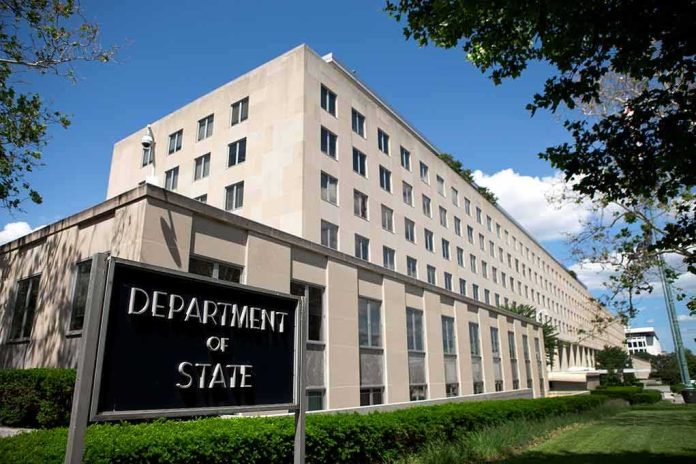
Washington told a Lebanese diplomat to leave the United States after posts praised the 1983 Marine barracks bombing in Beirut.
Story Snapshot
- The State Department declared Lebanon’s Detroit-based consul general persona non grata, according to multiple reports.
- Two posts from 2021 praised the 1983 Marine barracks bombing that killed 241 U.S. service members.
- The action used standard diplomatic tools to remove a foreign representative without a criminal case.
- A source near the diplomat claimed the account was hacked years ago, a claim that has not changed the outcome.
What Triggered The Expulsion
Reports identify the diplomat as Ibrahim Charara, Lebanon’s consul general in Detroit. The State Department declared him persona non grata and ordered him to leave the country. The cited reason traces to two dated social media posts from October 2021 that praised the 1983 bombing of the U.S. Marine barracks in Beirut. That attack killed 241 American service members and remains one of the deadliest days for the Marine Corps. The reported posts framed the bombing as “heroic resistance” and linked it to opposition to U.S. forces at Al-Tanf.
The language in those posts matters because it went beyond history. The October 23 post reportedly called the attack “heroic resistance.” The October 20 post linked the Marine barracks to the Al-Tanf base and vowed to “defeat” an occupier. That rhetoric celebrates violence against U.S. personnel and implies a standing militant stance. For American readers, that crosses a red line. For a host government, that is more than speech. It signals an official who cannot credibly serve in a U.S. city.
How Persona Non Grata Works
Persona non grata is the blunt instrument of diplomacy. A host nation can declare it without a court case and require the diplomat to depart. That is how the United States often handles conduct that undermines trust, threatens security, or violates norms. It is faster and cleaner than building a criminal file and does not ask a jury to rule on protected speech. Media reports describe exactly this process in Charara’s case, with notice to Lebanon’s embassy and a deadline to leave.
This approach draws a bright line on American soil. Praise for an attack that killed hundreds of U.S. service members is not a policy quibble; it is an endorsement of lethal force against Americans. When that message comes from a credentialed envoy, the United States asserts its right to close the door. That aligns with basic common sense and a long tradition: you cannot represent a foreign government here while cheering the killing of our people. The tool exists for precisely these moments.
The Disputed Authorship Claim
A source close to Charara told a Lebanese outlet that his social media account was hacked years ago and that he did not write the posts. The source said he no longer had access to the account, its email, or its phone number. That denial sits in the record but does not blunt the immediate diplomatic response. The United States acted on the visible statements and the risk they posed to the public trust around a credentialed foreign official.
Governments today treat digital footprints like revealing documents. Screenshots, timelines, and tone can sink a posting. Many diplomats learn this the hard way. Commentators have noted that once a host country decides a post crosses its red lines, persona non grata follows. It is swift, lawful under diplomatic norms, and does not require a public evidentiary package. The Charara case fits that pattern. The content praised a mass-casualty attack on Americans and suggested resolve to fight again.
Why This Matters Beyond One Consulate
The 1983 Marine barracks bombing is not a distant footnote. Families still carry the loss. The Marine Corps still honors the dead. Many Americans view praise for that attack as praise for terrorism, plain and simple. Detroit hosts one of the nation’s most active Arab American communities and many veterans. Keeping order and trust in that environment requires clarity. The United States drew that line, and it did so using a standard diplomatic remedy backed by decades of practice.
The broader message is hard to miss. Digital posts can end a diplomatic career even years later. They count as public speech that shapes whether an envoy is welcome. That is not censorship. That is a host nation controlling who speaks for foreign states on its soil. The United States does not need to prove a crime to send someone home. It only needs to decide an official’s presence is not acceptable under diplomatic norms and national dignity.
What Comes Next
Lebanon can replace its envoy and continue normal consular work in Michigan. The State Department can brief Congress if asked, but it does not owe a criminal case to justify persona non grata. If further records emerge, they will likely confirm the simple logic already at work: when an accredited diplomat praises the killing of Americans, the invitation ends. That stance respects U.S. service members, deters reckless rhetoric by foreign officials, and keeps politics from excusing the inexcusable.
Sources:
mediaite.com, jpost.com, ground.news, arabnews.pk