One wrong word in a busy Miami control tower nearly turned a routine takeoff into the kind of runway disaster everyone fears—but no one wants to talk about.
Story Snapshot
- An American Airlines jet to Bermuda had to slam on the brakes during takeoff when a business jet rolled onto the same runway.
- Air traffic control told the smaller jet it had crossed an active runway without clearance, then admitted the crossing instruction was meant for another plane.[1]
- The two aircraft ended up only about one-third of a mile apart, close enough to prove how thin the margin of safety can be.[1]
- The business jet was under a third-party maintenance operator, raising questions about who was really in charge when seconds mattered.[1]
A near miss on a hot Miami runway
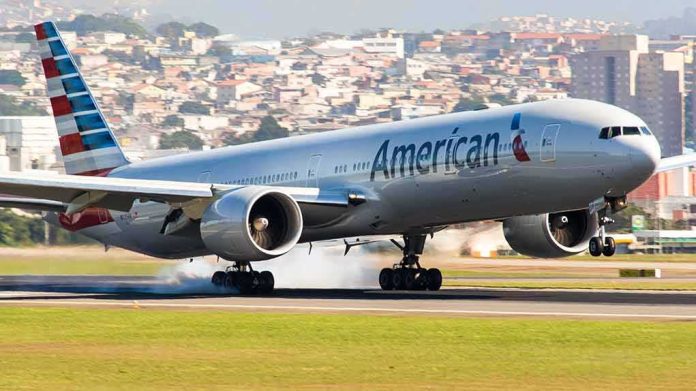
American Airlines Flight 308 was rolling down a runway in Miami International Airport on June 27, 2026, cleared for takeoff and heading for Bermuda.[1] As the jet accelerated, the flight crew suddenly saw another aircraft ahead on the same strip of pavement. That second plane was a NetJets Embraer Phenom 300 business jet, operating as Flight EJA434, which had moved onto the active runway instead of holding short.[1]
The American crew did exactly what passengers expect from professionals. They rejected the takeoff, brought the aircraft to a safe stop, and kept control of the situation. Reports describe the distance between the two planes as about one-third of a mile at their closest point, which is uncomfortably tight when you are dealing with heavy metal moving at takeoff speed.[1] No one was injured, and the American flight later departed safely for Bermuda once the runway was clear.[1][3]
What the tower said and what the pilot heard
After the scare, the real drama shifted to the radio. Air traffic control audio captured the controller telling the Phenom crew, “You just crossed an active runway.”[2] That statement matters because it signals the controller believed the business jet entered a live runway with no clearance. The pilot quickly pushed back, saying, “You just instructed me to cross the runway, sir,” making it clear he thought he was following orders.[2]
The controller then clarified, “No, we meant Amerijet 461,” admitting that any crossing instruction was intended for a different aircraft entirely.[2] That short exchange reveals a painful truth. The Phenom pilot may have honestly believed he had clearance, but the controller’s words show the system did not intend for that jet to cross. This is classic miscommunication, not outright defiance. Still, from a safety and conservative common-sense view, the standard stays simple: you do not enter an active runway unless you are sure the clearance is clearly and directly yours.
Responsibility, third-party operators, and FAA scrutiny
NetJets later confirmed that the Phenom was not under its direct operational control at the time, and a third-party maintenance provider was running the aircraft.[1] That single detail pushes this story beyond one scary moment. When business jets shift between owners, charter firms, and maintenance outfits, the chain of responsibility can get blurry. Passengers and the public expect one clear boss, but the more hands on the controls, the easier it becomes for standards and communication to slip.
American Airlines plane forced to abort takeoff after another jet veers onto same runway at Miami airport https://t.co/ZGlokPyEjp
— TruthWillCome2.0 (@SandyCee2400) June 29, 2026
The Federal Aviation Administration (FAA) has opened a formal investigation into the incident.[1] That investigation will dig into tower tapes, radar data, and operator records. It needs to answer whether the pilot misunderstood a call, whether the controller misspoke, or whether the system allowed a confusing phrase to put two airplanes on the same runway. The absence of a full FAA report so far means we still rely on media summaries and audio clips, not the complete official record, which leaves room for spin from all sides.[2]
A pattern bigger than one scary night
This Miami event is not a strange fluke. Runway incursions—any time an aircraft, vehicle, or person ends up where it should not be on a runway—remain one of the biggest threats in aviation safety.[9] Research shows that airports with intersecting runways and complex taxiway layouts, like Miami International Airport, have higher rates of incursions than simpler fields.[9] Miami’s own data shows a dozen reportable runway incursions over a recent monitoring period, confirming this is an ongoing problem, not a one-off scare.[12]
Federal Aviation Administration programs and airport projects now focus on better markings, clearer taxiway design, and detection systems to spot incursions faster.[10][15] Those efforts help, but they do not replace the human duty to speak plainly and listen carefully. From a conservative, common-sense view, the lesson is straightforward. Systems and gadgets can support safety, but personal responsibility by pilots, controllers, and operators must stay at the center. When lives ride on a single radio call, there is no room for sloppy language or fuzzy chains of command.
Sources:
[1] Web – American Airlines plane forced to abort takeoff after another jet …
[2] Web – American Airlines Flight AA308 was rolling down a Miami runway …
[3] Web – Runway Incursion Forces Aborted Takeoff at Miami – Instagram
[9] Web – Runway Incursion in Miami Forces American Airlines Flight to Abort …
[10] X – Runway Incursion in Miami Forces American Airlines Flight to Abort …
[12] Web – Runway Incursion Forces Aborted Takeoff at Miami – Facebook
[15] Web – Company News | Private Jet Blog & Articles – NetJets