
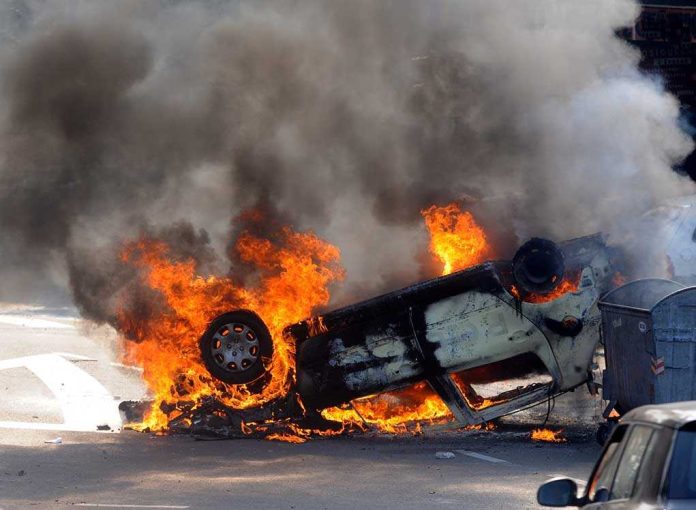
When Jeep told over 320,000 SUV owners to stop charging and park their vehicles outside—immediately—America’s electrification dreams collided headlong with the raw reality of battery fire risk, leaving industry experts and everyday drivers asking: can we trust what’s under the hood?
Story Snapshot
- Over 320,000 Jeep plug-in hybrid SUVs recalled due to battery fire risk
- Owners instructed not to charge and to park vehicles outdoors until further notice
- Failed prior software fixes force search for a permanent solution
- Regulators and Stellantis face mounting scrutiny over EV safety challenges
Jeep’s Recall Sends Shockwaves Across the EV Landscape
Jeep’s urgent warning landed like a thunderclap in November 2025. The recall affects both Wrangler 4xe and Grand Cherokee 4xe plug-in hybrids built between 2020 and 2026. Owners, told to unplug and park outside, watched their confidence in electric vehicles flicker. Stellantis, Jeep’s parent, admitted previous software patches failed, and the National Highway Traffic Safety Administration (NHTSA) stepped in, demanding compliance under campaign 25V741. This wasn’t a routine hiccup; it was a safety red alert that exposed unresolved risks deep within battery technology.
Jeep owners issued urgent ‘do not charge’ warning as 320,000 EVs recalled https://t.co/lqf2bq84Zo pic.twitter.com/eJUks1xsEZ
— The Independent (@Independent) November 5, 2025
Plug-in hybrids like Jeep’s 4xe rely on high-voltage lithium-ion batteries. When cell separators fail, they can trigger short circuits, leading to fires. Previous recalls in 2023 and 2024 tried to fix the issue with software updates, but fires persisted. The separator failures are no small flaw—they represent a critical vulnerability that engineers and safety experts have warned about, especially as the nation’s fleet transitions toward electrification. Jeep’s recall isn’t just about defective parts; it’s a warning flare for the entire EV industry.
Stakeholders Grapple with Uncertainty and Accountability
Stellantis finds itself at the crossroads of responsibility and reputation. The company must resolve the issue, maintain consumer trust, and satisfy regulators. NHTSA, holding the regulatory hammer, ensures Jeep’s compliance and communicates the urgency to the public. Owners, meanwhile, face inconvenience, safety risks, and uncertainty about when—or if—a permanent fix will arrive. Battery suppliers, whose products are under the microscope, must reckon with quality assurance and the specter of liability. The power dynamics are clear: Stellantis dictates the technical response, but regulators and consumers wield influence through oversight and demand for accountability.
Jeep owners, especially those who invested in electrification for environmental or economic reasons, now confront a paradox: the vehicles meant to reduce risk are themselves the risk. Dealer service centers are inundated with calls and complaints. Some owners consider legal action, while others wait—frustrated, anxious, and increasingly skeptical of EV promises. The recall’s scale and urgency amplify these tensions, with more than 320,000 affected vehicles and no clear timeline for resolution.
Industry-Wide Ripples and the Evolving Narrative of EV Safety
Jeep’s recall echoes similar incidents from Chevrolet and Hyundai, both of which faced battery-related fire risks and mass recalls in recent years. Industry analysts warn that recurring battery recalls could slow consumer adoption of EVs, undermining the momentum of America’s clean energy transition. Regulators face increased pressure to enforce stricter standards, and manufacturers must invest more in robust battery engineering. The financial costs—recalls, repairs, lost sales—are matched by reputational damage and consumer wariness.
The broader impact extends beyond Jeep owners. EV consumers across the country now question the reliability and safety of their vehicles. Dealerships, service centers, and suppliers all feel the strain. Politically, the episode fuels debates about the feasibility of rapid electrification and the role of government oversight. Socially, the incident erodes trust in a technology that was supposed to be safer, cleaner, and more reliable. The stakes could not be higher: as EVs become mainstream, their vulnerabilities can no longer be dismissed as fringe issues.
Expert Perspectives Reveal a Complex, High-Stakes Challenge
Automotive safety experts emphasize that battery separator failures are a critical risk for thermal runaway—the chain reaction that can ignite a fire. Consumer advocates highlight the need for transparent communication and swift action, noting that Jeep’s direct warnings at least reflect a serious approach to consumer safety. Recall management professionals underline the importance of rigorous post-market surveillance, arguing that effective recalls are essential to maintaining public trust, even when they expose uncomfortable truths.
Some industry experts warn that repeated battery recalls risk chilling consumer enthusiasm for EVs, potentially stalling the shift away from gas-powered vehicles. Others interpret the recall as evidence that regulators are holding manufacturers accountable and that the system, while imperfect, is responsive to real-world hazards. Academic commentators point out that separator failures represent a complex engineering challenge—one that underscores the need for ongoing innovation and vigilance. The consensus is clear: the Jeep recall is a watershed moment for EV safety, with lessons that extend far beyond the brand itself.
Sources:
Consumer Reports: Jeep SUV Recall Again Fire Risk Owners Told to Park Outside
Houston Chronicle: Jeep Recall Hybrid Grand Cherokee Wrangler