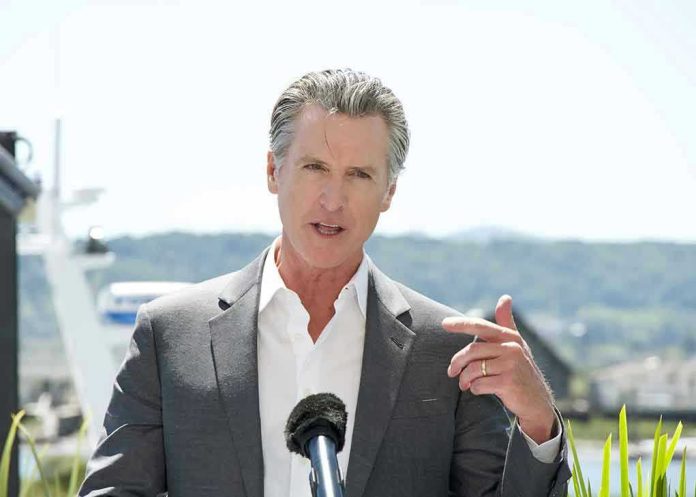
Governor Newsom’s surprising concession on transgender issues exposes a significant vulnerability within the Democratic Party.
Story Highlights
- Governor Gavin Newsom acknowledges transgender issues as a political barrier for Democrats.
- His comments reveal internal tensions between Democratic leaders and activist bases.
- Republicans leverage this division to critique Democratic governance.
- Newsom’s policy actions contrast with his moderated public statements.
Newsom’s Acknowledgment of Political Barriers
During a recent episode of his podcast, California Governor Gavin Newsom candidly admitted that the Democratic Party’s stance on transgender issues serves as a significant political barrier. This admission came during a discussion with conservative commentator Ben Shapiro, where Newsom accepted that issues such as “boys becoming girls” alienate certain voters. This moment marks a rare acknowledgment from a prominent Democratic leader about the challenges faced by the party’s stance on gender issues.
This admission is particularly noteworthy as Newsom is considered a potential contender for the 2028 presidential race. His acknowledgment reflects the growing tension between the Democratic Party’s activist base and its broader voter base. While activists push for progressive policies, the majority of Democratic voters hold more moderate views, creating a political predicament for leaders like Newsom.
Democratic Party’s Internal Tensions
The Democratic Party’s approach to transgender issues has been contentious since the mid-2010s. A significant divide exists between the party’s progressive activist base and its moderate voters. A New York Times poll indicated that over two-thirds of Democrats oppose policies allowing biological males to compete in women’s sports. Despite this, Democratic officials often align with activist demands due to their influence over party primaries and funding, leading to a disconnect with the wider electorate.
Governor Newsom’s admission highlights this tension, as it suggests a gap between the party’s public rhetoric and the practical implications of its policies. His comments on the podcast, coupled with past actions like signing the Transgender Respect, Agency, and Dignity Act, demonstrate an ongoing struggle to reconcile activist-driven policies with broader voter preferences.
Republican Strategy and Implications
Republicans are leveraging these internal Democratic tensions to critique the party’s governance. By exposing the contradictions in Democratic messaging and policy, they aim to paint the party as unable to effectively govern. This strategy is evident in Shapiro’s efforts to highlight the Democratic Party’s ideological capture by its activist wing, suggesting it undermines the party’s credibility on broader governance issues.
The implications for Newsom are significant as he contemplates a national campaign. His need to balance between appealing to a moderate national audience and maintaining his position within the Democratic Party’s activist-driven framework presents a formidable challenge. Whether the party can navigate these internal tensions without alienating either side remains a critical question for its future electoral prospects.
Sources:
Gov. Newsom agrees Shapiro Trans issue barrier people support Democratic Party
Democratic Party Transgender Ideology Gavin Newsom
Newsom retreats after Shapiro puts him spot over chilling ICE terrorism claim