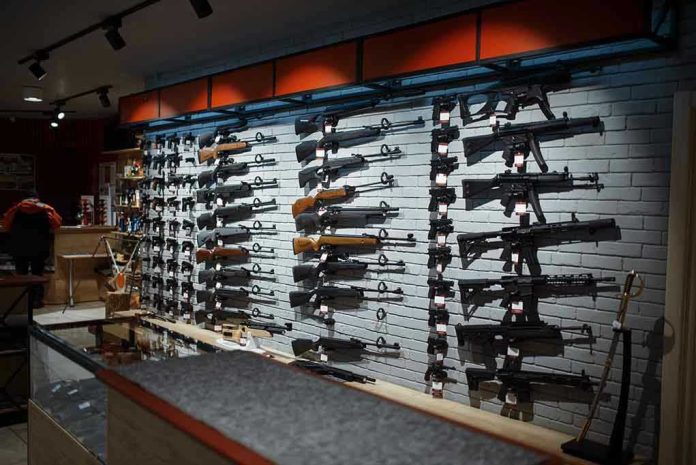
An American citizen in New York walked into a gun store twice and openly declared her intention to murder federal immigration officers, triggering a Department of Homeland Security investigation that exposes the deadly consequences of escalating anti-law enforcement rhetoric.
Story Snapshot
- An unnamed New York woman attempted to purchase a firearm on two separate occasions in Kenmore, explicitly stating her intent to kill Immigration and Customs Enforcement agents
- Department of Homeland Security launched a joint investigation with ICE agents and New York State Police, though no arrests or charges have been publicly announced
- DHS officials link the threat to inflammatory rhetoric comparing immigration officers to Nazis and slave patrols, warning of daily assaults and vehicle-ramming attacks against federal agents
- The investigation remains active as of late January 2026, with authorities urging the public to report harassment of ICE agents through dedicated hotlines
When Protection Becomes Premeditation
The woman’s stated justification reveals a disturbing psychology. She told gun store personnel she needed the weapon to protect herself from ICE agents, then escalated that claim to an explicit declaration of lethal intent. This progression from defensive posturing to offensive threat demonstrates how quickly perceived victimhood transforms into violent action. Gun store employees, trained to recognize red flags during firearms transactions, apparently flagged the incidents, triggering the federal investigation that now involves multiple law enforcement agencies across New York.
The Rhetoric Behind the Threat
DHS Assistant Secretary Tricia McLaughlin drew a direct line between inflammatory political discourse and real-world violence against immigration officers. Her public statement emphasized that federal agents endure comparisons to Nazi Gestapo, secret police, and slave patrols on a daily basis. These aren’t abstract insults bouncing around social media echo chambers. They create an environment where ordinary citizens become radicalized against law enforcement personnel who are simply executing congressionally mandated duties. When public figures dehumanize entire categories of federal employees, unbalanced individuals hear permission to act on violent impulses.
A Pattern of Escalating Violence
DHS characterizes this gun purchase attempt as part of a broader trend rather than an isolated incident. McLaughlin referenced increasing assaults, vehicle-ramming attacks, and multiple attempts to kill ICE and Customs and Border Protection officers. The agency’s decision to publicize this particular case signals concern about copycat behavior and the normalization of violence against immigration enforcement personnel. Federal agents now face threats not just during high-tension enforcement operations, but in their daily routines as identifiable government employees. The woman’s actions in Kenmore represent the crystallization of online hostility into tangible, prosecutable threats.
The Investigation’s Uncertain Future
The joint investigation by ICE, DHS, and New York State Police faces significant challenges. Authorities have released no information about the suspect’s identity, specific charges under consideration, or even the exact dates of her gun purchase attempts. This information vacuum suggests either an ongoing effort to build a prosecutable case or complications in establishing criminal intent beyond the woman’s verbal statements. Federal prosecutors must prove she took substantial steps toward acquiring a firearm with murderous intent, not merely engaged in provocative speech. New York’s stringent gun laws may have prevented the actual purchase, potentially complicating efforts to charge her with attempted murder versus lesser offenses like making terroristic threats.
The Human Cost of Political Polarization
McLaughlin’s statement emphasized that ICE and CBP officers are fathers and mothers who deserve to return home safely to their families. This humanizing appeal challenges the abstract vilification of immigration enforcement personnel. Federal agents enforcing immigration law operate under constitutional authority, implementing policies established through democratic processes. They don’t set immigration policy; they execute it. When citizens threaten to kill officers for performing lawful duties, the social contract sustaining civil society fractures. The Kenmore incident illustrates how political disagreement over immigration policy has metastasized into justification for violence against individual government employees who have no control over the laws they enforce.
DHS established reporting mechanisms for the public to alert authorities about harassment or threats against ICE agents, including a hotline at 866-347-2423 and an online tip form. The agency’s proactive solicitation of public assistance indicates concern that similar threats remain unreported across the country. The investigation continues without public updates on whether the woman faces imminent arrest or what specific charges prosecutors might pursue. Her case stands as a warning about the consequences when political rhetoric crosses from criticism of policy into dehumanization of the individuals tasked with enforcing it.
Sources:
New York woman tried to buy gun to ‘kill ICE agents,’ DHS investigating