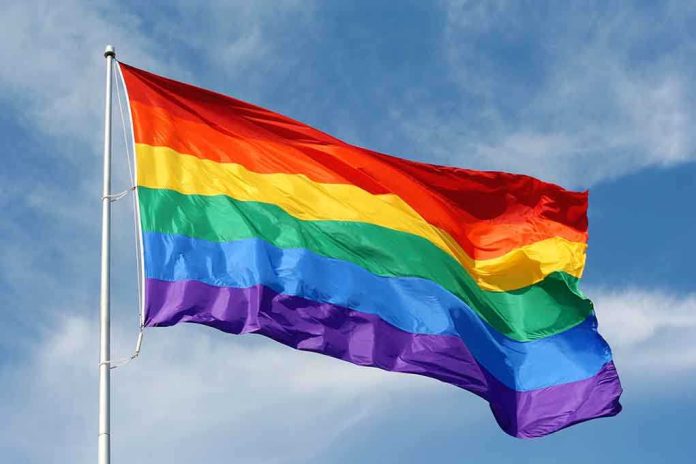
When a state bans your symbol of inclusion, you don’t fight back with flags—you fight back with art, and Boise just wrote the playbook.
Quick Take
- Idaho’s Governor signed HB 561 on March 31, 2026, banning non-official flags from government buildings with fines up to $2,000 per day per flag, forcing Boise City Hall to remove its Pride flag within days.
- One week later, Boise responded by installing rainbow-striped banners, wrapping flagpoles in Pride colors, and bathing City Hall in rainbow accent lighting—all framed as art installations, not flags.
- The display incorporates six traditional Pride colors plus black, brown, pink, blue, and white stripes, evoking the Progress Pride flag without replicating any single official design.
- Mayor Lauren McLean emphasized full legal compliance while maintaining the city’s commitment to being a safe and welcoming community for all residents.
The Law That Changed Everything
Idaho’s Republican-controlled legislature didn’t invent flag restrictions overnight. A 2025 law already prohibited unofficial flags on government property, but it lacked teeth—no enforcement mechanism, no consequences. Boise simply adopted the Pride flag as an official city flag and continued flying it, turning a toothless rule into a loophole. State Rep. Ted Hill saw this as defiance and authored HB 561 specifically to close that gap. When Governor Brad Little signed it into law on March 31, 2026, the stakes changed instantly. The new law explicitly barred any city flags adopted after 2023 and imposed punitive fines. Boise had one choice: comply or face escalating financial penalties.
Compliance with a Creative Edge
By April 1, the Pride flags came down from Boise City Hall’s flagpoles. But the city’s leadership, led by Mayor Lauren McLean, refused to let the symbol disappear entirely. Within a week, City Hall transformed. An eleven-stripe rainbow banner reading “Creating a city for everyone” materialized on the building’s facade. Flagpoles that once flew the Pride flag now wrapped in rainbow colors. Colored accent lighting bathed the entire structure in rainbow hues as evening fell. The city’s message was unmistakable: the law pertains to flags, and Boise remained in full compliance. What hung on the building now was art, not a flag. The distinction mattered legally, but more importantly, it mattered symbolically.
The Art of Defiance
The genius of Boise’s response lies in its specificity. The lighting display doesn’t replicate the traditional six-stripe Pride flag exactly. Instead, it incorporates the six rainbow colors, the black and brown stripes associated with the Philadelphia Pride flag honoring LGBTQ+ people lost to AIDS and those marginalized within the community, and the pink, blue, and white of the transgender flag. Together, this palette evokes the Progress Pride flag—a design that represents intersectionality and forward momentum within the LGBTQ+ community—without technically being any single official flag design. It’s a carefully constructed visual argument: we honor our values through art, and art isn’t regulated by your law.
What This Means Going Forward
Boise’s response sets a precedent that could reverberate across conservative states where similar restrictions exist. If art installations can convey the same message as flags without triggering penalties, cities nationwide might adopt similar strategies. The short-term victory is clear: Boise avoids fines while maintaining visible solidarity with its LGBTQ+ community. The long-term implications remain uncertain. Will state legislators close this loophole by regulating art displays? Will courts intervene? Will other cities follow Boise’s lead? For now, Boise’s City Hall stands as a monument to creative compliance—a building that found a way to say what its state tried to silence.
The tension between local values and state authority rarely finds such a visible expression. Boise chose not to surrender its principles; it simply translated them into a language the law couldn’t restrict. In doing so, the city reminded everyone watching that sometimes the most powerful statements aren’t made with flags at all.
Sources
Idaho said no Pride flags permitted. Boise said watch this
Idaho passed a law just to ban Boise from flying Pride flags. Their response was surprising