
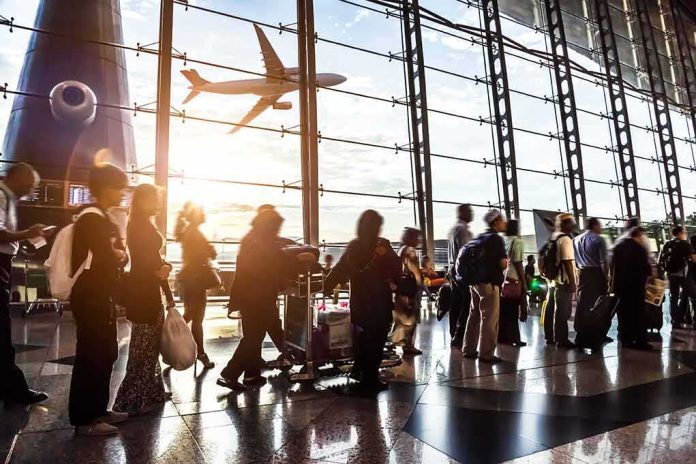
A packed Riyadh airport went from routine to ruin in seconds, and the ripple hit every traveler and airline in the kingdom.
Story Snapshot
- Houthi forces said they targeted King Khalid International Airport with a ballistic missile.
- Explosions, smoke, evacuations, and mass flight cancellations followed at the Riyadh hub.
- Saudi aviation officials reported deaths, injuries, and damage but avoided naming the attacker.
- A Saudia jet on the tarmac suffered heavy shrapnel damage, raising safety alarms.
What happened at Riyadh’s main airport, and why it mattered fast
Witnesses reported multiple blasts, smoke rising over King Khalid International Airport, and a rush to evacuate crowded terminals in Riyadh. Air traffic slumped as airlines scrubbed departures and crews scrambled to assess damage. Reporters on the ground described a large explosion and confusion as people moved out of secure areas and into the open. The images that followed told the same story: a civilian airport under threat, a shaken capital, and a region on edge.
Yemen’s Houthi military spokesperson Yahya Saree said the group aimed a ballistic missile at the airport and that it hit its target. The claim landed as airlines cut schedules and ground staff dealt with debris and panic. Saudi authorities confirmed attacks and casualties but did not assign blame in public statements. That split—loud claim of success, cautious official attribution—has defined this war theater for years and shapes how the world reads each blast.
Confirmed damage, disputed mechanism, and the aviation shockwave
Reuters reported a parked Saudia aircraft took heavy shrapnel damage, likely from an interception or another projectile. That detail fits a pattern seen in air-defense engagements: even “successful” shootdowns can spray speed and metal across a wide arc. Nearly half of Riyadh’s departures were canceled by midafternoon, with more expected, a sign that risk managers saw sustained danger, not a one-off scare. Whether a warhead struck or debris rained down, the effect on safety and schedules was real.
Saudi civil aviation officials later said there were deaths and injuries, plus two separate strikes—one on airport facilities and another on a Saudia aircraft. They still did not identify who did it. That restraint leaves outside observers leaning on the best available link: the Houthi public claim lined up in time with the blasts and disruption. As a matter of common sense, travelers care less who fired than whether terminals stay safe. Airlines showed their answer by canceling flights.
Competing accounts and what holds up under scrutiny
Saudi-led coalition officials said they intercepted ballistic missiles fired toward Riyadh. Saudi civil defense reported debris damaged a kindergarten and a medical site, which backs the interception story. These points conflict with the Houthi claim of a direct, accurate hit. Both stories can be partly true in a missile fight. Defense systems can break a missile, yet debris or unspent fuel can still injure and damage. The open question is which fragment, whose warhead, and where it fell.
International outlets tied the airport chaos to a broader campaign on Saudi airports that week. Reporters cited the Houthis claiming strikes on Riyadh and Abha, while Saudi authorities acknowledged attacks but stayed quiet on naming the attacker. That leaves a gap for now, but not a void. The airports suffered attacks, people died, and flights stopped. That is the heart of the record. The rest—missile type, precise impact spot, and debris origin—needs verified fragments and radar to close the case.
The stakes for travelers, airlines, and deterrence
Missiles aimed at a busy civilian airport hit three pressure points at once: public fear, airline safety rules, and national resolve. For travelers, the lesson is simple and grim. Even a near miss can strand you far from home. For carriers, one shredded fuselage on the ramp can trigger a week of risk reviews and route changes. For policymakers, attacks on civilian infrastructure cross a moral line that Americans across the spectrum reject as basic common sense.
**Houthi Attacks on Riyadh Airport**
**King Khalid International Airport – Escalation Through 10 October 2026**Yemen’s Ansar Allah (Houthi) forces have conducted a sustained campaign of ballistic missiles, cruise missiles, and drones against Saudi civilian aviation hubs. The…
— Intel Rooster 🇺🇸 (@IntelRooster) October 11, 2026
Authorities will need to release fragments, radar tracks, and security footage to settle what, exactly, hit what. Until then, the strongest facts stand on their own. Explosions shook Riyadh’s airport. The Houthis said they aimed there. Saudi officials reported casualties, damage, and suspended operations. A Saudia jet was mauled by shrapnel. Flights were canceled by the dozens. That evidence chain is more than enough to show a serious attack on air travel and a warning shot at regional stability.
Sources:
townhall.com, reuters.com, apnews.com, euronews.com, afp.com, abcnews.com, bbc.co.uk, amp.dw.com, english.aawsat.com