
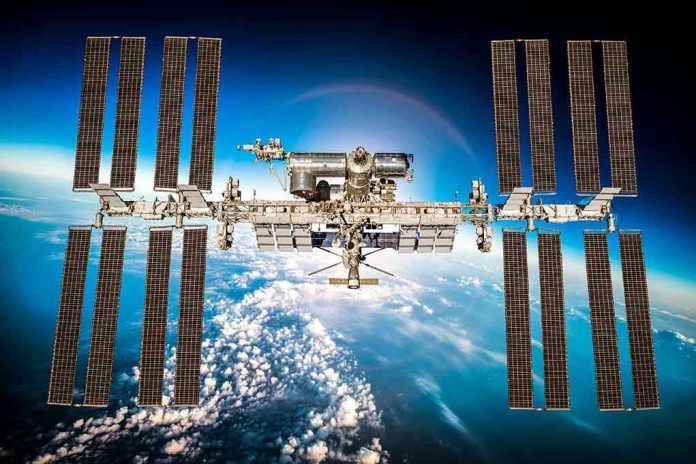
NASA just executed humanity’s first medical evacuation from the International Space Station, pulling an entire crew of four back to Earth over one unnamed astronaut’s serious health crisis.
Story Snapshot
- Crew-11 launched August 1, 2025, docked with ISS next day, planned six-month stay until medical issue forced early return.
- January 14, 2026: Crew undocked at 5:20 p.m. EST, splashed down off San Diego around 3:41 a.m. EST January 15.
- First U.S.-led mission aborted prematurely for medical reasons; condition stable but undisclosed.
- Commander Zena Cardman, pilot Mike Fincke, JAXA’s Kimiya Yui, Roscosmos’ Oleg Platonov returned via SpaceX Dragon Endeavour.
- ISS now runs with skeleton crew until Crew-12 arrives mid-February.
Crew-11 Launches into History
Zena Cardman commanded Crew-11 from NASA’s Kennedy Space Center on August 1, 2025. Mike Fincke piloted the SpaceX Dragon spacecraft. Kimiya Yui from JAXA and Oleg Platonov from Roscosmos joined as mission specialists. They docked with the ISS on August 2, integrating into Expedition 73. The crew later welcomed Expedition 74’s Soyuz MS-28. Their mission supported 25 years of continuous ISS habitation.
Medical Crisis Triggers Unprecedented Decision
Early January 2026, a serious medical concern emerged with one unnamed crew member. NASA Administrator Jared Isaacman announced the issue and authorized an early return. The condition remained stable, ruling out an emergency. This marked the first American-led human spaceflight aborted for medical reasons. Veteran astronaut Mike Fincke called it the right call on LinkedIn, praising teamwork.
Mike Massimino, former ISS astronaut, noted the rarity: crews usually handle issues onboard. No prior U.S. commercial crew mission ended early solely for one member’s health. NASA prioritized Earth-based care over risking prolonged exposure.
Precise Handover and Departure Sequence
On January 12, 2026, Mike Fincke handed ISS command to Roscosmos cosmonaut Sergey Kud-Sverchkov. Two days later, at 3:29 p.m. EST, the hatch to Dragon Endeavour closed. The crew prepared for undocking at 5:20 p.m. EST. A 10.5-hour journey followed, culminating in splashdown off San Diego at approximately 3:41 a.m. EST on January 15. SpaceX teams managed recovery smoothly.
Cardman highlighted international cooperation in her farewell. Fincke emphasized camaraderie as a feat of engineering and diplomacy. The remaining ISS crew—NASA’s Chris Williams, Kud-Sverchkov, and Sergey Mikayev—maintain operations until Crew-12 launches around February 15.
Implications for Space Exploration
This event sets a precedent in the Commercial Crew Program, launched after the 2011 Space Shuttle retirement. SpaceX Dragon proved reliable under crisis, validating reusability. Short-term, ISS runs minimally crewed. Long-term, NASA may refine onboard diagnostics for future missions like Artemis.
Geopolitically, the mission reinforced U.S.-Russia-Japan-ESA ties amid tensions. Common sense dictates prioritizing human life over schedules—Isaacman’s decision aligns with conservative values of responsibility and safety. Families gain relief, while the space community witnesses operational resilience. Crew-12, featuring Jessica Meir and others, prepares to restore full strength.
Sources: