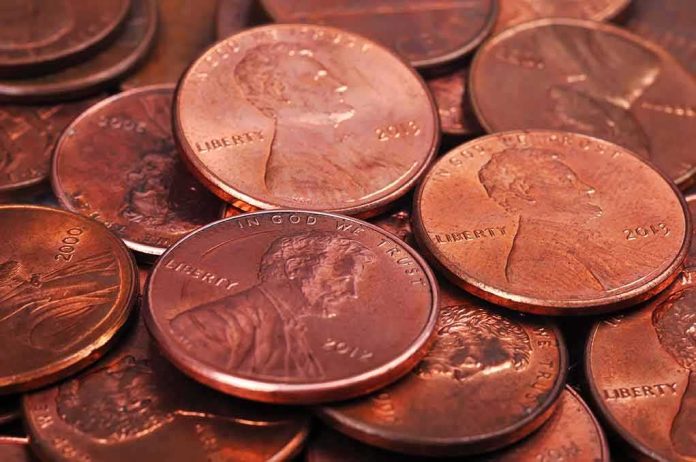
Congress moved to kill the penny and quietly set up a cheaper nickel, and that second step may matter more to your wallet than the first.
Story Snapshot
- Bill ends penny production for circulation and keeps old pennies as legal tender.
- Cash transactions would round to the nearest five cents under a national rule.
- Treasury may test a zinc-core, nickel-clad nickel to cut minting costs.
- Any new nickel must work in coin machines before approval, according to sponsors.
What Congress Actually Passed
The Common Cents Act ends penny production for general circulation and directs a rounding rule for cash purchases to the nearest five cents. The text also preserves existing pennies as legal tender, so you can still spend or deposit them. Lawmakers framed the nickel question as cost control. The act authorizes the Treasury to test a cheaper nickel composition and only adopt it if it proves workable in the real world. That sets a gate, not a mandate.
House committee materials describe the aim clearly: reduce the cost of making coins that cost more to mint than they are worth. The report singles out zinc as a lower-cost input for a revised nickel, if testing confirms savings without widespread disruption. Supporters argue this satisfies two basic duties. First, stop wasting money. Second, protect daily commerce by keeping machines reading coins the same way they do now.
How The Nickel Test Would Work
The bill lets the Treasury and the United States Mint test a nickel with a zinc inner layer and a nickel outer layer, a sandwich design used in other coins worldwide. Sponsors say adoption depends on two checks: clear cost savings and no significant disruption for vending machines, meters, fareboxes, and self-checkouts. The act does not shrink the coin or change its face value. It targets composition, which is the quiet lever that controls cost while aiming to keep coin-acceptor performance stable.
The strength of this approach is practical sequencing. First, lab and field tests. Next, pilot runs. Finally, a go or no-go call. That path respects small businesses that rely on coin acceptance every day. It also lines up with common sense: prove the change before you force it. The weakness is the public record so far shows intent and authority, not final test data or industry-wide certification results. Until those results appear, confidence rests on process rather than proof.
Rounding Rules, Prices, And Trust
The act’s rounding rule applies to cash totals, not to listed prices, and rounds to the nearest five cents, up or down. Critics warn rounding could raise costs for frequent cash users if stores tend to land on totals that round up more often than down. Past surveys showed many adults disliked rounding and wanted to keep the penny. Those concerns deserve respect. Fair rounding needs clear signage, consistent application, and audits so customers see that ups and downs even out over time.
American conservative values prize thrift, transparency, and choice. The government should stop minting money at a loss. The same government should not spring hidden costs on cash users. The compromise is simple. Publish the Mint’s nickel test results. Publish a real cost model that includes retooling and distribution. Enforce honest rounding so shoppers see that a five-cent rule is not a backdoor tax. Good policy earns trust by showing the math and keeping promises.
What To Watch Next
Three milestones will tell you where this goes. First, the Treasury and United States Mint need to release composition test data and broad machine-compatibility outcomes. Second, the Federal Reserve should lay out the logistics plan for handling remaining pennies and retail cash rounding at scale. Third, major vending and retail operators should confirm acceptance rates for any new nickel. If those boxes get checked, the nickel change becomes a quiet upgrade, not a headline fight.
Sources:
facebook.com, congress.gov, foxnews.com, usatoday.com, mcclain.house.gov