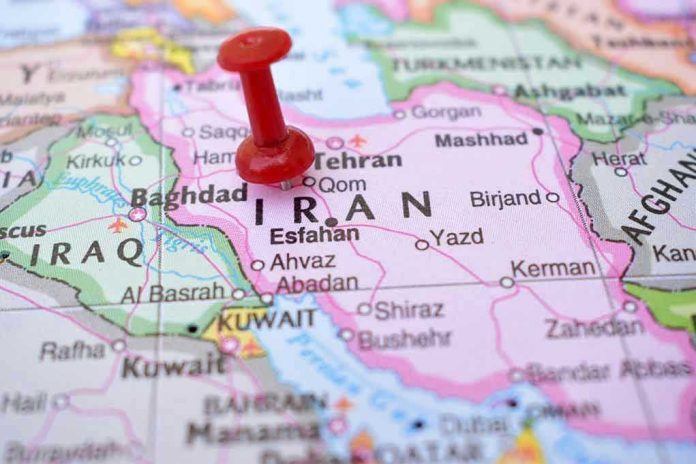
Iranian protesters are dying in the streets while chanting a slogan that would make foreign policy hawks in Washington uncomfortable: “Neither Gaza nor Lebanon, my life for Iran.”
Story Overview
- Economic protests that began in Tehran’s Grand Bazaar have evolved into nationwide anti-regime demonstrations spanning 110 cities
- At least 32 people have died and nearly 1,000 arrested as security forces respond with live ammunition and tear gas
- Protesters explicitly reject the regime’s foreign entanglements, demanding focus on domestic concerns over proxy wars
- The uprising represents the tenth consecutive day of unrest with no signs of abatement despite intensified crackdowns
When Economic Grievances Become Revolutionary Demands
The current wave of Iranian protests began December 28, 2025, with merchants striking in Tehran’s historic Grand Bazaar over economic conditions. Within days, these localized demonstrations transformed into something far more dangerous for the regime. Protesters moved beyond demanding economic relief to calling for the overthrow of Supreme Leader Ali Khamenei himself, chanting “Death to the dictator” across multiple provinces.
The regime’s initial response revealed internal divisions. Security officials initially considered less violent containment measures, but this approach was abandoned after Khamenei delivered a hardline speech on January 4. The shift marked a return to the brutal playbook that killed over 1,500 protesters during the 2019 fuel price demonstrations.
America First Echoes in Persian Streets
The most striking aspect of these protests lies in their nationalist character. Demonstrators consistently chant “Neither Gaza nor Lebanon, my life for Iran,” directly challenging the regime’s costly support for foreign proxies. This sentiment mirrors concerns many Americans have about their own government’s overseas commitments while domestic problems mount.
Iranian protesters understand what many in Washington’s foreign policy establishment refuse to acknowledge: a government that prioritizes foreign adventures over its citizens’ welfare ultimately serves neither. The Islamic Republic has spent billions supporting Hamas, Hezbollah, and various militias while ordinary Iranians struggle with inflation, energy shortages, and economic collapse.
The Crackdown Intensifies as Protests Spread
Security forces have responded to the demonstrations with increasing brutality. By January 6, at least 32 people were confirmed dead, with reports of live ammunition being used against crowds. Nearly 1,000 protesters have been arrested, including minors, and security forces have conducted raids on hospitals to detain wounded demonstrators.
The regime has attempted to mask the scale of unrest by ordering nationwide shutdowns in 21 provinces, officially blaming winter weather conditions. However, this tactic has backfired, as the closures have only highlighted the government’s fear of its own people. The Grand Bazaar, traditionally a pillar of regime support, has become what observers describe as a “war zone.”
Social Media Versus State Control
Despite the regime’s attempts to control information, protesters have successfully used social media platforms to coordinate and document their resistance. This technological edge has allowed demonstrations to spread faster than authorities can contain them, with 179 separate protest events recorded across 24 provinces in just the first week of January.
However, this same technology presents challenges for the opposition. While information spreads rapidly, the decentralized nature of social media organizing makes it difficult to build the unified command structure necessary for sustained political change. The regime exploits this limitation, using its centralized security apparatus to crush isolated pockets of resistance before they can coalesce into an existential threat.
Sources:
ABC News – Iran shaken by series of protests over past 50 years
Wikipedia – 2025–2026 Iranian protests
Critical Threats Project – Iran Update January 5, 2026
NCRI – Iran News in Brief January 7, 2026
NCRI – Iran News in Brief January 6, 2026
Britannica – 2026 Iranian Protests
Stimson Center – In Iran protests, information spreads faster than organization