
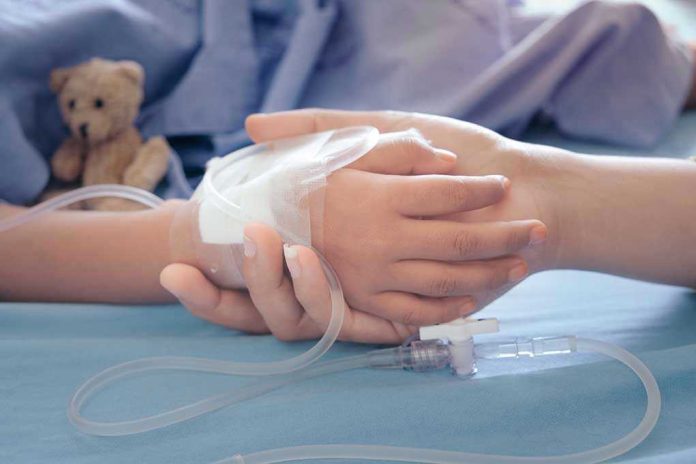
A South African boy spent eight years fully conscious and aware while everyone around him—doctors, nurses, and his own parents—believed he was a mindless vegetable waiting to die.
Story Snapshot
- Martin Pistorius fell mysteriously ill at age 12 and appeared to lose all cognitive function for what doctors said would be permanent
- He regained consciousness at 16 but remained completely paralyzed and unable to communicate for another eight years
- During this locked-in state, he heard his exhausted mother say she wished he would die—words that haunted both of them for years
- After finally proving his awareness at age 24, Pistorius learned to communicate via voice synthesizer and now lives independently in England with his wife
When the Body Becomes a Prison
Pistorius was a normal 12-year-old South African boy interested in gadgets and typical childhood pursuits when everything changed. He came home from school one day with what appeared to be flu symptoms. He never returned to that classroom. His condition deteriorated rapidly and mysteriously. He stopped eating. His muscles weakened. His fingers and toes curled into gnarled claws. Eventually, he stopped moving entirely. Doctors ran test after test, searching for answers that wouldn’t come for years. The eventual diagnosis—cryptococcal meningitis—explained the collapse but not what would happen next.
The Misdiagnosis That Lasted Years
Medical professionals delivered a devastating verdict to Pistorius’s parents: their son had become a vegetable with no remaining intelligence. They should prepare themselves for the inevitable and simply wait for him to die. There was no hope, no possibility of recovery, no reason to expect anything but a body kept alive by basic biological functions. The family placed him in a care home during the day and brought him home each evening, settling into a grueling routine that would stretch across years. What nobody knew—what nobody could detect—was that at age 16, Martin Pistorius woke up inside his unresponsive body.
Conscious in a Living Tomb
For eight years, from age 16 to 24, Pistorius experienced a nightmare that defies imagination. He could hear every conversation. He understood everything said around him. He felt every emotion—frustration, boredom, desperation, hope, despair. Yet he couldn’t move a muscle to signal his awareness. He couldn’t blink a response, squeeze a hand, or make the slightest sound. He was forced to watch children’s television, particularly the show Barney, which he grew to despise. To maintain his sanity, he taught himself to tell time by tracking shadows and sunlight across the room, turning his prison into a makeshift observatory of passing hours and days.
Four Words That Cut Deepest
The psychological burden on caregivers of severely disabled patients rarely receives honest discussion, but Joan Pistorius’s moment of breaking demonstrates its crushing weight. Exhausted and desperate after years of caring for what she believed was her son’s empty shell, she said words within his hearing that no parent should ever utter: “I hope you die.” Martin heard them clearly. He understood his mother’s desperation even as the words pierced him. Years later, after his awareness became known, Joan reflected on that moment with horror, saying it was “horrific” to think about. Martin, remarkably, demonstrated profound compassion, explaining that he gradually learned to understand her desperation as she looked at what appeared to be only a cruel parody of the healthy child she had loved.
The Breakthrough That Changed Everything
In July 2001, when Pistorius was approximately 24 years old, he underwent testing at the Center of Augmentative and Alternative Communication. Specialists asked him to identify words, and for the first time in over a decade, someone detected signs of the consciousness that had been trapped inside. This breakthrough marked the beginning of documented communication. Pistorius learned to use a voice synthesizer to speak and a wheelchair for mobility. His life transformed from living death to genuine independence. He eventually moved to England and married a woman named Joanna, building a relationship and life that medical professionals had declared impossible.
What This Case Reveals About Medicine and Mercy
The Pistorius case exposes critical failures in how medicine assesses consciousness in non-responsive patients. Diagnostic tools available during his condition proved inadequate to detect awareness behind paralysis. How many others have been misdiagnosed? How many conscious minds remain trapped because medical technology cannot yet detect their presence? These questions challenge assumptions about vegetative states and end-of-life decisions. The case also illuminates the unbearable burden placed on family caregivers and the moral complexity of their wishes for release—not from malice but from exhaustion and grief. Pistorius’s story validates both experiences: the patient’s suffering in isolation and the caregiver’s suffering in service.
Life After the Locked-In Years
Pistorius published a book about his experience in 2011, and his story has been featured in multiple documentaries, including NPR’s Invisibilia program. He has become an advocate for better diagnosis of consciousness disorders and recognition of locked-in syndrome. His emphasis on love as a sustaining force during his years of isolation provides a perspective that transcends the medical details. The fact that he found someone to marry and build a life with demonstrates that profound disability need not preclude meaningful relationships and purpose. His story remains a testament to human resilience and the critical importance of never assuming absence of consciousness in non-responsive patients. The shadow of those lost years will always remain, but Pistorius transformed his experience into awareness that may prevent others from suffering in similar silence.
Sources:
The story behind a vegetative patient’s shocking recovery